
The prospects for navigation in the Strait of Hormuz are uncertain, and it continues to threaten that aluminum supply prices will rise to new highs for seven to seven weeks
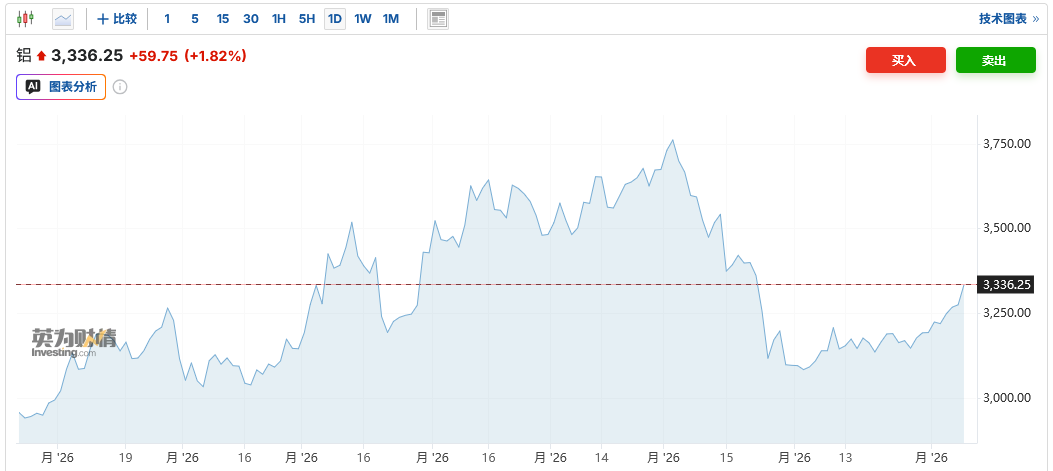
The Zhitong Finance App learned that as the prospects for the rapid reopening of the Strait of Hormuz are becoming increasingly bleak, the market is increasingly worried that supply in the Middle East will continue to be limited in the foreseeable future, and aluminum prices have risen for the 7th consecutive trading day. According to the data, London Metal Exchange (LME) aluminum futures once rose 1% to the highest level since June 23. As of press release, LME aluminum futures were reported at $3336.25 per ton.
On August 10, local time, Iranian Foreign Ministry spokesman Bagae said that the United States' imposition of a maritime blockade and military action against Iran is a major obstacle to the complete restoration of safe navigation in the Strait of Hormuz. Bagae said at a press conference on the same day that the current situation in the straits is not caused by differences between Iran and Oman. Iran and Argentina have reached a preliminary agreement on temporary navigation routes for commercial vessels, and are continuing discussions on parts of the joint statement. Bagae stressed that as long as the United States does not stop its naval blockade and military operations, the Strait of Hormuz will not have the conditions to fully resume safe navigation.
Meanwhile, US President Trump made a series of new broad demands on Iran on Monday, including demanding that Iran pay compensation to those who died as a result of the action against Iraq. These conditions are likely to be rejected by Iran.
The positions of the two sides are getting tougher, which means that reaching an agreement to reopen the Strait of Hormuz may require a longer tug-of-war process, which also weakens the market's hopes that aluminum supply in the Middle East will return to normal.
At the beginning of the Middle East war, aluminum prices rose sharply, then declined as the US and Iran began negotiations. However, since then, aluminum prices have resumed their upward trend. Since the end of June, aluminum prices have risen by more than 8%. As negotiations between the US and Iran to end the war continue to fall into a tug-of-war, and investors cut their bets on US interest rate hikes, the broader market for basic metals, including aluminum, strengthened as a result.
Since this year, aluminum stocks in LME warehouses have continued to decline and are now close to 250,000 tons, the lowest level since November 1990, although new supplies from China and Indonesia are increasing. Norway's Norsk Hydro ASA, a major European aluminum producer, warned last month that if trade and transportation in the Strait of Hormuz cannot return to normal, the annual supply gap in the global aluminum market could expand to more than 900,000 tons.
Before the US-Iran conflict broke out, the Middle East region contributed nearly one-tenth of the world's aluminum production. Some market participants pointed out, “Negotiations in the Middle East are not progressing smoothly. This should provide some support for aluminum prices.”
During the recent outbreak of war in the Middle East, Iran launched a direct attack on two key smelters in Abu Dhabi and Bahrain, causing irreversible production capacity shortages and driving a sharp drop in global aluminum supply expectations. Investment bank Bernstein analyst Bob Brackett previously pointed out that the war in the Middle East has caused damage to related facilities in the region and forced about 3% of the world's aluminum supply out of the market. UBS, on the other hand, expects global aluminum supply to grow by only 0.3% in 2026, lower than the 2.4% forecast previously.
Compared to the forecast before the conflict broke out, the forecast for aluminum production in the Middle East has been drastically lowered, and the scale of losses exceeds 3 million tons. More importantly, the path to resuming production is highly uncertain, depending on multiple factors such as the duration of the conflict, infrastructure repair cycles, logistics normalization, and re-stocking of raw materials.
Citi pointed out in a report released earlier that the possibility of a rapid V-shaped recovery in aluminum supply in the Middle East is extremely low. Citi added that the reason why the loss of aluminum supply in the Middle East is difficult to make up is that the supply flexibility of the global aluminum system has almost dried up. The bank pointed out that after years of supply-side reforms, China's aluminum production capacity has been limited by an effective upper limit, and incremental supply cannot be released quickly. Outside of China, most of the currently profitable global production capacity is operating at full capacity. Indonesia is one of the few regions that can provide meaningful growth, yet the pace and timing of its expansion still faces implementation and climbing risks. Meanwhile, aluminum producers in countries such as Europe and the US have been slow to resume production and increase production capacity due to electricity supply issues.
Meanwhile, Citi's benchmark forecast shows that even with weak demand, the aluminum market supply gap will reach about 2.7 million tons in 2026. Citi also pointed out that before the war in the Middle East broke out, aluminum stocks were at their lowest level in 55 years. Hidden inventory, financing inventory, trader inventory, and pipeline inventory can still quietly absorb the supply gap for a certain period of time, but over time, the continued decline in inventory will fundamentally change the market structure — aluminum inventory is not only a physical buffer, but also an embedded short hedging source related to massive financing and term arbitrage. Falling inventory means that these short positions are gradually being closed, and the market's embedded short base continues to shrink.
J.P. Morgan Chase also pointed out earlier that once the supply gap is formed due to damage to key smelting production capacity, even if geographical conflicts are marginally mitigated and logistics conditions improve, the market will not be able to quickly return to its original balance. Iran's direct attack on two key smelters in Abu Dhabi and Bahrain has escalated what might have been regarded as a “short-term transportation disturbance” into a substantial loss of smelting capacity.
J.P. Morgan added that more importantly, supply elasticity in the aluminum industry is extremely low, making this crisis characterized by significant path dependency. Aluminum smelting is not a typical commodity industry where “prices rise — supply recovers immediately”. Once a smelter is shut down, resuming production often involves extremely high capital, energy, equipment, and process restart costs, and is far more complicated than the market thinks, so capacity recovery is usually measured in “years” rather than “weeks” or “months.”