
Stock market “version answer” released! The combination of “AI computing power bottleneck+high-quality cash flow” crushes all capital to the European market, which has both offense and defense
Since this year, the European stock market can be called the “version answer” to the global stock market investment strategy so far this year. The European stock market has made great strides, breaking the pessimistic predictions that Wall Street has intensively given before — these pessimistic Wall Street strategists have agreed that the Iran war will drag the European market into an increasingly severe stagflation situation.
The European stock market, which is the world's strongest leader in the two major themes of “AI computing power bottleneck+high-quality cash flow,” has attracted global capital to the region since 2026. Although Europe does not have America's “Big Seven Tech Giants” or AI semiconductor leaders such as AMD, Broadcom, and Micron, it has semiconductor equipment and advanced packaging chain assets that are extremely difficult to replace in the global AI capital expenditure chain. For example, global lithography giant ASML.US (ASML.US) is already the largest component stock in the MSCI Europe Index, with a weight of about 4.22%. TSMC, Samsung, and Intel's advanced packaging production capacity is inseparable from BE Semiconductor, a hybrid bonding leader from Europe.
Semiconductor equipment manufacturers such as Asmack and BE Semiconductor are the most typical “upstream capacity bottlenecks” in the AI computing power expansion chain. Asmack is already the listed company with the highest market capitalization in Europe, and Asmack's publicly traded ADR price (ASML.US) in the US stock market has risen by up to 65% since this year, outperforming the S&P 500 and NASDAQ 100 indices. This lithography giant benefits from the world's unprecedented AI chip and memory chip production capacity expansion cycle with the most direct logic: advanced logic, advanced DRAM, and HBM-related process expansion are all inseparable from EUV/DUV lithography equipment. Furthermore, large-scale expansion of production of advanced AI GPUs, HBMs, and high-end logic chips must rely on key semiconductor equipment such as EUV/DUV lithography, etching, deposition, measurement and inspection, and Europe is in a leading position in this field.
However, where the European stock market can really be called the “version of the answer” is that it is not an extremely crowded and high-beta technology index like the Philadelphia Semiconductor Index and the Nasdaq 100 Index, but rather embeds AI computing power growth factors into a balanced chassis of traditional industries with extremely fragmented, low concentration of positions, and very high cash flow quality over a long period of time. Taking the MSCI European Index as an example, the financial weight is about 25.22%, industry is about 19.37%, healthcare is about 12.43%, and information technology is only 8.45%, in addition to consumer necessities about 8.29% and energy about 5.12%; the top ten constituent stocks also include Asmack, HSBC, Roche (Novartis), Nestlé (Nestlé), AstraZeneca (AstraZeneca), Shell Petroleum, Siemens, and SAP.
This is why European stock indices naturally form a very different income structure from NASDAQ: Asmack, Besi, SAP, Siemens, ASM International, etc. provide AI computational power/digitalization/electricity bottleneck growth elasticity; banks and insurance benefit from higher interest rates and nominal growth; classic defense sectors such as pharmaceuticals, essential consumption, and energy provide strong free cash flow, dividends, and hedging protection similar to downside options for a long time — this is why when high-beta assets such as AI computing power infrastructure themes are heavily deleveraged, Europe There is no need to endure the same amount of valuation compression as Korea's KOSPI Index, the Philadelphia Semiconductor Index, and NASDAQ, which are highly concentrated on large technology stocks.
The Zhitong Finance App learned that the benchmark stock index of the European stock market, the Stoxx Europe 600 Index (Stoxx Europe 600 Index), has risen sharply by 12% since this year and has not shown a sharp correction like the South Korean and US stock markets. In particular, it has outperformed the global market since July — the Stoxx Index has outperformed the South Korean stock market by more than 10 percentage points; among them, the benchmark stock indexes of Germany, Italy, and France have all recently risen to record highs. Furthermore, German government sovereign bonds outperformed US treasury bonds, while the euro hovered near a two-month high.
Investors are actively flocking to European equities and even European sovereign bond markets, attracted by the best earnings season in four years, an increasingly strong cash flow growth curve, and the momentum of economic resilience that is increasing but not enough to worry ECB interest rate makers. In particular, some of the world's top bond investment funds say that compared to the US, Europe is more attractive because the Federal Reserve's policy path still lacks clarity.
The European Resilience Deal unexpectedly won! The third tier of equity and debt remittance is strengthening, and AI computing power bottlenecks and cash flow resilience are reshaping the global capital landscape
Sophie Huynh, portfolio manager at Asset Management in Paris, France, said: “The European economy is at its best in a sweet spot: inflation data and inflation expectations are not out of control, so there is no need for the ECB to raise interest rates; at the same time, it has Asmack's global AI computing power production capacity bottleneck, and the economic growth is strong enough to boost the stock market.” “We have added some European stock call option positions because we anticipate that there is still potential room for further growth in the market.”
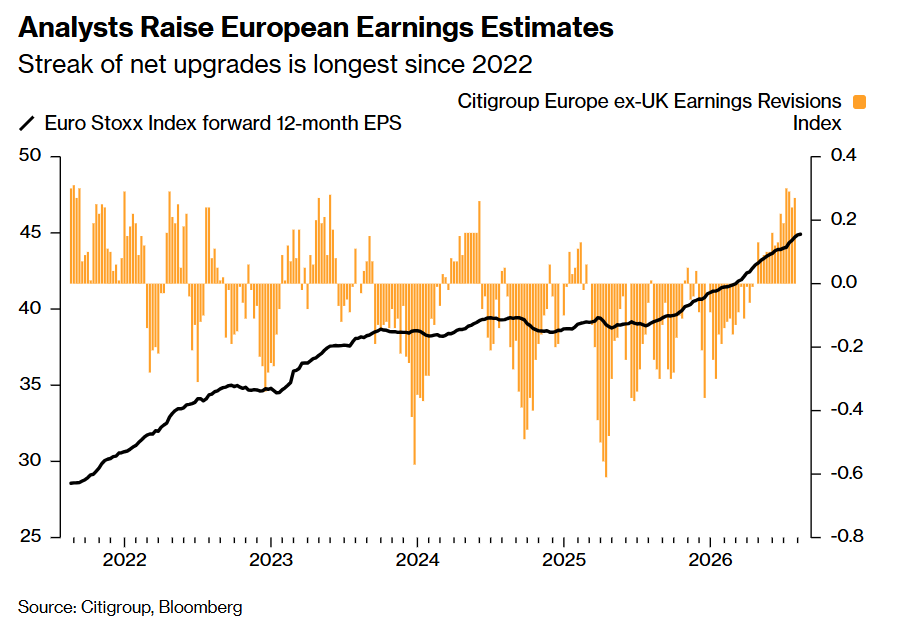
As shown in the chart above, analysts continued to raise European corporate profit expectations — the net increase continued for the longest period since 2022.
According to data compiled by Bloomberg Intelligence, second-quarter profits of MSCI European Index constituent stocks surged 17% year-on-year, the biggest increase since the end of 2022. Industries that are more sensitive to economic growth, such as IT, mining, and large industrial products, are among the biggest contributors to profit growth.
Helen Jewell, international chief investment officer for fundamental stocks from asset management giant BlackRock, said, “People are really attracted to this strong diversified profitability resilience.” Europe's broader exposure to artificial intelligence is also playing a role, enabling investors “to participate in AI computing power infrastructure topics in a less risky way, without being as highly concentrated as in some markets in Asia and the US.”
After initially mainly rewarding large US technology and semiconductor stocks that invested hundreds of billions of dollars to build AI computing power infrastructure, market participants are now turning to companies that will benefit on a large scale from adopting AI technology. A basket of large European AI technology adopter stocks built by Bank of America, including SAP and Siemens, has risen 14% since this year, while US hyperscale cloud service providers have only risen 4% during the same period.
Benedicte Lowe, a European equity derivatives strategist at Markets 360 from BNP Paribas, said, “The European macro narrative is improving, and this is undeniable.”
Bond investors are also actively turning to Europe, as the region's growth prospects are improving, but it still lags behind other major global economies. According to data compiled by Bloomberg Intelligence, the real GDP of the Eurozone is expected to grow by 0.8% and 1.2% in 2026 and 2027, which is lower than the US forecast of 2.2% and 2.1%, but there is no need to worry too much about ECB austerity expectations as investors are increasingly worried that the Federal Reserve's monetary policy path under Walsh's helm is becoming more vague.
The ECB has raised interest rates once this year, by 25 basis points. The interest rate futures market is expected to raise interest rates one or two more times before the middle of next year to contain the impact of the war on inflation. However, relatively moderate economic growth prospects and clear monetary policy curves are still underpinning strong market demand for Eurozone bonds, particularly at a time when fiscal and policy risks in markets such as the US and Japan are becoming increasingly difficult to price.
“European government bonds remain attractive to international investors,” said Erik Liem, an interest rate strategist at Commerzbank. “The ECB has responded to the US-Iran geopolitical shock. Its policy path is more likely to be predicted by the market than the Federal Reserve, and the Federal Reserve's communication methods are shifting in a new direction.”
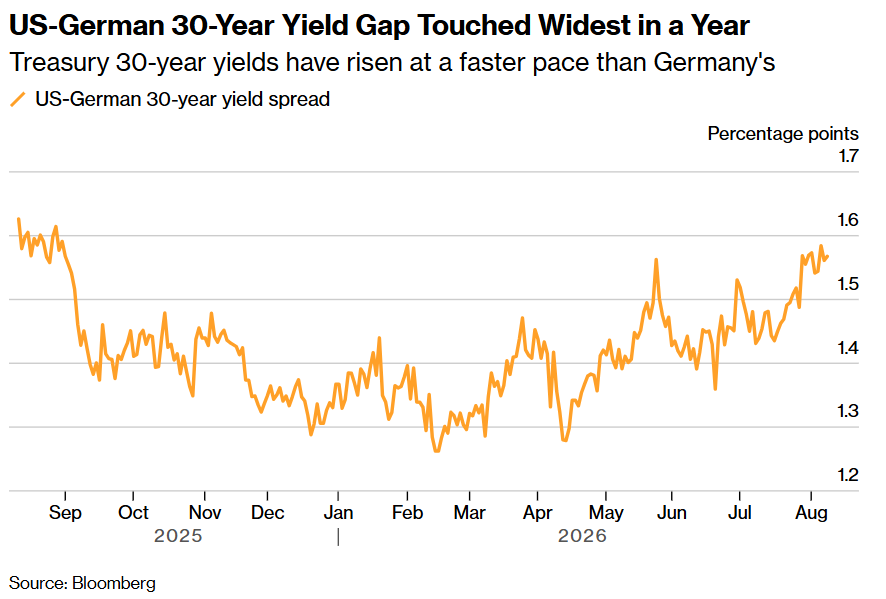
As shown in the chart above, the yield difference between US and German 30-year treasury bonds was once the widest in a year — highlighting that the yield on US 30-year treasury bonds is rising faster than German treasury bonds.
Last week, the difference in yield between US 30-year treasury bonds and German 30-year treasury bonds widened to the largest level in a year, as investors began to question the credibility of the Federal Reserve and America's long-term fiscal trajectory. Europe is not completely devoid of fiscal pressure, and next year's elections in France and Italy also pose potential risks, but these risks are still considered less urgent.
The shift in market sentiment is also reflected in the upward flow of cross-border capital. According to Japan's latest balance of payments data, Japanese institutional investors bought French sovereign bonds last month and sold US treasury bonds and Australian bonds at the same time.
The improvement in demand for European assets is also reflected in the euro exchange rate. The euro hit a seven-week high last Friday and is currently trading above $1.15. Although this part reflects the overall weakening of the US dollar, the Mitsubishi UFJ Financial Group expects the euro to rise to 1.20 US dollars by the middle of next year as the reserve management agencies of major central banks further diversify their sovereign currency allocations.
Derek Halpenny, head of research at Mitsubishi UFJ Bank, said: “If we look at the next 12 to 24 months, the euro is the number one currency we think should increase our allocation.”
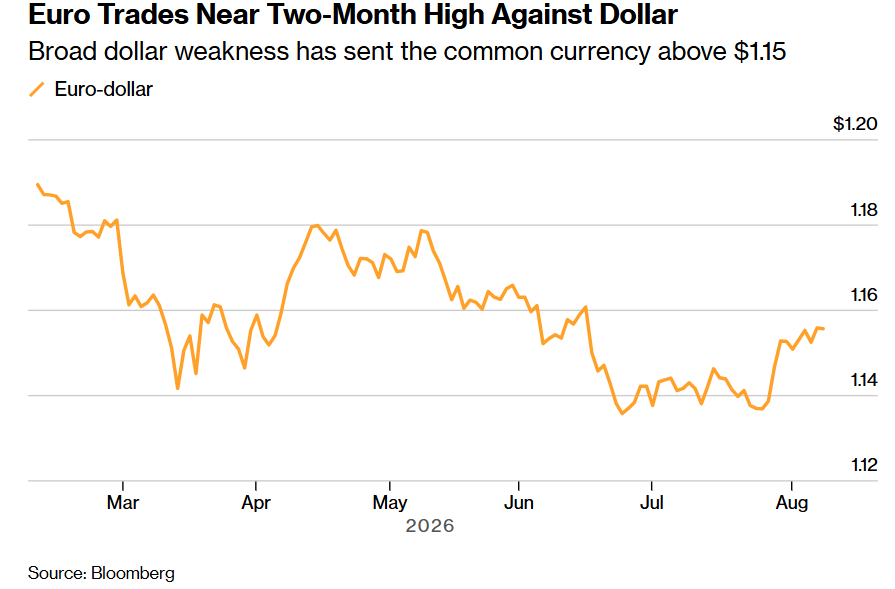
As shown in the chart above, EUR/USD has been hovering at a high level for nearly two months — the general weakening of the US dollar propelled the euro above $1.15.
However, some market participants still doubt how long this round of renewed optimism in the European equity and bond exchange market will last.
Oil prices have risen nearly 23% from their July low, yet an agreement to fully reopen the Strait of Hormuz is still slow to be reached. Low liquefied natural gas stocks in Europe, combined with rising global food prices, may further increase inflationary pressure later this year.
“The ECB has been active in containing inflation and has raised interest rates in response to the Middle East conflict, while also sending signals that it is willing to act further — this supports the euro.” Cross-asset strategist Ven Ram from Bloomberg Strategists said.
James Athey, a senior fund manager at Marlborough Investment Management, believes that the bond market is likely to have fully taken into account further ECB interest rate hikes, but fiscal deterioration and political uncertainty will still dampen market sentiment. In terms of exposure to the economic cycle, he also preferred Japanese stocks over European stocks.
Duncan Toms, a multi-asset strategist from HSBC, believes that whether the appeal of European financial assets can continue depends on how quickly investors re-rotate back to stocks that previously dominated AI-themed trading, including the AI semiconductor sector, which had a more significant weight in US stocks and Asian stock markets. Toms said, “Since we believe that the deleveraging process for global stock markets, especially East Asian stock market momentum trading, is basically over, from a relative performance perspective, if the semiconductor sector regains upward momentum, then it will be very difficult for Europe to continue to outperform other markets by a large margin.”
European stock market with both offense and defense: semiconductor equipment leaders are responsible for offense, and cash flow giants are responsible for defense
Although Europe does not have America's “Big Seven” hyperscale technology giants or AI semiconductor leaders such as AMD and Broadcom, it has semiconductor equipment and advanced packaging that are extremely difficult to replace in the global AI capital expenditure chain. The large-scale expansion of production by South Korea's two largest memory chip giants, as well as the record performance and semiconductor equipment capital expenditure of TSMC and Micron Technology, have greatly strengthened the mid-term growth logic of the European semiconductor equipment chain, especially “AI computing power sellers” such as Asmack and Besi.
For semiconductor equipment manufacturers, expanding memory chip production is not simply about building a few more production lines, but rather spending huge sums of money to build more clean rooms, and the demand for HBM, advanced DRAM, enterprise-grade SSD, 3D NAND, and advanced packaging is driving unprecedented strong demand for lithography, etching, deposition, measurement, materials engineering, and advanced packaging equipment.
According to analysts who are optimistic about the stock price and basic outlook of the semiconductor sector, any developments relating to the expansion of production capacity of chip manufacturers such as SK Hynix, TSMC, and Samsung are positive catalysts for Asmack covering EUV/DUV lithographers, as well as semiconductor equipment giants focusing on advanced process processes such as etching, thin film deposition, and CMP, as well as semiconductor equipment giants focusing on 2.5D/3D advanced packaging.
Asmack Q2 has revenue of 9.3 billion euros and net profit of 2.9 billion euros, and clearly indicates that AI computing power infrastructure investment is simultaneously driving demand for advanced logic chips and memory chips; BE Semiconductor (Besi)'s second-quarter revenue increased 68.7% year-on-year and orders increased 128.8%. The company pointed to hybrid bonding (hybrid bonding), photonics (Photonics), data centers and AI computing requirements as the main driving force. In other words, Europe has a number of sellers at the “physical bottleneck” of AI computing power. They do not bear all the risks of commercializing large models themselves, but they directly share the dividends of expanding production of advanced global GPUs, HBM, and Chiplet packages.
More importantly, the European stock market is not simply “AI+ defense,” but rather “AI computing power bottleneck+high quality free cash flow+low position concentration”, embedding AI growth factors into a traditional industrial chassis with extremely scattered and high cash flow quality. The advantage of the US and Asian stock markets is still profit growth driven by many AI computing power infrastructure manufacturers and large technology giants. The advantage of the European market is that it can use lower exposure of a single AI technology factor and the most diverse safe-haven weights to simultaneously obtain investment returns at both ends of AI technology adoption and AI computing power bottlenecks, and steady returns under drastic pullbacks.
However, this also means that once global capital once again vigorously pursues high-beta sectors such as AI semiconductors, and American AI leaders and tech giants once again gain an absolute profit advantage, Europe's decentralized combination may change from “absolute strength” to “low volatility but relative failure.” The most valuable place in Europe right now is that it has both scarce AI computing power assets on the offensive side and huge cash flow compound assets on the defensive side.