
Qunzhi Consulting: Global tablet panel shipments in the first half of the year were about 150 million pieces, which was basically the same as the previous year
The Zhitong Finance App learned that according to statistics from Sigmaintell (Sigmaintell), in the first half of 2026, global tablet panel shipments were about 150 million pieces, which is basically the same as the previous year. Among them, 26Q2 shipped about 75 million tablets, a slight decrease of 1.1% over the previous year, and the industry surface continued to stabilize. However, behind the stabilization of total volume, the market demand structure is undergoing profound changes — the brand tablet market continues to be under pressure, while the South China tablet market bucked the trend and became the main force supporting the scale of the industry.
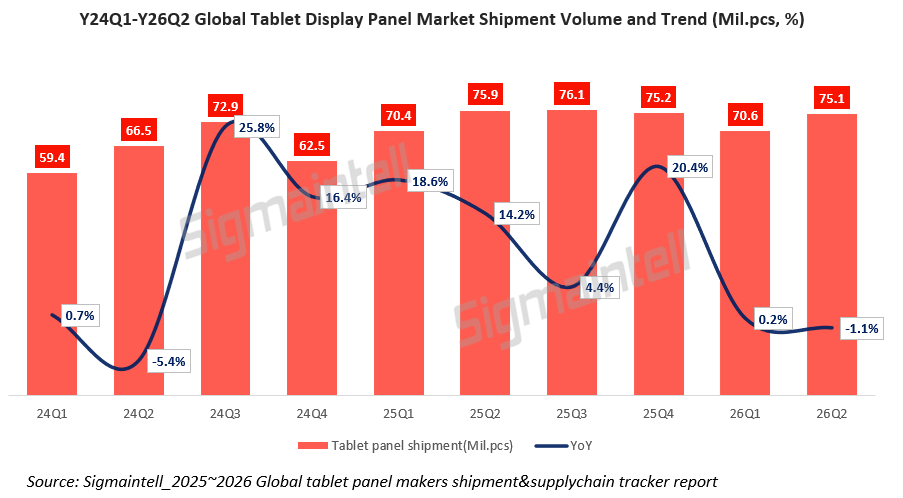
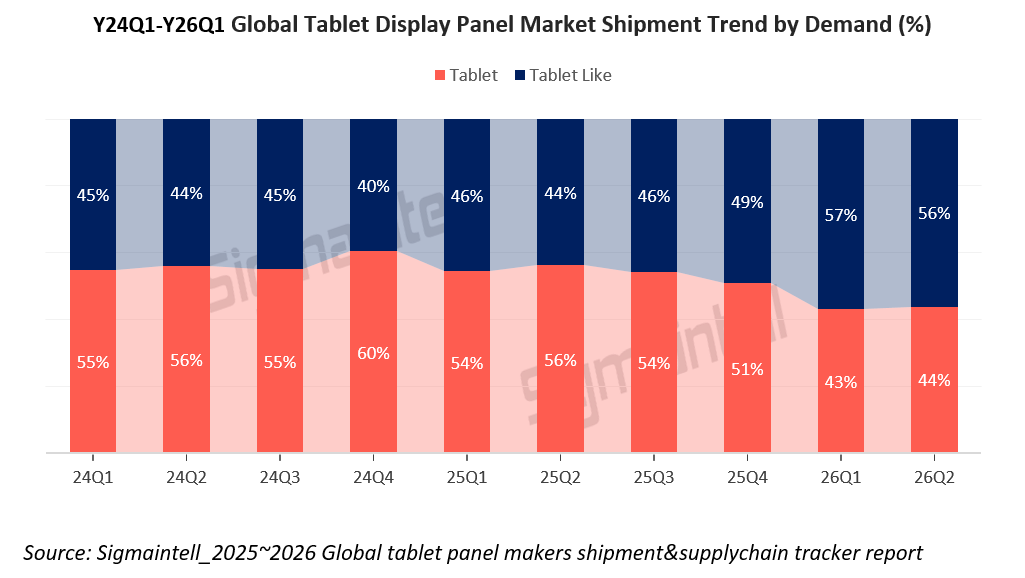
Looking at the structural side, in the first half of 2026, brand panel shipments were about 63.5 million pieces, down about 20.8% year on year, down about 13.2 million pieces from the same period last year; while shipments of similar tablet panels were about 82.1 million pieces, an increase of about 30.4% year on year, an increase of about 19.1 million pieces over the previous year. Both types of markets offset the decline in overall demand and keep the industry stable at the aggregate level.
The core driving force behind this structural change is the different sensitivity of different markets to changes in cost pressure and terminal demand. Affected by rising storage costs, rising machine prices, and weak consumer demand, brand-side procurement strategies tend to be cautious, and demand for traditional tablet panels has entered an adjustment cycle; at the same time, South China tablets have continued to expand with stronger cost control capabilities, channel drive, and growth in demand segments such as maintenance markets and innovative applications, becoming an important source of market growth.
Panel technology structure differentiation: low-cost A-Si LCD benefits from South China demand, OLED is under pressure in the short term
Judging from the technical structure, global demand for tablet panels was clearly divided in the first half of 2026. Overall, low-cost LCD technology is benefiting from the expansion of the South China market, while the middle and high-end technology routes are affected by rising terminal prices and demand adjustments, putting pressure on them in the short term.
a-SI: Demand in South China drives growth, and the brand market shrinks at an accelerated pace
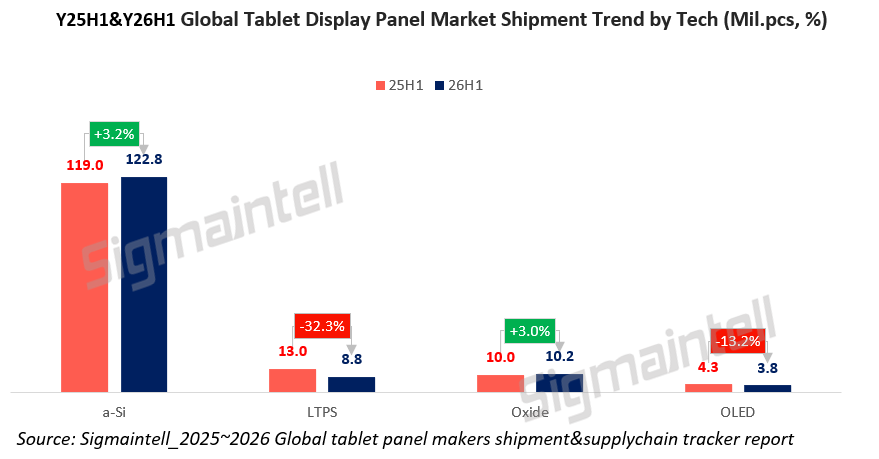
In the first half of 2026, a-Si LCD shipped about 120 million pieces, an increase of 3.2% over the previous year. However, the increase mainly comes from the South China tablet market; demand for a-Si in the branded tablet market fell by about 23.0% year on year. The decline in brand-side a-Si mainly comes from two aspects: on the one hand, rising storage costs are driving up machine prices and demand in the ultra-low-end market shrinks; on the other hand, brand products continue to upgrade technology, and some main products such as Lenovo (00992), Xiaomi (01810), and Honor continue to migrate from a-Si to Oxide, further squeezing A-SI demand. As a result, a-Si growth is more reflected in demand shifts brought about by changes in market structure.
LTPS: National supplement overdraft compounded flagship price increases, and demand entered an adjustment cycle
In the first half of 2026, LTPS LCD shipped about 8.8 million pieces, a year-on-year decrease of 32.3%, making it the technology category with the biggest decline. The decline in LTPS demand was mainly affected by two factors: on the one hand, domestic brands benefited from the national supplement policy in 2025, and demand for high-end tablets was released early, leading to an overdraft of some demand in 2026; on the other hand, the price of LTPS flagship tablet products rose significantly in 2026. In particular, the price of high-end Android tablets gradually increased from about 3,000 yuan to a range of about 4,500 yuan, and the willingness to buy terminals was suppressed to a certain extent. In the medium to long term, the space for LTPS LCD in the tablet market will gradually narrow and be squeezed in both directions by the two technology routes of Oxide LCD and OLED.
Oxide: Technology upgrades continue to be promoted, becoming an alternative direction for a-Si and LTPS
In the first half of 2026, Oxide LCD shipped about 10.2 million tablets, up 3.0% year on year, maintaining moderate growth. Oxide's growth mainly comes from brand product technology upgrades, that is, some high-end products that originally used the A-Si solution gradually switched to oxide to obtain lower power consumption, higher refresh rates, and better display performance. As the brand continues to improve its mid-range product configuration, oxide will still be an important direction for LCD internal structure upgrading
OLED: Short-term demand is suppressed by the cost cycle, but the medium- to long-term growth trend is clear
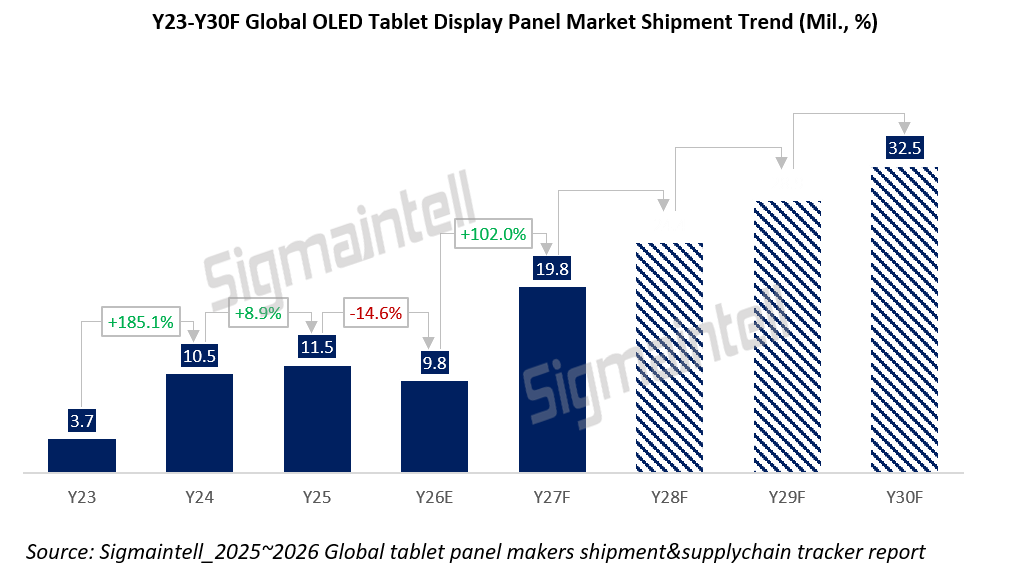
According to Sigmaintell (Sigmaintell) data, in the first half of 2026, approximately 3.8 million OLED panel panels were shipped, a year-on-year decrease of 13.2%. Although the number of OLED penetration models continues to increase, actual panel demand has declined due to rising terminal prices and weak high-end demand.
In the short term, the decline in OLED demand is mainly due to a decline in consumer acceptance due to the increase in the price of high-end tablets. In particular, after the cost pressure of flagship products was transmitted to terminals, it suppressed some switching demand. At the same time, although brands such as Apple, Samsung, and Huawei continue to advance the OLED product layout, some new products are affected by price factors, and the pace of demand release has slowed down. As a result, the 2026 OLED market is characterized by “penetration continues to advance, but sales are under phased pressure.”
In the medium to long term, OLED tablets are still in the early stages of growth and are expected to re-enter the growth cycle in 2027. With the release of the Apple iPad Air OLED, the gradual release of the G8.6 OLED production line, and the continued penetration of OLED into 13-inch large-size productivity tablets and 8-9-inch flagship small tablets, OLED costs are expected to be further optimized, driving more brands to accelerate adoption. It is expected that after 2027, as the pressure on storage costs eases and demand from the high-end market recovers, the OLED layout of the Android brand will expand further, and the OLED tablet market will enter a stage of continuous growth.
Summary and outlook: The flat panel market was supported by structural migration in the first half of the year, and downward pressure on demand was further released in the second half of the year
In the first half of 2026, the global flat panel market remained stable as a whole, and shipments were basically flat year on year, but the growth momentum of the industry has changed markedly. Demand for branded tablet panels continues to shrink, and the South China tablet market has become the main supporting force due to factors such as low price demand, channel drive, maintenance market, and innovative application expansion.
Looking ahead to the second half of 2026, Sigmaintell (Sigmaintell) believes that as the pressure on storage costs is further transmitted to terminals, the brand side faces greater price pressure and demand challenges, and the demand for brand tablet panels is expected to continue to be pressured; at the same time, after rapid growth in the South China tablet market, it will also be affected by cost pressure, and growth momentum will weaken. As a result, global tablet demand is expected to enter a deep adjustment cycle in the second half of the year, and panel shipments will face downward pressure.