
GGII: Shipments of lithium iron phosphate cathode materials are expected to exceed 1.2 million tons in 2030
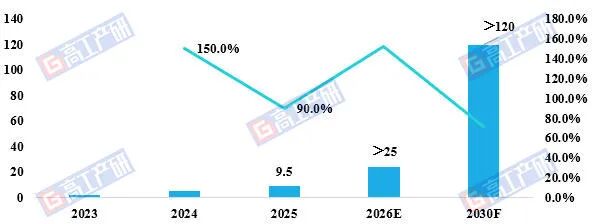
The Zhitong Finance App learned that shipments of lithium iron phosphate cathode materials using the iron red method have entered the fast track. According to GGII data, in 2025, China shipped 95,000 tons of lithium iron phosphate cathode materials, accounting for 2.4% of the market. Shipments are expected to exceed 1.2 million tons in 2030, an increase of more than 10 times, and the market share will increase to more than 10%.
Iron oxide red is a reddish brown inorganic powder. The core downstream applications include two major directions: pigment dyes and battery materials. In the field of batteries, iron oxide red is mainly used as a precursor for materials such as lithium iron phosphate cathode materials, layered oxide cathode materials, and lithium rich lithium ferrate supplements. In the future, iron oxide red is also expected to be used in fields such as sodium iron phosphate cathode materials and lithium iron manganese phosphate cathode materials in the battery field.
The core drivers are as follows:
1) The iron red lithium iron phosphate cathode material has made up for the shortcomings in performance. Five generations of iron red lithium iron phosphate cathode materials have been shipped in batches, and it is also the most advanced lithium iron phosphate cathode product currently shipped in batches on the market;
2) The iron red process has always had outstanding cost advantages;
3) There is a shortage of sulfuric acid supply in the industry, driving up the price of ferrous sulfate and the short supply of iron phosphate products, further amplifying the cost advantage of iron red lithium iron phosphate.
Shipment volume and forecast of lithium iron phosphate cathode materials in China (10,000 tons,%, conservative estimate)
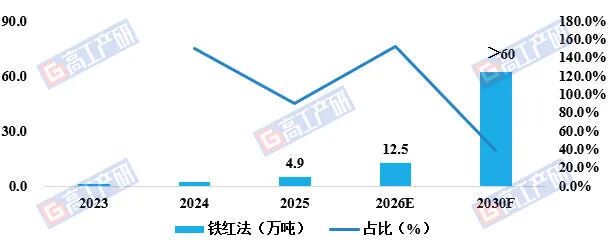
According to GGII data, domestic battery-grade iron oxide red market demand has entered a high growth channel. In 2025, China shipped about 49,000 tons of battery-grade iron oxide red, an increase of 90% over the previous year. Among them, it is mainly used in the field of LFP cathode materials (the shipment scale of iron oxide red precursors used in layered oxide cathode materials and lithium-rich lithium ferrate lithium supplement materials is still relatively small). GGII expects red iron oxide shipments to exceed 600,000 tons by 2030, an increase of more than tenfold in five years.
The increase in battery-grade iron oxide red shipments is mainly driven by the increase in shipments of lithium iron phosphate cathode materials using the iron red method. 2026 is the first year of expansion of production capacity for lithium iron phosphate cathode materials. In May 2026, the 200,000 ton project at GCL Lithium Battery Leshan Base entered the commissioning stage, and plans to expand production capacity to nearly 1 million tons within the next 2 years.
2023-2030 China's battery-grade iron oxide red shipment volume and growth rate (10,000 tons,%)
Currently, there are significant differences in technology and production capacity of domestic battery-grade iron oxide red companies, which are mainly reflected in three aspects:
1) There are different levels of product iteration. Some companies can produce high-quality battery-grade iron oxide red suitable for four, four and a half, or even five generations of lithium iron phosphate cathode materials, while some companies' products are only suitable for three and a half generation processes;
2) The production cost gap is large. The maximum cost difference per ton of battery-grade iron oxide red among companies is close to 1,000 yuan;
3) The adaptability of raw materials is different. Some companies can only use a small amount of high-quality iron sheet raw materials to produce battery-grade iron oxide red. Leading companies can adapt to a wider range of raw materials, and there is more room for raw material selection.
According to GGII analysis, the iron oxide red industry will present three major development trends in the future:
1) High-end iron oxide red products suitable for five and a half or six generations of lithium iron phosphate cathode materials, which are expected to be mass-produced within 1-2 years;
2) The quality and stability of battery-grade iron oxide red products will continue to be upgraded;
3) The industry's production base is gradually moving to the western region to support downstream customers nearby, while relying on regional advantages to reduce production factor costs.