
IPO Interpretation | Beijing Junzheng (300223.SZ): Niche storage boom is improving, A+H empowers the expansion of multi-category chip platforms
The increasing penetration rate of smart cars and the spread of end-side AI devices are reshaping the global semiconductor supply and demand pattern. Currently, the industry is characterized by structural differentiation: large overseas manufacturers focus their production capacity on high-end cloud-based computing power and storage products, and the resources obtained by mature process circuits that vehicles and industrial control rely on continue to shrink.
The implementation of new production capacity for mature wafers is lagging behind. Demand for superimposed automotive and industrial control terminals remains stable, and the supply of niche chips with low power consumption for vehicles tends to be tight. The racetrack supply and demand pattern has changed, bringing domestic alternatives to domestic manufacturers with self-development and mass production capabilities in the process of implementing intelligent automotive and edge AI.
The continuous iteration of high-reliability chips, the construction of global customer systems, and supply chain risk hedging all require enterprises to have long-term and continuous capital investment capabilities. Standing in the context of this industry, Beijing Junzheng Integrated Circuit Co., Ltd. (abbreviation: Beijing Junzheng (300223.SZ)) successfully passed the Hong Kong Stock Exchange main board hearing on August 9. The company plans to use the capital raised from the listing to invest mainly in the three core product line technology upgrades; industrial chain strategic investment and mergers and acquisitions; global sales network construction; working capital and other general corporate purposes.
“Storage+Computation+Simulation” chip provider
According to the prospectus, Beijing Junzheng is a “storage+computing+simulation” chip provider. The company's products are widely used in automotive electronics, industrial medical applications, as well as AIoT and intelligent security equipment.
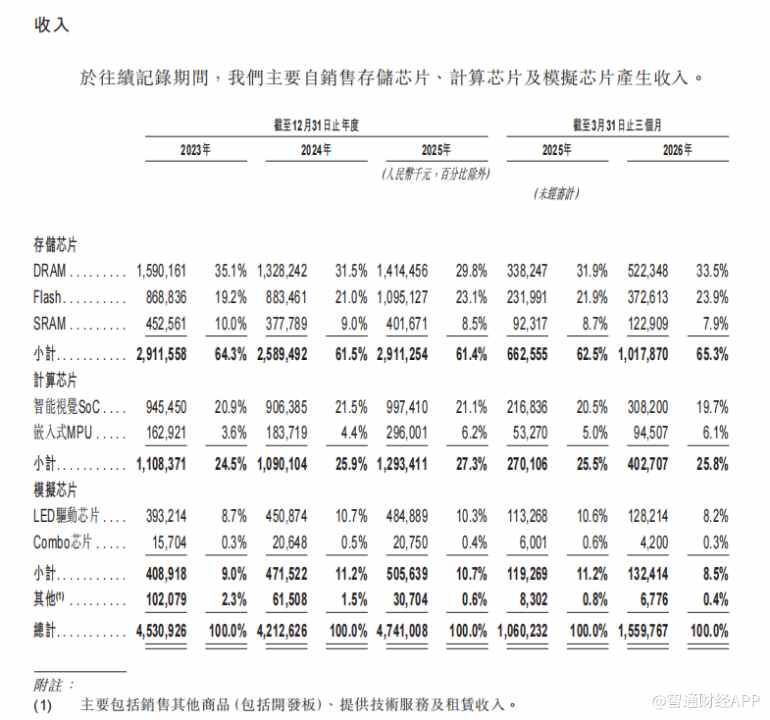
The company has developed memory chips (including DRAM, SRAM, NOR Flash and NAND Flash) mainly used in automotive electronics and industrial medicine, computing chips for AIoT and security, and analog chips (including LED driver chips and combo chips) for automotive electronics, industry and home appliances. The company's products meet automotive and industrial standards, and have the characteristics of high quality, high reliability, low energy consumption and long product life. In the first quarter of 2026, memory chips, computing chips, and analog chips accounted for 65.3%, 25.8%, and 8.5% of the company's revenue, respectively.
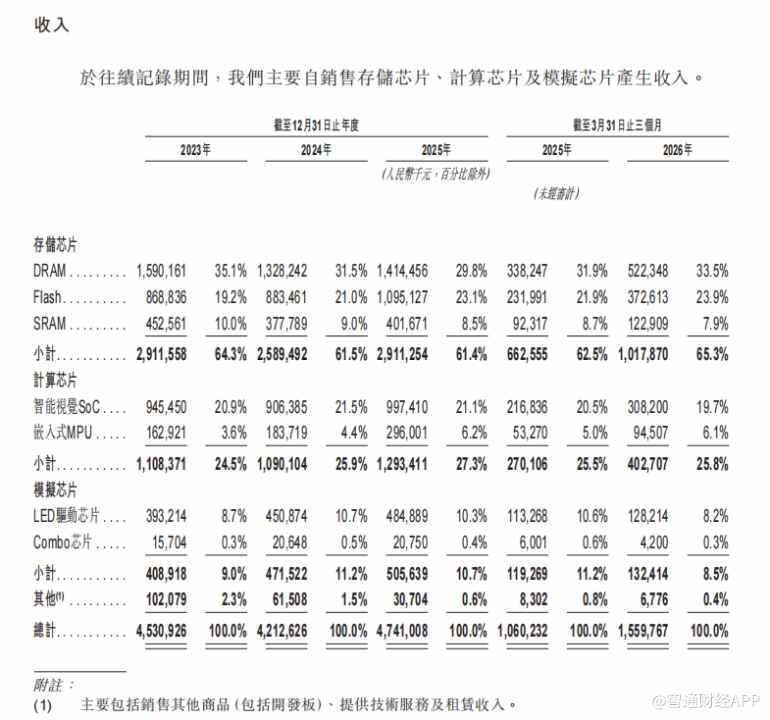
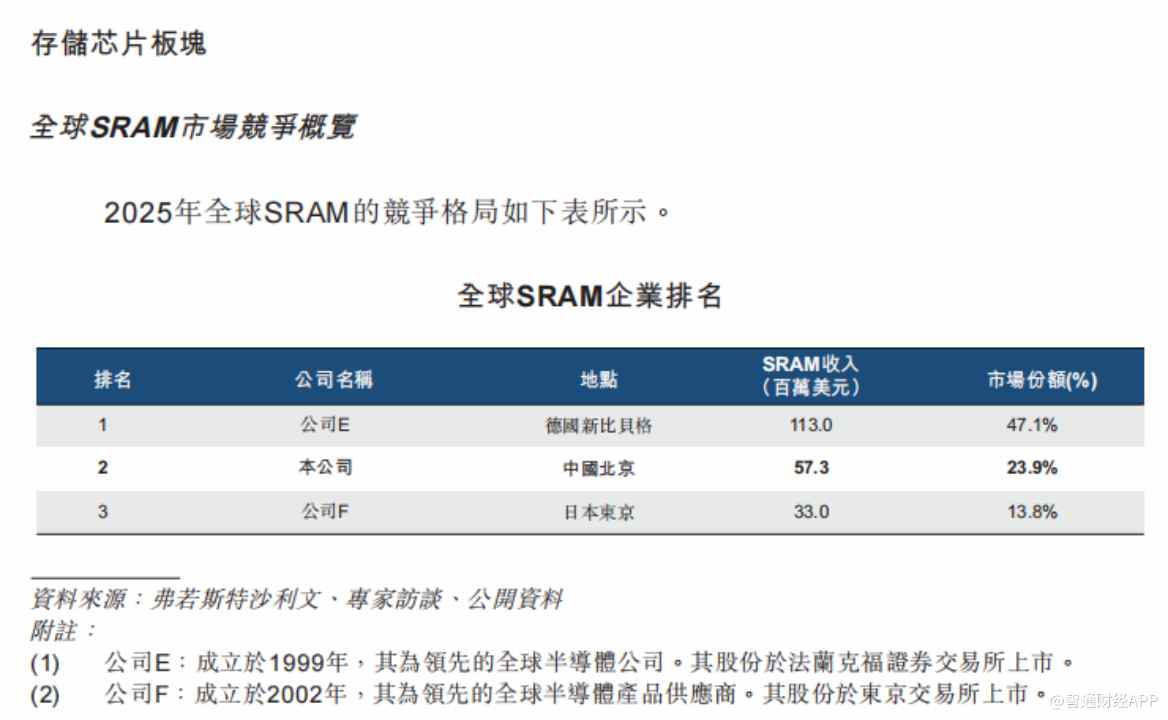
According to Frost & Sullivan data, Beijing Junzheng is at the top of the world in several niche chip segments. In 2025, in terms of revenue, the company ranked 7th in the global niche DRAM market, with a market share of 2.1%; ranked second in the global SRAM market with a market share of 23.9%; ranked 7th in the global NOR Flash market, with a market share of 5%; and the global IPCam SoC ranked second, with a market share of 17.6%.
Beijing Junzheng's ability to achieve top industry rankings on multiple chip tracks stems from the superposition of the company's many core competencies. According to the prospectus, the company's competitive advantage is reflected in the three-in-one product layout, independent core technology, supply chain and quality control, global sales network, and international talent team. Among them, R&D is the core of the company's business strategy. In 2023-2025, the company's R&D expenses were 708 million yuan (RMB, same below), 681 million yuan, and 712 million yuan, respectively, with R&D expenses exceeding 15%; in the first quarter of 2026, R&D investment was 172 million yuan, with an expenditure rate of 11%.
Taking memory chips as an example, continuous investment in R&D mainly revolves around the high performance and high reliability requirements of automotive electronics and industrial medicine. Automotive and industrial scenarios have clear restrictions on chips. They need to pass automotive-level production and control processes to achieve wide temperature and humidity operating capabilities, long-term supply, and full life cycle support, while putting forward stricter thresholds for data storage durability and defect rates. In order to adapt to such complex working conditions, the company has implemented a number of self-developed technologies within the storage product: DRAM products are equipped with on-chip error detection and error correction technology, which can identify two errors and correct one error, and meet ISO 26262 functional safety standards. Compared with mainstream external architecture solutions in the industry, NOR Flash relies on characteristic process optimization to achieve high bandwidth and low power consumption performance. Its 128Mb NOR Flash has superior read/write and erase performance compared to mainstream industry, with built-in error detection and error correction mechanisms, and data storage capabilities superior to mainstream industry. Industry standards.
The above high reliability R&D ideas are also applied to other product lines. The company's computing chips rely on self-developed RISC V architecture and lightweight NPU units to iteratively adapt AI MCU and vision processors for edge large model reasoning, covering terminals such as home cameras and industrial robots; the analog chips focus on in-vehicle lighting and industrial power supply scenarios, promote multi-channel integrated Combo chip iteration, and match the vehicle's electronic upgrade needs.
Memory chips are booming, and performance is growing at an accelerated pace
In terms of performance, in 2023, 2024, 2025, and the first quarter of 2026, Beijing Junzheng achieved operating income of 4.531 billion yuan, 4.213 billion yuan, 4.741 billion yuan, and 1.56 billion yuan respectively; comprehensive gross margin for the same period was 35.5%, 35%, 32.8%, and 42.6%; net profit to mother was 516 million yuan, 364 million yuan, 375 million yuan and 320 million yuan respectively.
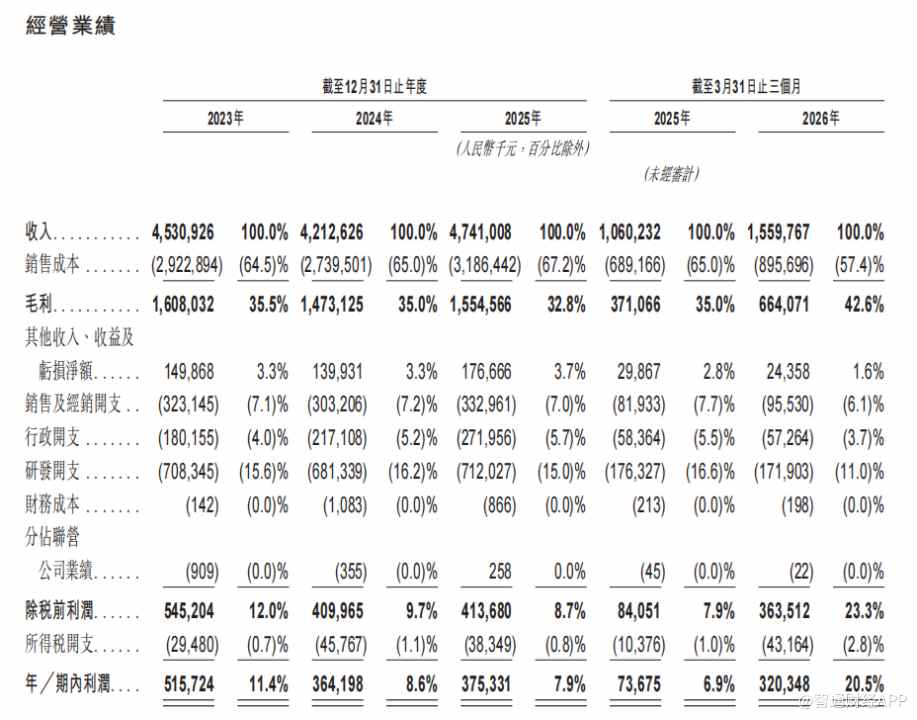
The Zhitong Finance App learned that in 2024, downstream channels continued to lose inventory, and terminal demand was weak, putting phased pressure on revenue and profits; in 2025, industry inventories were gradually cleared, and the market was repaired; in 2026, the boom improved further, and the sharp rise in product volume and price led to a significant recovery in profits. Specifically, in the first quarter of 2026, the company's revenue from memory chips, computing chips, and analog chips reached 1,018 million yuan, 403 million yuan, and 132 million yuan respectively, with year-on-year increases of 53.6%, 49.1%, and 11.1%, respectively. Among them, memory chips contributed the most.
Looking at the global memory chip market, the Frost & Sullivan report points out that multi-scenario demand resonance is driving the expansion of the storage industry: AI models spawn PB-grade high-capacity, low-latency storage, driving HBM and 3DDRAM; automotive electrification and intelligent upgrades, lidar, and autonomous driving domain control bring new demand for high-capacity and high-reliability storage; industrial machine vision and edge computing broaden the industrial storage market; folding AI phones and smart wearables continue to drive demand for high-capacity, low-power storage.
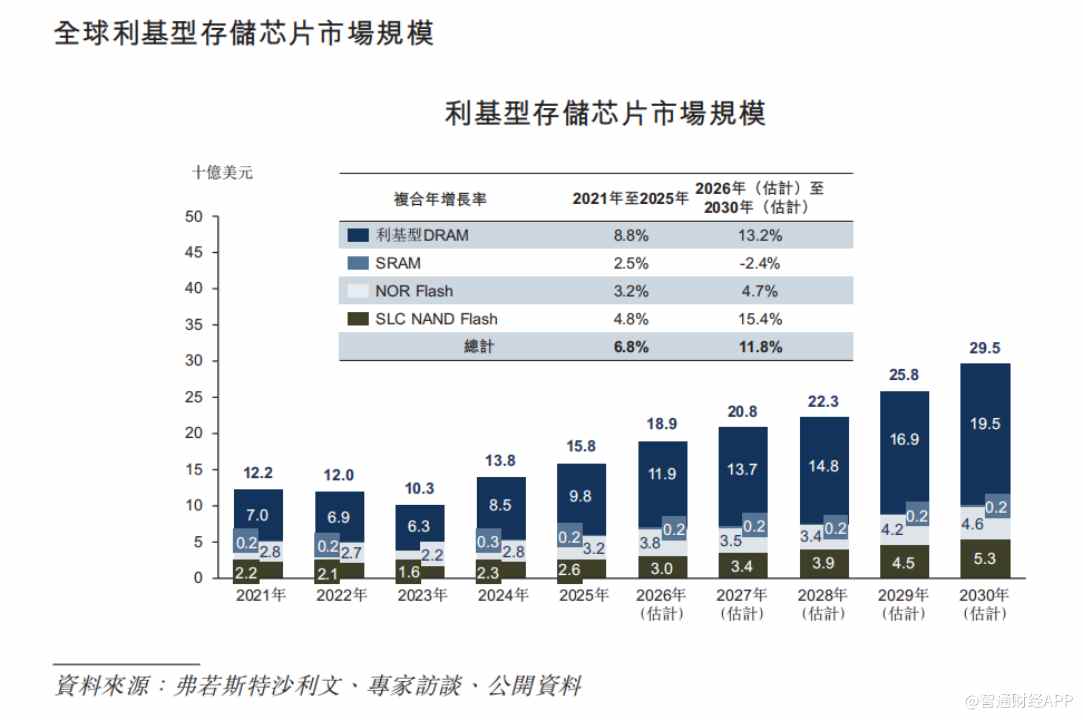
At the same time, in the context of global supply chain restructuring, countries are accelerating the autonomy and control of the storage industry chain. Domestic manufacturers are iteratively speeding up 3DRAM and 3DNAND technology, and vehicle and industrial control storage are gradually replacing domestic production in batches; major overseas storage companies are adjusting production capacity and deepening technical cooperation. There are signs that the industry is gradually weakening the simple price war and evolving in the direction of value competition. The global niche storage market will grow at a compound rate of 6.8% in 2021-2025. Institutions expect the compound annual growth rate to increase to 11.8% from 2026 to 2030, and the market size will reach US$29.5 billion in 2030.
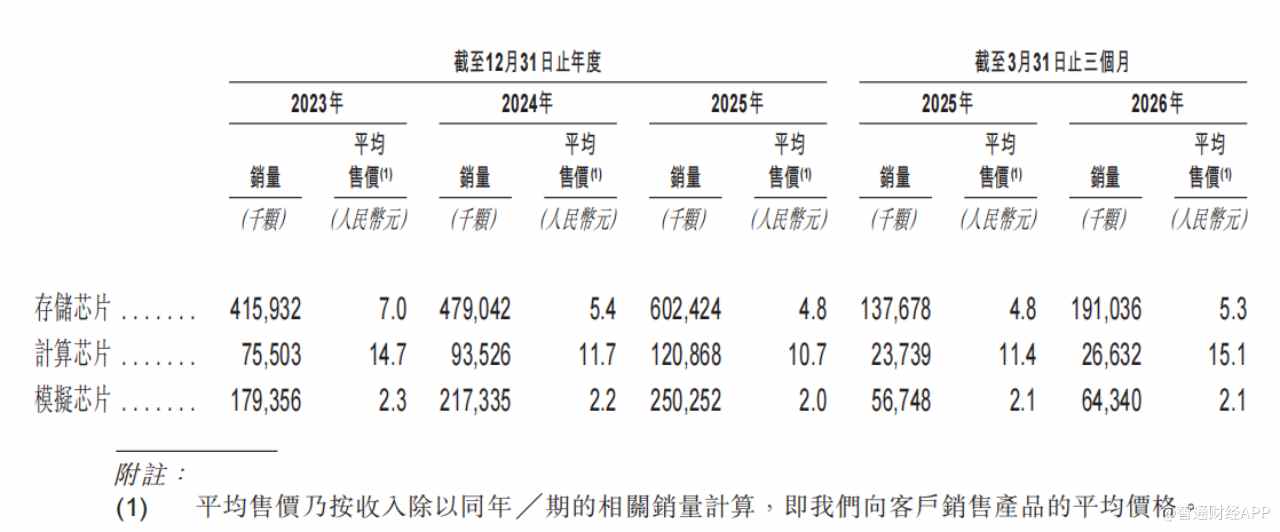
Benefiting from the recovery in the industry cycle, the average sales price of the company's products rose at the same time. In the first quarter of 2026, the average sales price of the company's memory chips was 5.3 yuan, up 10.4% year on year; the average price of computing chips was 15.1 yuan, up 32.5% year on year. The sharp rise in volume and price increased current gross margin by 7.6 percentage points to 42.6% year on year.
Looking at the medium to long term, the extent to which Beijing Junzheng's two core growth leads have finally been realized has yet to be verified. First, intelligent automobiles are driving up bicycle storage usage. Currently, the vehicle regulation storage market is still dominated by overseas manufacturers. Due to supply chain safety considerations, car companies' willingness to introduce two or more supplies is increasing. The company has a complete vehicle regulation storage mass production and global customer certification base, and has obtained domestic replacement tickets, but the vehicle regulation certification introduction cycle is long, and the pace of implementation is uncertain. Second, under the wave of end-side AI, self-developed RISCV architectures and AI-MCU products are in the early stages of release. It remains to be seen whether the computing business can break out of the original basic security market and open up new market space.
Overall, relying on the complete product matrix of “storage+computation+simulation” and continuous investment in R&D, Beijing Junzheng stands in the phased industrial dividend window brought about by major factories' production capacity strategy adjustments. The Hong Kong stock listing supplements capital, and is expected to help iterate technology and expand overseas markets, and strengthen its current position in the niche chip field. However, it is also necessary to objectively understand that this round of industry dividends is more due to phased changes in the allocation of production capacity by overseas manufacturers, and it is difficult to directly transform it into a permanent competitive barrier. There is a possibility that the current tight balance between supply and demand will be broken once overseas original manufacturers re-invest in mature processes, or if domestic production capacity releases exceed expectations. Coupled with realistic constraints such as slow introduction of superimposed vehicle regulations and uncertain commercialization progress of new businesses, the company's future growth will be realized, and it is still necessary to continue to observe the evolution of the industry pattern and the progress of its own business implementation.