
US stock outlook | Futures of the three major stock indexes soar, Nvidia (NVDA.US) teamed up with Wall Street to leverage 500 billion US dollars to once again approach 160 yen
Pre-market market trends
1. On August 11 (Tuesday), the futures of the three major US stock indexes rose sharply before the US stock market. As of press release, Dow futures were up 0.06%, S&P 500 futures were up 0.17%, and NASDAQ futures were up 0.33%.

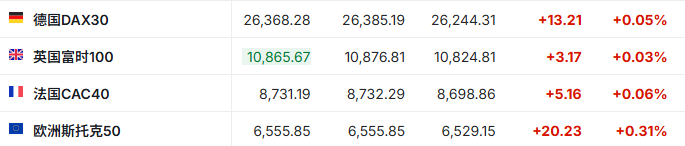
2. As of press release, the German DAX index rose 0.05%, the UK FTSE 100 index rose 0.03%, the French CAC40 index rose 0.06%, and the European Stoxx 50 index rose 0.31%.
3. As of press release, WTI crude oil rose 0.12% to $82.23 per barrel. Brent crude oil fell 0.05% to $87.68 per barrel. According to reports, the Pakistani side said that signals about the US and Iran indicate that the two sides are “close to reaching some kind of arrangement” and that the situation is moving in the direction of peace. Meanwhile, according to Iran's Meher News Agency, Pakistan's interior minister arrived in Tehran to hold talks.

Market news
The Bank of Japan may raise interest rates in September to deal with the risk of inflation. According to people familiar with the matter, after raising interest rates in June, the Bank of Japan may consider raising interest rates again at the next policy meeting from September 17 to 18 to deal with the rising risk of inflation. Prices in Japan are likely to rise further due to the rapid growth in demand related to artificial intelligence, the sharp depreciation of the yen, and the rise in crude oil prices. Previously, many financial market participants once expected the Bank of Japan to raise interest rates approximately every six months. However, according to a summary of meeting opinions released on Monday, at the Bank of Japan's latest policy formulation meeting held from July 30 to 31, some policy committee members have indicated that the pace of interest rate hikes should be accelerated. One member said that “the rate of increase in policy interest rates may exceed market expectations,” while another said that the Bank of Japan needs to “speed up the pace of adjustment to the degree of monetary easing.”
Erase half of the intervention increase! The yen is once again approaching 160, and Bezent shouted “do whatever it takes” to hide that ammunition is limited. US Treasury Secretary Scott Bessent proposed an uncapped approach to help Japan save the yen. This statement may cause questions from market participants, who believe that the firepower he can actually use is limited. The yen fell by as much as 1% on Monday, erasing half of the increase brought about by the first joint intervention between the US and Japan since 1998. After the intervention of July 31, the yen was once close to 155 yen per dollar, but now it has fallen below the 159 mark. As of press time, the USD/JPY exchange rate is hovering around 159. After that extraordinary act, Bezent said, “We will support them at any cost to help the American economy, American taxpayers, and stabilize the global economy.” The problem is that as far as exchange-rate intervention ammunition is concerned, Bezent seems to be limited by its main special instrument — an exchange stabilization fund of less than 220 billion US dollars. By comparison, it is estimated that Japan spent 53 billion US dollars on Japanese yen operations on July 30 alone (the day before the US-Japan coordinated action). “The US can influence the direction of public opinion by coordinating intervention with Japan, but it cannot change the fundamental facts,” said Nathan Tuft, senior portfolio manager at Manulife Investment Management. As for the capabilities of the US authorities, he said, “They have strong financial resources, but they are not limitless.”
Trump's intensive remarks covered control of Hormuz, his strategy for Iraq, and communication with the Federal Reserve. The situation in the Middle East is intertwined with internal affairs and diplomacy. On Tuesday, the US President made intensive statements on a number of issues, reaffirming America's actual control over the Strait of Hormuz issue, saying that Iran has cleared mines laid out by Iran in this strategic waterway, and clearly stated that Iran has three strategic options: monitoring the deterioration of its situation, carrying out severe attacks, and continuing economic pressure, stressing that the US side controls large amounts of Iran's capital and assets. In response to speculation from the outside world about the prospects for peace talks between the US and Iran, Trump has also submitted compensation claims to Iran, covering human casualties during previous clashes and families of protesters suppressed in the past 50 years, and has instructed US representatives to formally push forward related claims in all future negotiations. This is in direct opposition to Iran's previous compensation claims. At the internal affairs level, Trump clarified that the two sides had only had a brief conversation since Federal Reserve Chairman Walsh took office, denying claims of frequent communication. This statement coincides with the market being highly sensitive to the independence of the Federal Reserve and policy trends, in an attempt to downplay the impression that the White House directly interferes with central bank decisions. In terms of security and immigration matters, Trump revealed that after the end of the NATO summit in early July, he secretly left Turkey on an Air Force C-32A and did not use the old special plane “Air Force 1”. At the same time, the government has announced the cancellation of more than 175,000 visas for foreign citizens on the grounds of criminal activities, violations, and violent remarks against US citizens. Furthermore, Trump extended the shipping exemption period of the “Jones Act” for 90 days but reduced the scope of application to energy products and fertilizers, and publicly supported current Chairman Infantino on FIFA personnel arrangements, saying that he successfully hosted the most successful World Cup event in history, and that changing candidates would be a huge mistake.
The era of “chip inflation” has begun, and memory prices have skyrocketed due to AI grabbing goods, and computers and phones are even more expensive. The explosive growth in demand for artificial intelligence is driving the price of memory chips to skyrocket. This phenomenon, known by the agency as “chip inflation,” has formed a structural trend, and there are no signs of abating in the short term. According to the data, the price index for producers of electronic components and accessories rose nearly 30% year on year in June, the biggest annual increase since records began in 1966, easily surpassing the peak level in the early days of the PC era in 1980 and during the supply crisis during the pandemic. In order to lock in computing power resources, large technology companies have signed supply agreements with suppliers for several years to seize memory production capacity in advance. As a result, traditional PC and mobile phone manufacturers can only compete for supplies in an increasingly shrinking remaining supply pool, and cost pressure is transmitted downstream. There are reports that a leading mobile phone manufacturer is considering introducing a new memory chip supplier to cope with the cost surge, but this requires regulatory approval, reflecting the actual constraints in the current supply chain pattern. The rule that memory prices have dropped by about 90% every five years over the past 60 years is no longer applicable in the AI economy. The increase in memory prices in the past year has been more than fivefold, marking a complete reversal of the decades-long trend of price reduction, putting full pressure on the procurement costs of cloud services, terminal equipment, and even enterprise hardware. Market expectations are changing, from initially worrying that companies will cut technology spending due to rising costs to current companies continuing to increase investment to avoid future procurement gaps. Analysts describe this mentality as “fear of missing out on procurement.” The US CPI data to be released on Wednesday has attracted much attention. Agencies estimate that the impact of this round of chip price increases on the overall CPI may be limited, but segments such as personal computers may face a year-on-year price increase of about 10%, and the impact felt by end consumers will be more direct.
It is rumored that OpenAI bought back 7 billion US dollars of employee holdings to prepare for a potential IPO, and the valuation remained at 852 billion US dollars. According to a source familiar with the matter, OpenAI has completed a deal to help employees sell about $7 billion worth of company shares and prepare ahead of time for the company's possible initial public offering (IPO). Two people familiar with the matter said that in this takeover deal, OpenAI is buying back shares from current and former employees rather than seeking outside investors to participate as in the past — in the past, OpenAI invited investors, including Thrive Capital and SoftBank Group, to buy company shares held by employees. According to people familiar with the matter, the deal valued the startup at $852 billion, which is in line with its valuation during the most recent round of financing.
Anthropic met with investors on the eve of its IPO to confront multiple challenges and mitigate the impact of competition. According to reports, AI giant Anthropic (with a market capitalization of 965 billion US dollars) is meeting with potential investors to boost market confidence for what may be the largest IPO in history. The company plans to go public in September or early October, but the exact pricing and schedule are yet to be announced. Currently, Anthropic is facing a series of new challenges, including the spread of low-cost AI systems, tense relationships with the Trump administration, and waves of opposition to data center construction across the US. In the pre-IPO conference in recent weeks, investors have raised questions about the impact of these factors on the company's growth, reflecting the huge uncertainty about the victory or loss of the AI competition and financial stability. Company executives downplayed the competitive threat of low-cost AI systems during the conference and emphasized that they would focus heavily on providing cutting-edge AI models. Meanwhile, Anthropic revealed to some investors that it plans to further expand into healthcare and biological AI applications.
Q2 Global gas engine orders soared 71% to a record high! Daxingqi's combustion engine has entered the “supercycle”, and production of the leading engine is scheduled until 2030. J.P. Morgan said that global gas turbine orders reached a record high in the April-June quarter, driven by a sharp increase in electricity demand. J.P. Morgan analyst Phil Buller and others said in a report released on Monday that global gas turbine orders reached about 38 gigawatts (GW) in the second quarter of this year, up 29% from the first quarter and 71% from the same period last year. Analysts pointed out that the US is still the largest market, accounting for nearly half of the order share. According to J.P. Morgan Chase, Siemens Energy AG (Siemens Energy AG) received the largest number of orders in the second quarter, around 12.5 gigawatts; followed by General Electric Co. (General Electric Co.) The order size was 11.3 gigawatts; Mitsubishi Power Ltd. (Mitsubishi Power Ltd.) ranked third, with an order size of 5.3 gigawatts. The bank's analysts added that increased demand is driving up costs. A combined cycle gas turbine scheduled to be delivered in 2031 will cost three times as much as the unit delivered last year.
Individual stock news
Nvidia (NVDA.US) teamed up with the Big Six Wall Street giants to raise more than 500 billion US dollars to create a new asset class for AI chips. Nvidia announced that it has signed a memorandum of understanding with Apollo Global Management (APO.US), Blackstone Group (BX.US), Blackstone (BLK.US), Brookfield Asset Management (BAM.US), Goldman Sachs (GS.US), and KKR (KKR.US) to mobilize more than 500 billion US dollars in third party capital to provide financial support for hyperscale enterprises, AI laboratories and various customers to build data centers and purchase Nvidia hardware. The plan aims to transform AI chips and computing power infrastructure into collaterable asset classes such as commercial real estate, toll roads, etc., and use institutional credit, insurance funds, and private capital to finance customers and prevent them from taking up their own balance sheets. Nvidia CEO Hwang In-hoon said, “This is indeed the first time that tech chips have become an investable asset class” because these assets are profitable, long-lived, fungible, and flexible. Wall Street giants believe that computing power has evolved into a key asset class driving global economic growth. Blackstone President Grey said AI computing power would be viewed as a “financeable asset,” and demand far exceeded supply; BlackRock CEO Fink compared the project to the birth of home mortgage-backed securities in the 1970s, calling it “the next future of financial engineering.” The plan comes after the global market shock in July — when investors questioned whether tech giants' AI investments would pay off, and ratings agencies such as Moody's warned that unprecedented capital spending was squeezing free cash flow and increasing debt burdens. Nvidia's move challenges the traditional perception that GPUs have historically been viewed as rapidly depreciating hardware, in an attempt to transform them into infrastructure that can be recognized by banks for a long time. However, skeptics may question whether AI chips can continue to preserve their value as a new generation of chips is introduced. BlackRock CEO Fink stressed that some of the funds have been raised and need to be put into operation as soon as possible to ensure that the US maintains a leading global position in the AI field.
SK Hynix (SKHY.US) plans to increase NAND production capacity in China by 50%. According to reports, Solidigm, a NAND subsidiary of SK Hynix, has restarted construction of the second phase of the NAND flash memory production base in Dalian, China in the first half of this year. After production is put into operation, SK Hynix's local production capacity will expand by about 50%. The plant began construction four years ago, then shut down for a long time due to the slump in the memory market. SK Hynix plans to start introducing semiconductor production equipment as early as November, and officially put into operation in the first half of next year. According to reports, the wafer delivery capacity of the new production line is around 50,000 pieces per month. As demand for enterprise-grade solid-state drives surged due to the popularity of artificial intelligence data centers, NAND prices rose nearly tenfold within a year.
Expanding from 15 billion to 20 billion dollars! It is rumored that Intel (INTC.US) plans to raise the scale of additional issuance, and the wave of equity financing is surging in the AI era. People familiar with the matter revealed that Intel is planning to expand the scale of its stock sale. The target amount of capital raised will be raised from 15 billion US dollars announced on Monday to about 20 billion US dollars, an increase of one-third. People familiar with the matter said that the price of this offering is expected to be around $95 per share or higher. The price is about 6.5% off from last Friday's closing price. One of the people familiar with the matter said that if the right to over-allot is exercised, the amount of this offering could exceed US$20 billion. People familiar with the matter also revealed that this stock sale has attracted more than 100 billion US dollars in subscription demand, which shows the strong interest of the market in Intel's current financing plan. People familiar with the matter said that related discussions are still ongoing, and details, including distribution scale and price, may still change. An Intel spokesperson declined to comment.
Shares are soaring! Fermi (FRMI.US) won the first AI data center lease and locked in a 15-year contract for $6.5 billion. On August 10, Fermi, which focuses on AI hyperscale data center development, announced that its Project Matador campus in Carson County, Texas has signed the first binding customer lease with AI cloud provider TensorWave. Boosted by this news, Fermi's stock price surged 16% before the market on Tuesday. According to a statement issued by Fermi, the lease was signed between Fermi's subsidiary Fermi Campus 1 LLC and TensorWave TEX1, LLC, a subsidiary of TensorWave. The first phase covers a facility supported by a total power capacity of 222 megawatts and is expected to generate total contract revenue of approximately $6.5 billion over an initial period of 15 years. The lease comes with the right to expand two additional data centers, and if fully exercised, the cooperation between the two parties will expand to over 650 MW in three phases. The facility is expected to begin phased delivery in the second half of 2027. Once fully delivered, it is expected to support tens of thousands of next-generation AMD Instinct GPUs for large-scale AI training and inference. The lease also includes two five-year renewal options each, with potential extensions of up to 25 years.
Anthropic signed a $9.1 billion computing power deal with mining company Riot (RIOT.US). People familiar with the matter revealed that AI company Anthropic PBC has reached an agreement worth about 9.1 billion US dollars with Bitcoin mining company Riot Platforms, which has recently begun providing AI data center computing power to the outside world. The deal highlights that Anthropic (which owns the AI model Claude) is trying to obtain sufficient computing power to meet the growing needs of its customers. Meanwhile, Riot announced financial results for the second quarter of 2026 after the market on Monday. Revenue exceeded expectations, but losses exceeded market expectations. Riot revealed earlier Monday that it has signed a 20-year power supply agreement to provide 191 megawatts (MW) of electricity capacity at its Rockdale (Rockdale), Texas campus — enough to simultaneously power around 143,000 homes — to supply a “leading cutting-edge AI company.” According to people familiar with the matter, this company is Anthropic. Driven by this news, Riot shares surged 16% before the market on Tuesday.
It is rumored that AMKR.US (AMKR.US) plans to sell shares in the Chinese business, with a valuation of 1.5 billion US dollars. According to people familiar with the matter, the global outsourced semiconductor packaging and testing (OSAT) giant Amac Technology is considering strategic adjustments to its Chinese business, including options such as selling a portion of its shares. The Tempe, Arizona-based company has hired a consulting agency to help prepare for the spin-off of the business unit and test the initial intentions of potential buyers. According to reports, EMAC Technology may retain a minority interest in this business, while the overall valuation of the Chinese business is between 1 billion and 1.5 billion US dollars.
Morgan Stanley (MS.US) launched the US Innovation Infrastructure Program with the goal of leveraging $1.5 trillion in capital. Morgan Stanley announced the launch of the “American Innovation Infrastructure Plan”, promising to facilitate approximately $1.5 trillion in financing, capital raising and related investment activities over the next ten years, focusing on strategic industries such as artificial intelligence, semiconductors, cybersecurity, and energy infrastructure. On August 10, Morgan Stanley announced that as a new initiative, the bank will assist companies in capital raising, financing, consulting and other related activities over the next ten years. The plan revolves around three core areas: first, innovation platforms and strategic industries, covering artificial intelligence, semiconductors, and cybersecurity; second, infrastructure construction to serve the innovative economy; and third, capital supply for entrepreneurs and high-growth enterprises.
Key economic data and event forecasts
20:15 Beijing time: The US ADP employment week announced changes for the week ending July 25.
22:00 Beijing time: Total annualized sales of existing homes in the US in July.
00:00 Beijing time the next day: The EIA releases the monthly short-term energy outlook report.
04:30 Beijing time the next day: Changes in US API crude oil inventories for the week ending August 7.
Performance Forecast
Wednesday morning: CoreWeave (CRWV.US), ultra-microcomputer (SMCI.US), Lumentum (LITE.US).
Wednesday pre-market: Nebius Group (NBIS.US).