
Lockheed Martin (LMT) Stock May Be Undervalued Despite Its 89% 5 Year Run
Lockheed Martin stock has delivered an 89.2% return over the past 5 years, yet current valuation work suggests the shares may still trade below an estimate of intrinsic value based on a Discounted Cash Flow (DCF) model and earnings multiples that both screen as undervalued.
- That 89.2% 5 year gain means existing shareholders have already seen a strong payoff, so new buyers need to weigh what is already reflected in the price.
- A multiyear PAC 3 missile production contract and ongoing missile defense programs can support long term cash flow expectations, while reliance on U.S. defense appropriations and program execution risk may limit how much value investors are willing to assign today.
- The stock passes most of Simply Wall St's checks, with 5 out of 6 suggesting Lockheed Martin looks inexpensive relative to those fundamentals.
The issue now is whether the current share price around US$597.77 still offers enough upside versus the intrinsic value estimate to justify taking or adding to a position in Lockheed Martin.
Does Lockheed Martin Look Undervalued on Cash Flow?
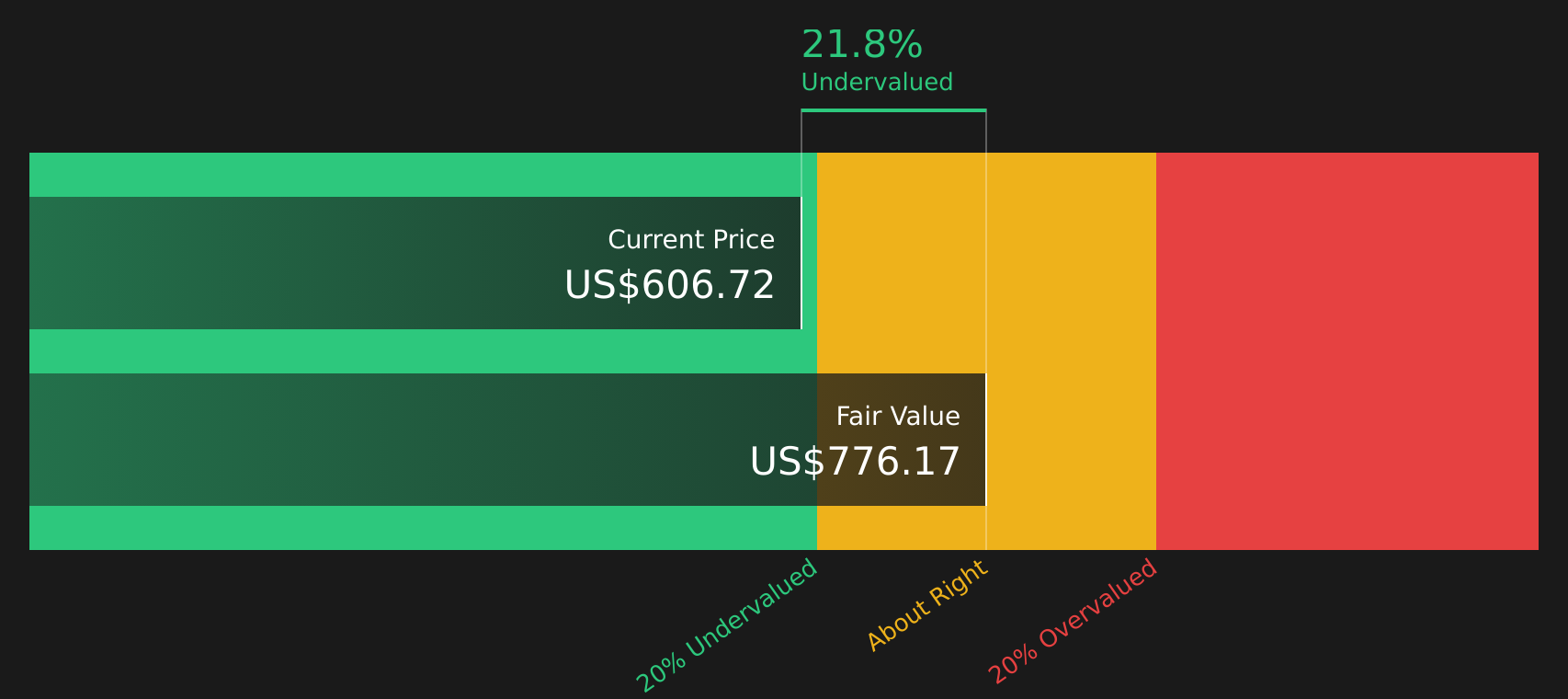
The Discounted Cash Flow (DCF) approach estimates what Lockheed Martin is worth based on the cash it can generate for shareholders over time. For Lockheed Martin, the model uses latest twelve month free cash flow of about $8.6b and assumes cash flows continue to grow rather than shrink, which fits a large, established defense contractor with long running programs.
On these assumptions the DCF points to an estimated intrinsic value of about $779 per share, which sits above the current share price of around $597. Despite the recent US$58.62b multiyear PAC 3 missile production contract adding visibility to missile defense cash flows, the market price still sits below what this cash flow based model suggests.
Overall, the Discounted Cash Flow work indicates Lockheed Martin stock currently screens as undervalued relative to its estimated intrinsic value.
Our Discounted Cash Flow (DCF) analysis suggests Lockheed Martin is undervalued by 23.2%. Track this in your watchlist or portfolio, or discover 51 more high quality undervalued stocks.
Is Lockheed Martin a Bargain on Earnings?
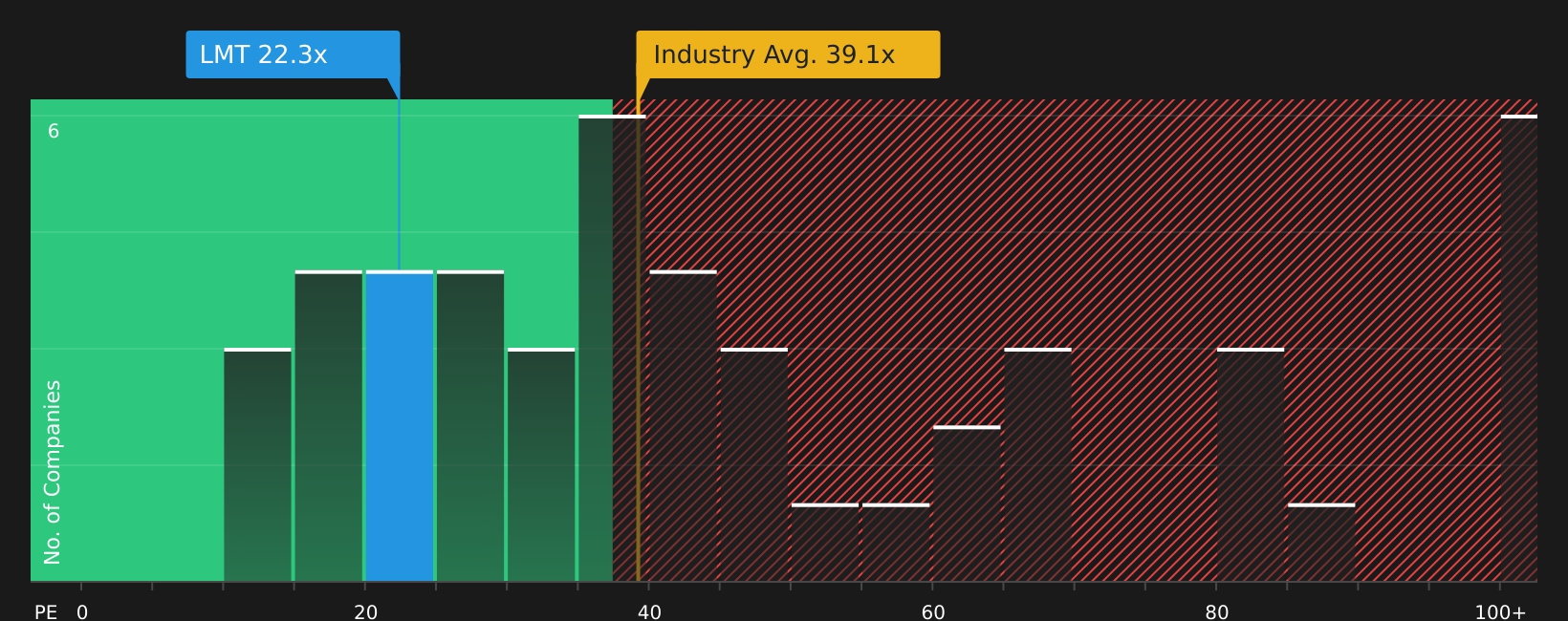
The P/E ratio suits Lockheed Martin because earnings are a key anchor for a mature defense contractor with long running programs. On this metric, Lockheed Martin trades at about 21.9x earnings, which sits well below the Aerospace & Defense industry average of roughly 38.9x and a peer group average near 47.5x. That already suggests the market is assigning a lower earnings multiple than many comparable stocks.
A fair P/E multiple for Lockheed Martin, based on its size, margins, industry profile and risk factors, is estimated at about 31.3x. This is comfortably above the current 21.9x level, so the stock trades at a discount to what this framework implies and also to the wider sector. For investors who mainly look at earnings based valuation, Lockheed Martin screens as relatively inexpensive compared with both its tailored fair multiple and its peer set.
On the P/E multiple, Lockheed Martin stock appears undervalued relative to both its estimated fair ratio and the broader Aerospace & Defense industry.
See what the numbers say about this price — find out in our valuation breakdown.
The Lockheed Martin Narrative: What Would Justify Today's Price?
Simply Wall St Narratives for Lockheed Martin pick up where this valuation puzzle leaves off, outlining which paths for Lockheed Martin's growth, margins and earnings would justify a meaningfully higher or lower share price than today. Each narrative connects a fair value to a clear story about Lockheed Martin's possible catalysts and risks, allowing you to track over time which version of events appears closest to what is actually happening.
Community views on Lockheed Martin sit far apart, with some investors focused on missile backlog and others worried about long term program and budget risk.
Bull case: 5% undervalued
"Demand for advanced platforms such as the F-35, PAC-3, THAAD, and hypersonic weapons is being reinforced by actual combat use and rising geopolitical tensions, with multiple U.S. and international customers increasing orders and strong backlog growth likely..."
Read the full Bull Case to see why Lockheed Martin could be undervalued
Bear case: 17% overvalued
"The company's continued high reliance on a small set of large programs, including the F-35 and classified Aeronautics projects, creates significant vulnerability to evolving defense priorities or budget cuts..."
Read the full Bear Case to see why Lockheed Martin could be overvalued
Do you think there's more to the story for Lockheed Martin? Head over to our Community to see what others are saying!
The Bottom Line
On the current numbers, Lockheed Martin screens as undervalued on both Discounted Cash Flow (DCF) work and earnings multiples, which is a rare alignment for a large defense stock. The gap between the intrinsic value estimate and the share price, along with a discounted P/E versus peers, suggests the market is cautious about execution and future U.S. defense budget outcomes. For you as an investor, the key question is whether that discount reflects genuine long term program and funding risk or whether it proves to be a mispricing as existing contracts and backlogs play out.
This article by Simply Wall St is general in nature. We provide commentary based on historical data and analyst forecasts only using an unbiased methodology and our articles are not intended to be financial advice. It does not constitute a recommendation to buy or sell any stock, and does not take account of your objectives, or your financial situation. We aim to bring you long-term focused analysis driven by fundamental data. Note that our analysis may not factor in the latest price-sensitive company announcements or qualitative material. Simply Wall St has no position in any stocks mentioned.
Have feedback on this article? Concerned about the content? Get in touch with us directly. Alternatively, email editorial-team@simplywallst.com