EVtank: AIDC has broad prospects for storage and sodium-ion battery shipments are expected to exceed 435 GWh in 2030
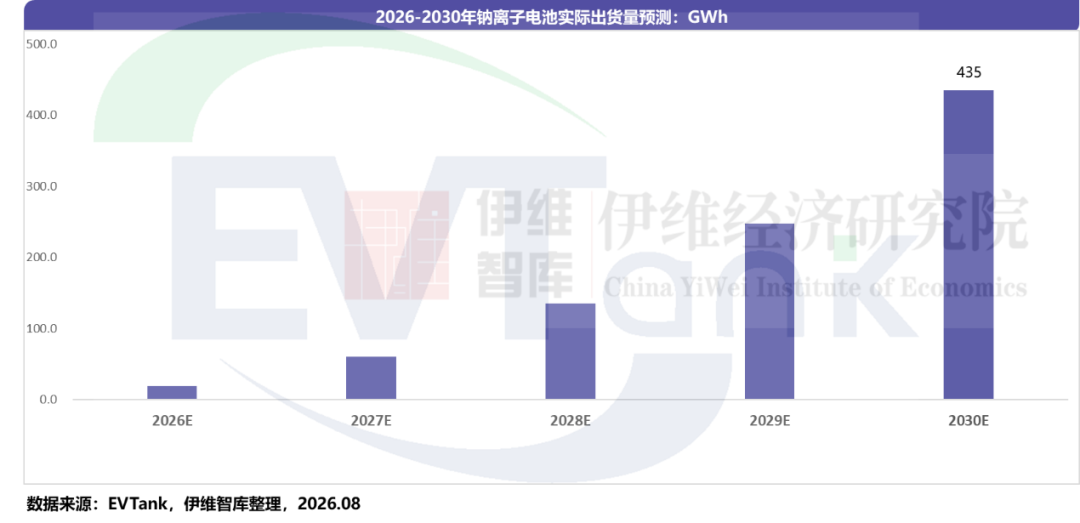
The Zhitong Finance App learned that recently, the research institute EVtank and the Ivy Institute of Economics jointly released the “White Paper on the Development of China's Sodium-Ion Battery Industry (2026)”. EVtank stated in the white paper that in 2025, sodium-ion batteries will be used on a large scale in core scenarios such as energy storage, two-wheelers, power, and start-stop power, and innovative models such as AIDC storage and “lithium-sodium collaboration” will continue to emerge, driving the accelerated growth of sodium-ion battery shipments. EVtank expects actual shipments of sodium-ion batteries to reach 435 GWh in 2030.
In 2025, China's sodium-ion battery shipments reached 8.1 GWh. The top shipping companies were Vico Technology, Haishida, Ningde Times, Fudi Battery, and Paineng Technology.
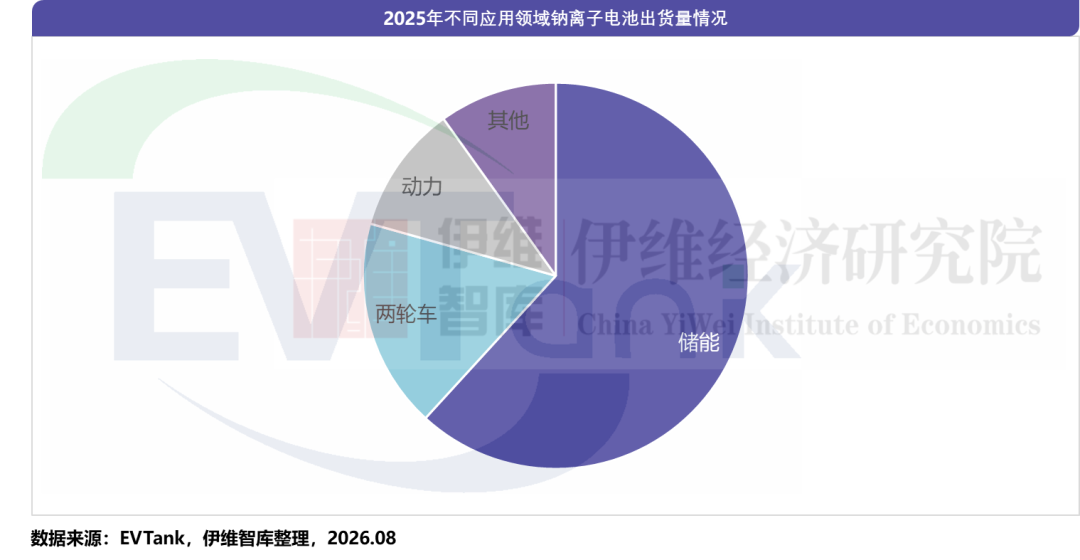
Judging from specific application scenarios, sodium-ion batteries will still be mainly used in the field of energy storage in 2025, accounting for more than 60%; followed by two-wheelers, new energy vehicles, and start-stop power supplies. Looking at the technical route, in 2025, sodium ion battery cathode materials, polyanion routes account for more than 70% of shipments due to their low cost and cycle performance advantages, surpassing layered oxides to become the current mainstream sodium ion battery cathode material technology; hard carbon anode materials are still absolutely mainstream, accounting for more than 90%.
Looking ahead, the new battery consumption tax regulations will be officially implemented on September 1, 2026. Sodium-ion batteries will be exempt from consumption tax until the end of 2028, while lithium batteries will resume taxation. The duty-free dividend over a period of more than two years is expected to reduce comprehensive tax costs for sodium-electric companies, reduce product terminal pricing, and accelerate the cost parity process for sodium-ion batteries and lithium iron phosphate. Judging from downstream applications, the development path of sodium electricity is not a complete replacement for lithium batteries, but rather relies on its own cost and performance advantages to create a differentiated layout with energy storage as the main focus, power supplementation, and special scenarios to accurately match the needs of market segments.
Energy storage is the core area where sodium electricity is first released on a large scale. Energy storage requires low battery size and weight. It values safety, cycle life, low temperature performance and electricity cost. It is highly compatible with the advantages of sodium electricity, and can cover scenarios such as alpine energy storage, computer room power backup, power grid peak shifting, and industrial and commercial energy storage. At the same time, the rapid development of the AI industry is driving the power consumption of AIDC computing power centers to rise rapidly, bringing about massive distribution and storage demand. Sodium batteries have core advantages such as high rate charge/discharge rate, long cycle life, and short-term high power output, and can accurately hedge hidden dangers such as voltage flickering and frequency disturbances caused by fluctuations in AIDC computing power load. Sodium electricity can also be combined with lithium batteries to form a lithium-sodium cooperative energy storage solution. Using “peak sodium electronic control value and lithium battery guarantee time” as the core architecture, the long and short term power complement each other, and are adapted to high and low ratio operating conditions, which perfectly meet the energy storage needs of AIDC's entire scenario. In the future, energy storage will become one of the core application fields of sodium-ion batteries.
The power battery sector focuses on mid-range and low-end models with special operating conditions. The current performance of sodium batteries can meet the needs of electric two-wheelers. Priority will be given to replacing lead-acid batteries and some lithium batteries in the field of electric two-wheelers; due to energy density constraints, the current application of sodium electricity in the field of new energy vehicles falls short of expectations, and is mainly suitable for entry-level mini trams, short-haul trucks, and light trucks. As leading companies such as Ningde Era and BYD increase their layout, it is expected that the penetration rate of sodium-ion batteries in the low-end NEV sector will gradually increase.