Federal Reserve Officials Speak Out to Warn of Inflation Risks! Tonight the July CPI is expected to be the key ruling on the path to interest rate hikes
The Zhitong Finance App learned that Chicago Federal Reserve Chairman Goulsby said that compared to any weakness in the labor market, he is more concerned about excessive inflation. However, it is currently unclear whether this concern translates into his support for the interest rate hike that several of his colleagues wanted last month.
Goulsby said in a video recorded on June 22, released on Tuesday: “The biggest problem facing our economy right now is not the collapse of the industry and the collapse of jobs, but rather that prices are rising too fast. We have an inflation problem, and people hate inflation.” After looking at indicators such as the unemployment rate, recruitment rate, and layoff rate, he said, “They show that the labor market is stable — not a good thing to say; this is my description of it.”
The Federal Reserve kept the policy interest rate unchanged in the range of 3.50% to 3.75% on July 29. Of the 12 voting policy makers in the Federal Reserve, 3 objected and voted for interest rate hikes. Goulsby did not have the right to vote this year, and in the face of inflation that continues to exceed the Fed's 2% target level and has continued for more than five years, he did not say whether he supports the decision to keep interest rates unchanged.
After the Federal Reserve announced its latest interest rate decision at the end of last month, many policymakers warned of the risk of continued high inflation and released their openness to tightening monetary policy. Cleveland Federal Reserve Chairman Hamak said on Monday that in order to push inflation back back to the Fed's target level of 2%, interest rates may be raised more than once in the future. She believes that the current interest rate level has not formed a “meaningful limit” on the US economy, and inflation is unlikely to fall back to the target level on its own.
Hamak said in an interview on Monday that a single interest rate hike of 25 basis points may not be enough to have much impact on the overall economy. Therefore, if the Federal Reserve needs to further reduce inflation through monetary policy, it may eventually need to take a “certain number of” interest rate hikes. However, at the same time, she stressed that currently she does not want to prejudge how many interest rate hikes will be needed, nor is she willing to set the end point for this round of policy adjustments in advance.
Hamak was one of the three dissidents who supported interest rate hikes at the Federal Reserve's July policy meeting. In a statement after the meeting, Hamak warned that the longer inflation remains high, the more difficult it will be to push it back to target levels in the future.
St. Louis Federal Reserve Chairman Mussalem said last week that with the inflation rate above the Federal Reserve's 2% target, policymakers cannot afford to endure higher inflation while waiting for the possibility of strong productivity growth. Mussalem said, “In this context, the key is for monetary policy to effectively curb real inflation, rather than enduring today's slightly higher inflation in pursuit of tomorrow's productivity growth.” He added, “The central bank's most important contribution to long-term economic growth is to provide a background for price stability, and enterprises can plan investment and innovation to promote economic growth in this context.”
Federal Reserve Governor Cook also reiterated last week that if inflation does not continue to slow down in the future, she is prepared to support further interest rate hikes, and warned that as inflation continues to rise above the 2% target, the Fed may not have much time to wait; otherwise, it will be more difficult to control inflation in the future. Minneapolis Federal Reserve Chairman Kashkari said that the Federal Reserve should start gradually raising interest rates now to reduce inflation that is still above target and avoid being forced to take more aggressive measures to raise interest rates in the future due to further consolidation of inflation.
However, there are also policy makers who are wary. US Federal Reserve officials who support continuing to wait and see believe that tariffs, energy prices, and some price shocks brought about by geopolitical conflicts may be temporary, and that early interest rate hikes may put unnecessary pressure on the labor market before inflation naturally falls back.
Key inflation reports set the course for future interest rate hikes
Every inflation data has the potential to rewrite policy narratives, and this week's CPI and PPI are particularly important. Federal Reserve officials are now divided on the next direction of interest rates. Last week's weak non-farm payrolls report added uncertainty to the policy outlook — while jobs declined, the unemployment rate declined slightly, and the signal was chaotic. However, given that the Federal Reserve currently takes inflation as its primary consideration, if the data exceeds expectations or even only meets expectations, officials may be forced to reconsider tightening policies.
The new chairman of the Federal Reserve faces the same challenges as during the Powell era. In a context where job market signals are still unclear (monthly data is insufficient to determine overheating or overcooling), stubborn price pressure will still be a key weight in decision-making. Bank of America economist Stephen Juneau said on Friday that last month's CPI was likely to be a “one-off” anomaly, and that “a report in line with our expectations will reinforce the reasons for the Federal Reserve to raise interest rates in September.”
The US CPI data for July will be released at 20:30 Beijing time on Wednesday. Currently, the market's consensus forecast shows that overall CPI is expected to rise 0.1% month-on-month and 3.4% year-on-year; core CPI is expected to rise 0.2% month-on-month and 2.5% year-on-year. Both year-on-year indicators were down 0.1 percentage points from June. It is worth noting that the month-on-month growth rate will shift from -0.4% in June to positive growth, reflecting a narrowing in the decline in energy prices and a rebound in some segments of inflation.
The Goldman Sachs economic team's forecast is more dovish. The core CPI is expected to rise 0.19% month-on-month (lower than the market consensus 0.2%) in July, and the overall CPI will only rise 0.05%. Goldman Sachs also warned that a rebound in oil prices would make it difficult for the market to completely relax.
J.P. Morgan deduced five scenarios. The most likely outcome (40% probability) is that core inflation is between 0.2% and 0.25%, which is expected to drive the S&P 500 up 0.25% to 0.75%.
Deutsche Bank expects CPI to record 0.15% month-on-month, and the core CPI increase may reach 0.26% month-on-month. Bank of America analysts believe that if the inflation data unexpectedly falls short of expectations, the US dollar may react more strongly, as this will largely rule out the possibility of the Fed raising interest rates in September.
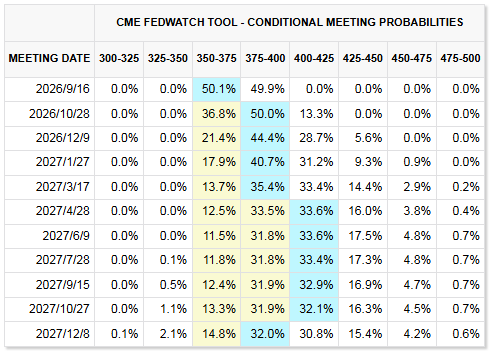
According to CME's “Federal Reserve Watch” data, as of August 12, the market expects the probability that the Fed will keep interest rates unchanged in September at 50.1%, and the probability of raising interest rates by 25 basis points is 49.9%. This probability gradually declined after being close to 80% at the beginning of the month, and is currently at a critical point of 5 to 5.