
TrendForce: All-solid-state batteries enter the engineering verification period, and mainstream global manufacturers accelerate vehicle regulation testing and implementation in multiple fields
The Zhitong Finance App learned that according to TrendForce Jibang Consulting's latest “Global Solid-State Battery Industry Development Quarterly Report _2Q26”, the all-solid-state battery (ASSB) industry will enter a critical period of engineering verification in 2026. Companies such as Toyota (Toyota), Honda (Honda), Nissan (Nissan), and Samsung SDI (Samsung SDI) are slightly leading the way in small-scale trial production of ASSB modules. Vehicle regulation products from Japanese manufacturers have been verified and confirmed in some performance indicators and are accelerating the performance of automotive ASSB modules. Assessment.
TrendForce Jibang Consulting said that in 2026, the ASSB Technology Readiness Level (TRL) showed significant progress. In core development regions such as China, Japan, and South Korea, ASSB performance verification and confirmation have passed the laboratory prototype verification stage (TRL1-3), and some leading manufacturers are moving towards TRL5-6, which means that the R&D focus is gradually shifting from breakthroughs in laboratory material performance to engineering manufacturing, product consistency and vehicle specification verification.
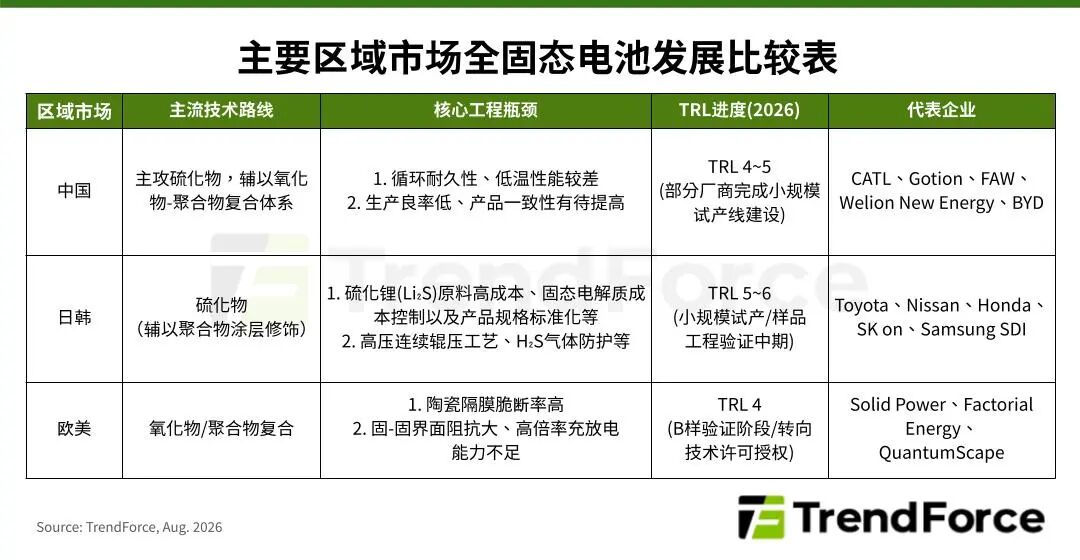
In the first half of 2026, leading Japanese and South Korean manufacturers achieved a breakthrough in the performance verification of ASSB samples in pilot engineering lines. Vehicle ASSB batteries completed partial performance and reliability confirmation, and design goals were achieved in key indicators such as charging/discharging performance and durability. For example, Nissan's thick 23-layer stack-structured automotive ASSB battery has completed charge/discharge tests, confirming that its capacity retention performance is superior to traditional liquid lithium-ion batteries. At the same time, leading Chinese manufacturers such as Ningde Times (300750.SZ), BYD (002594.SZ), and FAW (China FAW) successfully promoted the ASSB small-scale trial production line and accelerated the upgrading of technology to TRL4-5.
While promoting vehicle regulation verification, ASSB applications are spreading from electric vehicles to high value-added scenarios. According to TrendForce Jibang Consulting's survey, solid-state battery products (SSB) from global manufacturers such as Samsung SDI, Maxell (Maxell), Ilika, ProLogium (Huineng Technology), and Factory target the fields of drones/eVTOL, microelectronics, construction machinery, and embedded intelligent robots, and are facing iconic applications or orders.
Core materials such as lithium sulfide ushered in new opportunities
From a supply chain perspective, since 2025, industrial investment and capacity expansion in China, Japan, South Korea and other regions have focused on core raw materials such as solid electrolytes and lithium sulfide. According to TrendForce Jibang Consulting statistics, as of the first half of 2026, the global lithium sulfide production capacity has exceeded 600 metric tons, which is expected to rise significantly to the level of one thousand metric tons by 2027.
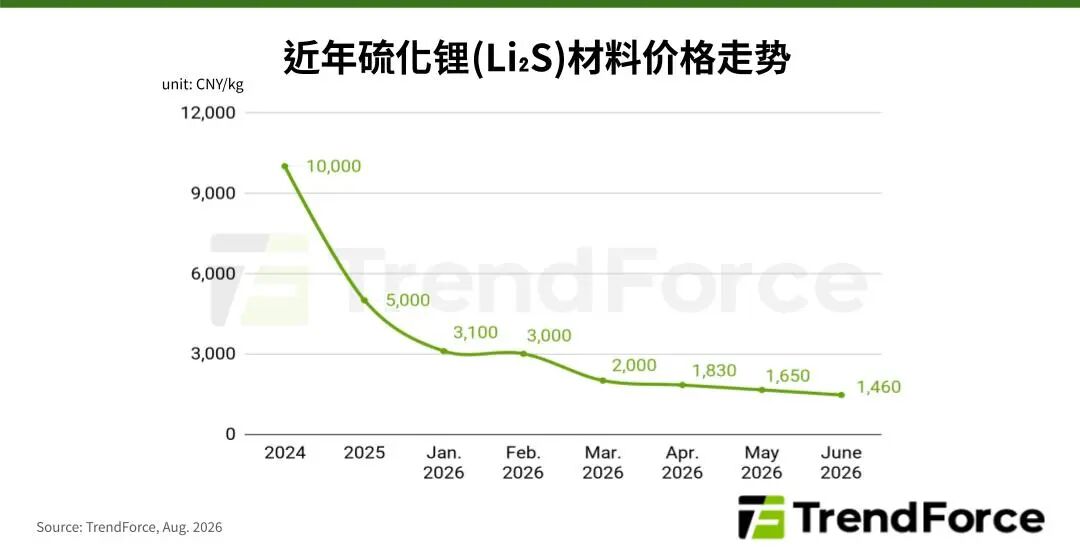
The sulfide route became the mainstream of the market during ASSB's small-scale trial production and development phase, leading to an increase in demand for lithium sulfide and an accelerated decline in costs. TrendForce Jibang Consulting pointed out that since 2026, monthly lithium sulfide shipments from some manufacturers have broken through from “kg grade” to “metric ton grade”, ushering in the first wave of market opportunities. Driven by the ASSB supply chain's demand to reduce costs, the price of lithium sulfide has dropped by more than 50% in the past half year, to only around RMB 1,460 per kilogram in June.
Overall, ASSB currently focuses on small-scale trial production research and development, and overall demand is relatively limited. If battery packaging vehicles are successfully verified in the future, demand for core materials will grow significantly.