
US stock outlook | The three major stock index futures rose sharply, and US July CPI surged after the release of Nebius (NBIS.US) results tonight
Pre-market market trends
1. On August 12 (Wednesday), the futures of the three major US stock indexes rose sharply before the US stock market. As of press release, Dow futures were up 0.12%, S&P 500 futures were up 0.26%, and NASDAQ futures were up 0.71%.

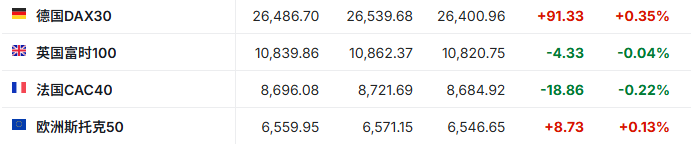
2. As of press release, the German DAX index rose 0.35%, the UK FTSE 100 index fell 0.04%, the French CAC40 index fell 0.22%, and the European Stoxx 50 index rose 0.13%.
3. As of press release, WTI crude oil rose 0.49% to $83.61 per barrel. Brent crude rose 0.29% to $89.17 per barrel.

Market news
The “anchor of global asset pricing” ushered in a critical moment! If the US CPI sends a dovish surprise, US debt bears will make up or boost the rise in risky assets. Wall Street strategists are unlikely to be more divided than they are now as to whether the Federal Reserve will choose to return to raising interest rates next month. However, one thing is undisputed: the US CPI inflation report released on Wednesday will largely determine the Fed's next move. According to the swap market transaction situation, the probability of a 25 basis point interest rate hike currently included by traders is about 50%. After the unexpected weakening of non-farm payrolls in July, Wall Street almost formed an extreme 50:50 split price on whether the Fed raised interest rates by 25 bp in September, while the Federal Reserve under Walsh's leadership clearly reduced forward-looking guidance, making the market have to rely again on hard data to determine the policy path. Therefore, the impact of July's CPI is clearly asymmetrical — that is, moderate inflation data can further weaken the reasons for interest rate hikes, but data that exceeds expectations and is more likely to quickly turn the September rate hike back into the benchmark scenario. As far as the 10-year US bond yield, the “anchor of global asset pricing,” the current bond market risk-return is actually clearly skewed in the pricing direction of “July's moderate CPI driving a rapid decline in yield”, mainly because macro data and the CTA bond market position structure are positively resonating.
Federal Reserve Officials Speak Out to Warn of Inflation Risks! Tonight the July CPI is expected to be the key ruling on the path to interest rate hikes. Ahead of the US CPI in July, many policymakers warned of the risk of continued high inflation. Chicago Federal Reserve Chairman Goulsby said that compared to any weakness in the labor market, he is more concerned about excessive inflation. Hamak said in an interview on Monday that a single interest rate hike of 25 basis points may not be enough to have much impact on the overall economy. Therefore, if the Federal Reserve needs to further reduce inflation through monetary policy, it may eventually need to take a “certain number of” interest rate hikes. However, at the same time, she stressed that currently she does not want to prejudge how many interest rate hikes will be needed, nor is she willing to set the end point for this round of policy adjustments in advance. Last week, St. Louis Federal Reserve Chairman Mussalem also said that with the inflation rate above the Federal Reserve's 2% target, policymakers cannot afford to endure higher inflation while waiting for the possibility of strong productivity growth. Federal Reserve Governor Cook also reiterated last week that if inflation does not continue to slow down in the future, she is prepared to support further interest rate hikes, and warned that as inflation continues to rise above the 2% target, the Fed may not have much time to wait; otherwise, it will be more difficult to control inflation in the future. Minneapolis Federal Reserve Chairman Kashkari said that the Federal Reserve should start gradually raising interest rates now to reduce inflation that is still above target and avoid being forced to take more aggressive measures to raise interest rates in the future due to further consolidation of inflation.
The “AI Computing Power Demand Trend Vane” performance has exploded again! Hon Hai's Q2 profit surged 35%, revenue surged 54% in July, and the AI infrastructure supercycle is still ongoing. Hon Hai's latest quarterly profit increase was higher than analysts' unanimous expectations, highlighting the continued strong demand for Nvidia's AI GPU server cluster product line from large cloud computing vendors and AI application leaders such as Anthropic and SpaceXAI. According to financial data, in the three months ending June, Hon Hai's net profit increased sharply by 35% year-on-year to 60 billion Taiwan dollars (about 1.9 billion US dollars), higher than analysts' average forecast of 58.4 billion NTD. The company previously reported a 40% increase in quarterly revenue. In July, revenue surged 54.2% to NT$946.5 billion. Analysts on average expect Hon Hai's cumulative revenue for the current quarter to continue to grow sharply by 32% against the backdrop of last year's high base. Furthermore, in terms of market-focused performance prospects, Hon Hai's management expects AI server rack (AI server rack) shipments to continue to achieve “high double-digit growth” in the third quarter, and that Hon Hai will increase production capacity in the US, including Texas and Wisconsin. In the performance statement, Hon Hai's management clearly stated that the AI computing power infrastructure is driving the company's performance growth and has a “strong” view on the future of AI servers.
Putting the brakes on fanatical retail investors: South Korea will tighten regulations on leveraged ETFs again, and speculate on single stock leverage before going through a “5-day simulation market.” South Korea will require new investors in individual stock leveraged ETFs to complete simulated trading exercises and further tighten regulations on such high-risk products that amplify market fluctuations. The Korea Financial Services Commission (FSC) said in a statement that new investors in single-stock leveraged ETFs must complete simulated transactions for at least 5 days and a cumulative total of at least 5 hours. The new regulations will apply to both domestic and overseas investments from August 19. The previous round of sharp declines caused investors to lose their positions by billions of dollars. This move is the latest move by the regulatory authorities to curb retail exposure to leveraged ETFs. Previously, regulators had raised the minimum cash deposit for such transactions to 30 million won (approximately $21,000) and extended the mandatory online training period for new investors in single-stock leveraged products to 3 hours.
IEA: The global oil supply gap will widen despite falling demand. The International Energy Agency (IEA) said that as the war in Iran escalates again, even if the impact on demand caused by high oil prices intensifies, the decline in global oil inventories will still reach more than double the previous estimate this quarter. The IEA said in its monthly report that the global oil market will face a supply gap of 1.8 million barrels per day due to “a new round of hostilities and disruptions in shipping” that hinder the recovery of production, and the supply gap may reach its highest level in five years in 2026. The IEA raised its forecast for the decline in global oil demand by nearly 50% to 1.6 million b/d this year, while global inventories are once again tightening. This will be the biggest drop in demand on an annual average since the COVID-19 pandemic in 2020. The IEA expects that as the oil market reverses to oversupply, the world's reduced inventories will be replenished next year. The agency said that member states such as the US, Japan, and Germany needed to refill emergency oil reserves after announcing a record release of oil reserves in March.
Rumor has it that the US and Iran are not currently discussing extending the cease-fire. According to reports, a senior Iranian source said, “There are currently no discussions between Iran and the US on extending the cease-fire. From Iran's perspective, there is no effective date for the cease-fire, so there is no need for an extension. The US broke the provisional agreement 48 hours after it was reached, and withdrew from the agreement a few days later. One of the issues currently being discussed is the return of the US to the Memorandum of Understanding and determining a time frame for the US to fulfill related commitments, but no progress has been made on this issue so far.”
Individual stock news
Strong demand for AI boosted growth, and Nebius (NBIS.US) Q2 revenue exceeded expectations. On Wednesday, Nebius Group reported that second-quarter revenue exceeded market expectations. Boosted by strong demand for artificial intelligence infrastructure and cloud services, which pushed the company to win larger contracts and increase pricing for computing power, the company's stock price rose about 15% in pre-market trading. According to the data, total revenue for the quarter ended June was US$582.3 million, higher than analysts' average expectations of US$5727.5 million. Its core business, AI cloud service revenue, accounted for about 98% of the Group's total revenue, an increase of more than 500% over the previous year. The company also reiterated its full-year performance guidelines for FY2026 and stated that demand for AI computing capabilities continues to grow at an accelerated pace, helping it obtain larger and higher profit margin customer contracts. Nebius revealed that a total of four landmark AI cloud service agreements were signed this quarter, with an average total contract value of more than 1 billion US dollars. The total contract value increased nearly four times over the previous quarter. The company said its pricing capacity increased this quarter, benefiting from strong demand for next-generation AI chips and higher rental rates for previous-generation GPUs. Approximately 70% of agreements signed during the period include advance payments from customers, covering 50% to 60% of related capital expenses.
CoreWeave (CRWV.US) backlog of orders surpassed US$104 billion, raising full-year guidance. CoreWeave achieved second-quarter revenue of $2.58 billion, up 112% year over year, exceeding analysts' average expectations of $2.56 billion. The quarter's net loss of $626 million, or loss of $1.14 per share, was mainly due to huge interest expenses to expand infrastructure — net interest expenses for the quarter were as high as $640 million, more than double the same period last year, but still significantly better than analysts' expectations of $1.41 per share. CoreWeave's most exciting data for the second quarter was that the backlog of orders (Revenue Backlog) reached about 104 billion US dollars, up 246% year over year, and continued to rise from 99.4 billion US dollars at the end of the previous quarter. Revenue guidance for the full year 2026 was raised from US$12 billion to US$13 billion to US$12.4 billion to US$13.2 billion. Analysts had previously estimated full-year revenue of $12.63 billion.
Strong demand for AI optical communication has become a growth engine! Lumentum (LITE.US) Q4 results and Q1 guidance both surpassed expectations. Lumentum's fourth-quarter revenue increased 109.3% year over year to US$1.06 billion, better than analysts' average forecast of US$990 million. Adjusted net profit was US$326 million, up 415% year on year; adjusted earnings per share was $3.23, better than analysts' average forecast of $2.97; adjusted gross margin was 50.4%, up 1,260 basis points year over year, better than analysts' average expectation of 48.8%; adjusted operating margin was 36.6%, up 2,160 basis points year over year. Lumentum's guidance for the first fiscal quarter of FY2027 also exceeded expectations. The company expects revenue for the first fiscal quarter to be US$1,225 million to US$1,275 million, with a median forecast range of US$1,250 million higher than the analysts' average expectation of US$1.50 billion; the adjusted earnings per share are expected to be US$4.05 to US$4.35, and the median forecast range of US$4.20 is higher than the analysts' average expectation of US$3.58.
The quarterly revenue outlook for ultra-micro computers (SMCI.US) far exceeds the most optimistic expectations, further confirming the AI computing power frenzy. Revenue for the quarter ending September is expected to reach 14.5 billion to 15.5 billion US dollars, and earnings per share after excluding specific projects are expected to be 1.01 to 1.10 US dollars. According to market compilation data, analysts expect average revenue of about US$12 billion and earnings per share of US$0.74, and this outlook has even surpassed the market's most optimistic revenue forecast of US$13.3 billion. Ultramicrocomputer further predicts that revenue for the new fiscal year starting in July will reach 65 billion to 72 billion US dollars, while the average analyst estimate is only 54.4 billion US dollars.
The consumer electronics industry was also notified of price increases: Microsoft (MSFT.US) has allegedly raised Windows 11 licensing fees. The consumer electronics industry is already causing costs to rise due to a shortage of semiconductors, and the software side also seems to be showing bad signs. According to reports, Microsoft increased the Windows 11 license fee by 7% to 10%, which is a significant increase over previous years, and the higher the CPU, the higher the license fee. Asus and Acer plan to increase prices by about 5% later this year. Among them, the average price of Asus products is already 30% higher than in Q4 2025.
Musk: In five years, AI will account for 99% of SpaceX's (SPCX.US) valuation, and the goal is to build 10 gigawatts of computing power by the end of next year. At a recent SpaceX all-staff conference, Elon Musk drew up a blueprint for the company's future development, with AI being given the highest strategic priority. According to his judgment, SpaceX's AI business will quickly surpass traditional space-related businesses and become the core pillar driving the company's revenue and valuation, while space sectors such as rockets, spacecraft, and Starlink will take on more of the role of supporting infrastructure. Musk said, “Our AI business revenue is not likely, but it will definitely surpass that of all other SpaceX businesses in September.” He also said, “I dare say that in five years, AI will definitely account for 99% of the company's valuation, and the total value of SpaceX at that time will be an astronomical figure.” Musk called gaining a competitive advantage in the AI field the “most important message” of this conference: “We must take the AI circuit. Because the dominant forces in the future will be AI and robots.” Musk said that SpaceX has set up an “AI training cluster with the strongest computing power in the world” and plans to expand the current computing power by about 10 times by the end of next year, with a target of 10 gigawatts. Musk said, “If we launch 10 gigawatts of AI computing power by the end of next year, it will bring in revenue of 300 to 500 billion US dollars every year. This is a huge figure.”
Samsung (SSNLF.US) and SK Hynix (SKHY.US) are preparing “epic” dividend repurchases, totaling more than 140 billion US dollars. According to reports, Samsung Electronics and SK Hynix will announce a new shareholder return plan as soon as the end of August. The combined return scale of the two companies may exceed 200 trillion won (about 141.2 billion US dollars), which is expected to reach a record high. Both companies have now said that the exact timing and scale of the release have not yet been finalized. Market expectations for large-scale shareholder returns are rapidly heating up. Meanwhile, Singapore's sovereign wealth fund Temasek plans to directly invest in the Korean stock market with its own capital for the first time, and plans to open positions with Samsung Electronics and SK Hynix. Boosted by two news, both companies' stock prices rose about 6% on the same day, driving the Korea Composite Index (KOSPI) to break through 6,500 points.
“Free up money” for 100 billion AI gambling! Rumor has it that Oracle (ORCL.US) has launched a new round of layoffs: some teams may be cut in double digits. According to internal documents and several people familiar with the matter, Oracle is preparing a new round of layoffs to cut employee costs. The layoffs for some teams may reach double-digit percentages. The company has asked management to submit a list of affected employees, with the goal of completing cost reduction before the second fiscal quarter begins on September 1. This is yet another round of large-scale layoffs at Oracle in fiscal year 2026. According to official documents recently submitted by the company, in the 2026 fiscal year ending May 31, 2026, the total number of Oracle employees has been reduced by about 21,000, a decrease of 13%. Currently, there are about 141,000 full-time employees worldwide. The company officially acknowledged for the first time in its annual report that the application of AI is one of the reasons for job cuts. Oracle clearly states in the document: “The adoption and deployment of AI technology in the company's operations has led and may continue to reduce the number of employees. ” The restructuring was costly: Oracle paid $1.84 billion in severance pay and other separation-related costs in fiscal year 2026, far higher than the previous fiscal year of $374 million. Notably, this layoff almost erased the employee growth brought about by Oracle's $28 billion acquisition of Cerner in 2022.
Google (GOOGL.US) “steals the beach” in Latin America's digital economy! Three new submarine optical cable systems have been added to connect Chile, Panama and other countries. Google announced on Tuesday that it will lay three new submarine cable systems — Alisios, Canoa, and OlaLuz — in the Americas. According to the press release, Alisios will connect the Dominican Republic, Panama, and Chile; Canoa will connect the Dominican Republic to Bermuda; and OlaLuz will connect the Dominican Republic to Florida in the US. Among them, Chile is striving to establish itself as a digital hub for its region, attracting technology companies with its economic and political stability, extensive optical fiber networks, submarine cables, and abundant renewable energy. In addition to the new Alisios submarine cable, the project currently underway also includes the Google-supported Humboldt submarine cable, which will cross the Pacific Ocean and connect Chile and Australia.
General Motors (GM.US) reached a parts procurement agreement of up to 4.5 billion US dollars to avoid the risk of a “stuck neck” in the supply chain. GM recently reached a unique parts procurement arrangement worth up to 4.5 billion US dollars, which aims to preserve cash while preventing the risk of supply chain disruptions that have hit the global automotive industry hard this century. According to a public document submitted on Tuesday, this procurement financing instrument of up to $4.5 billion involves a specialist company called Procura Auto Parts, which focuses on the procurement of rare or critical components. Procura will receive funding through a syndicate led by J.P. Morgan Chase and Santander, and make advance payments to selected suppliers on behalf of GM. In return, GM will issue a formal written commitment called the “Irrevocable Payment Promise” (IPU) to repay Procura after the relevant parts are put into production and use, no later than July 31, 2029. The arrangement allows GM to move inventory costs off the balance sheet while better securing future supply. GM declined to disclose specific components the agreement could target. The “problem components” facing the automotive industry include semiconductor chips (including dynamic random access memories), rare earth materials, and wire harnesses.
Key economic data and event forecasts
20:30 Beijing time: US July CPI.
22:30 Beijing time: Changes in US EIA crude oil inventories for the week ending August 7.
The next day at 01:00 Beijing time: US 10-year treasury bond auction on August 12.
Performance Forecast
Thursday morning: Cisco (CSCO.US), Coherent (COHR.US)
Thursday pre-market: JD (JD.US)