
Is Investing in Coca-Cola Stock Near an All-Time High a Better Buy Than PepsiCo Under $140 Per Share?
Key Points
Coca-Cola stock is trading near an all-time high for all the right reasons.
PepsiCo’s yield is elevated because of its falling stock price, while Coca-Cola’s yield has compressed.
Wall Street is overlooking the strength of PepsiCo’s international segment.
Coca-Cola (NYSE: KO) stock is up nearly 24% year to date, hovering around an all-time high, and handily outperforming the Nasdaq Composite (up 13.7%) and S&P 500 (up 12.9%). By comparison, PepsiCo (NASDAQ: PEP) is $138 per share at the time of this writing -- down 3.8% year-to-date and about 8% away from a five-year low.
Investing in Coca-Cola has paid off far better than buying PepsiCo in recent years. But investors looking to put $1,000 into either dividend stock right now likely care more about where the company could be headed than where it has been.
Missed Nvidia in 2009? This Rare Signal Is Flashing Again. In 2009, a "Double Down" signal flashed for a little-known chipmaker called Nvidia. For the first time in years, that same "Total Conviction" signal is flashing for a company 1/100th the size of Nvidia. Continue »
Here's why Coke has been in favor, and why the Pepsi sell-off has gone too far.

Image source: Getty Images.
Coke keeps delivering despite a challenging operating environment
Coca-Cola stock trades at its steepest premium to PepsiCo in years -- sporting a 26.3 forward price-to-earnings (P/E) ratio compared with just 16.1 for Pepsi. And Pepsi's dividend yield has ballooned to 4.3% compared with just 2.4% for Coke.
Investors are willing to pay a premium price for Coke because it has done a masterful job of navigating inflationary pressures and consumer spending challenges and has shown remarkable resilience despite a widespread consumer shift away from sugary beverages and artificial flavors and colors toward healthier options and natural ingredients, whereas Pepsi's results, especially in North America, have shown far less resilience.
Coke is delivering far better organic revenue growth than Pepsi -- a testament to its strong brand portfolio. And Coke's trailing-12-month (TTM) operating margins of 31.9% are far higher than Pepsi's 15.6% TTM operating margins thanks to its international network of bottling partners, which mix, bottle, package, and distribute Coca-Cola products. The bottling network gives Coca-Cola superior operating leverage, especially because Coke's focus is on non-alcoholic beverages, whereas Pepsi has more moving parts, with a massive snack business anchored by Frito-Lay and Quaker Oats.
PepsiCo's ace in the hole
Since PepsiCo has such a large snack business, it has been caught up in negative investor sentiment toward packaged food companies. By way of comparison, the stocks of Kraft Heinz, Hormel Foods, Campbell's, Conagra Brands, and even McCormick are all trading near 10-year lows.
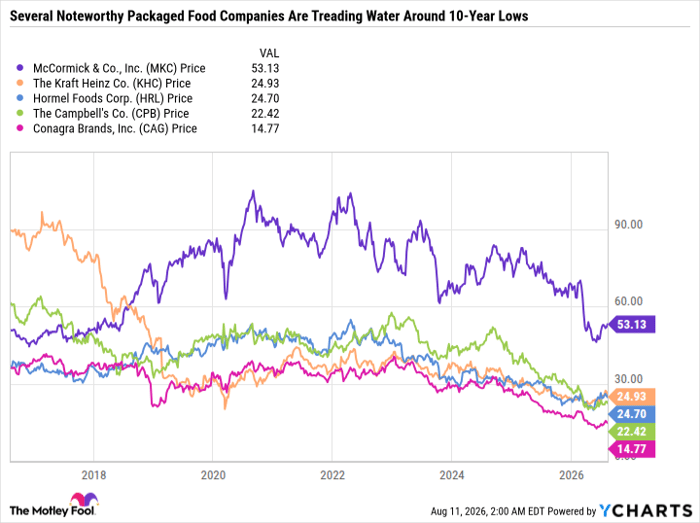
Data by YCharts.
But PepsiCo is a far larger company with several category-leading brands it can lean on during a slowdown. What's more, Pepsi has been diversifying into mini-meals and health-conscious options to cater to wellness trends. Management has been adamant about offering alternatives for consumers. And many of Pepsi's recent acquisitions support this strategic shift, including its 2025 acquisitions of Siete Foods (grain-free, simple ingredient-focused items) and the prebiotic soda brand Poppi.
Starting in fiscal 2025, Pepsi began reporting Quaker Foods North America and Frito-Lay North America under one PepsiCo Foods North America (PFNA) umbrella. It also used to report Europe separately from the Middle East and Africa. Pepsi now separately reports its international beverage franchise results, which include its international franchise and SodaStream businesses. For the sake of comparing results across different corporate structures, here are Pepsi's results separated into North American foods, North American beverages, and international (including food, beverage, and franchise beverage businesses).
Segment Revenue for the 24 Weeks Ended ... |
June 12, 2021 |
June 11, 2022 |
June 17, 2023 |
June 15, 2024 |
June 14, 2025 |
June 13, 2026 |
5-Year Change |
|---|---|---|---|---|---|---|---|
PepsiCo Foods North America (PFNA) |
$10 billion |
$11.4 billion |
$12.9 billion |
$12.7 billion |
$12.7 billion |
$12.7 billion |
26.9% |
PepsiCo Beverages North America (PBNA) |
$11.2 billion |
$11.5 billion |
$12.6 billion |
$12.7 billion |
$12.7 billion |
$13.6 billion |
21.4% |
International (Food and Beverage) |
$12.8 billion |
$13.5 billion |
$14.7 billion |
$15.4 billion |
$15.3 billion |
$17.3 billion |
35.1% |
Total |
$34 billion |
$36.4 billion |
$40.2 billion |
$40.8 billion |
$40.6 billion |
$43.6 billion |
28.2% |
Data source: PepsiCo.
Pepsi's North American food and beverage business has been in a significant slowdown over the past three years, whereas international operations continue to drive the company's overall results. International now makes up 40% of Pepsi's total sales. Comparing the 24 weeks ended June 13, 2026, to the 24 weeks ended June 14, 2025, Pepsi's Europe, Middle East, and Africa convenient foods and beverage businesses, as well as Latin America Foods and Asia Pacific Foods, are experiencing double-digit revenue growth.
Pepsi is a top buy for income investors
Coca-Cola has outperformed PepsiCo in recent years, but Pepsi is the superior buy now. Pepsi has a much lower P/E ratio and a higher dividend yield. And it continues to generate strong free cash flow to support its growing payout -- which it has increased for 54 consecutive years, compared with 64 consecutive years for Coca-Cola. Both Coke and Pepsi are Dividend Kings -- increasing their dividends annually for at least 50 consecutive years -- and their dividend streaks show no signs of ending anytime soon.
Perhaps most importantly, investors may be overlooking just how solid Pepsi's international food and beverage business has been performing -- a testament to the strength of its international brand portfolio and distribution network. It's also worth noting that, unlike other packaged food companies, which are seeing meaningful declines in sales and earnings, PFNA is still near a record high in revenue, and PBNA is at a record high. Or, put another way, the pace of Pepsi's North America food and beverage business is slowing, but it isn't even close to the declining sales some of its packaged food peers are seeing.
Investors who believe Pepsi can adjust to shifting consumer preferences by offering healthier options within its existing brands and continue making savvy acquisitions are getting the chance to buy the stock at a dirt-cheap price. Coke is still a good blue chip dividend stock to hold; it's just not as screaming of a buy given it is already priced as the category leader -- meaning it must continue doing a lot right just to back up its existing valuation.
Daniel Foelber has no position in any of the stocks mentioned. The Motley Fool recommends Campbell's, Kraft Heinz, and McCormick. The Motley Fool has a disclosure policy.