
Seagate (STX) Stock Looks Fully Priced Despite Cash Flow Upside
Seagate Technology Holdings has delivered an extremely strong run over the past three years, yet its valuation checks send a mixed message, with a low overall value score sitting alongside an intrinsic value estimate that still indicates a discount to the current share price.
- Seagate has returned very roughly 14x over the past three years, which puts extra pressure on today’s buyers to be comfortable with what is already priced in.
- Heavy demand linked to AI infrastructure buildout can support investor optimism on future cash flows. However, questions about how long that demand surge lasts remain a key risk for the stock’s valuation.
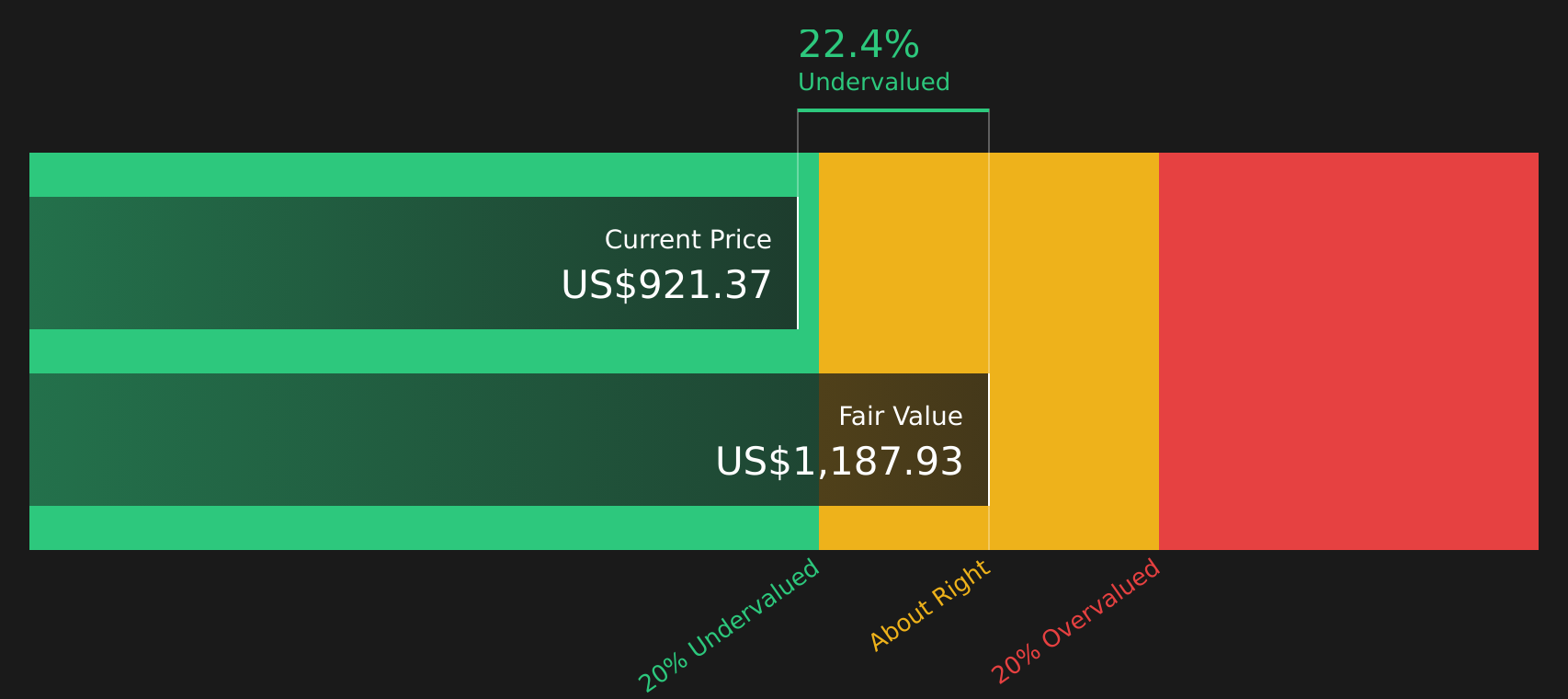
- The company scores just 2 out of 6 on broader valuation checks, which suggests the stock does not screen as a straightforward bargain even though the Discounted Cash Flow (DCF) estimate points to Seagate trading about 26.2% below its intrinsic value.
For investors, the debate is whether Seagate Technology Holdings is still attractively priced after such a strong share price run, or whether the easy valuation upside has already been used up.
Is Seagate Technology Holdings a Bargain on Cash Flow?
The Discounted Cash Flow (DCF) model here estimates what Seagate Technology Holdings could be worth based on its projected future cash generation. The model starts from last twelve month free cash flow of about $3.2b and assumes that cash flows keep growing from this base rather than shrinking, which is presented as a key element in the valuation story for Seagate.
Under these assumptions, the DCF points to an intrinsic value of about $1,191 per share in dollar terms. This figure is above the current share price, so on this model Seagate screens as about 26.2% undervalued. The strong AI related demand highlighted in recent earnings coverage is cited as a reason the market is willing to pay more, while the cash flow model still suggests the stock is not fully reflecting those projected streams.
Overall, the DCF workup implies Seagate Technology Holdings appears undervalued relative to the cash flows analysts currently project.
Our Discounted Cash Flow (DCF) analysis suggests Seagate Technology Holdings is undervalued by 26.2%. Track this in your watchlist or portfolio, or discover 49 more high quality undervalued stocks.
Is Seagate Technology Holdings Fairly Priced on Earnings?
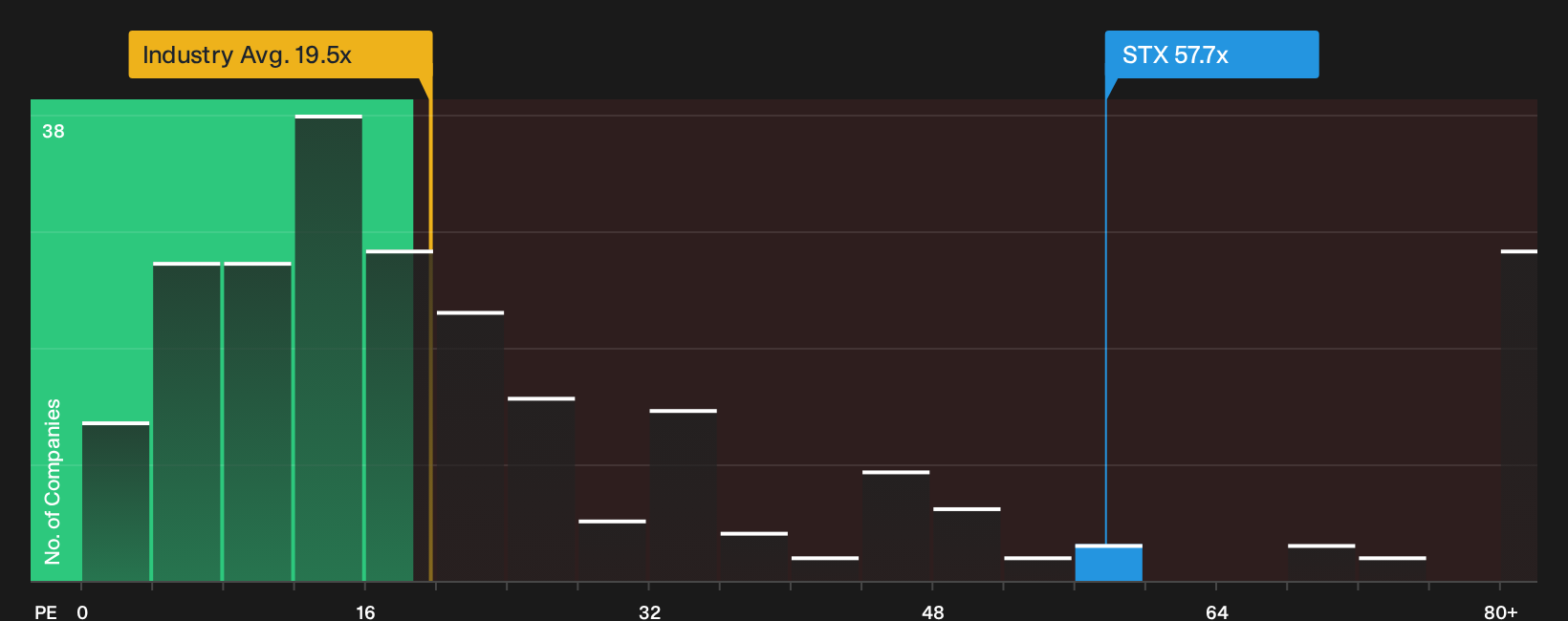
P/E is a useful lens for Seagate Technology Holdings because earnings remain a key anchor for how investors value this kind of mature hardware and storage business. On this measure, Seagate trades on a P/E of about 62.5x, which is roughly double both its Tech industry average of about 21.7x and a peer group average of about 31.4x. That alone signals that the market is paying a sizeable premium for the stock’s current earnings.
The fair P/E ratio implied by the model is about 57.9x, which is only slightly below where Seagate Technology Holdings currently trades. This suggests that, after factoring in its growth outlook, margins, size and risk profile, the present P/E is not far from what the model would expect. The stock does not screen as especially cheap or stretched on this earnings multiple despite the strong recent interest linked to AI storage demand.
On balance, Seagate Technology Holdings looks roughly fairly valued on its current P/E multiple.
See what the numbers say about this price — find out in our valuation breakdown.
The Seagate Technology Holdings Narrative: What Would Justify Today's Price?
Simply Wall St Narratives pick up where the Seagate Technology Holdings valuation puzzle leaves off by spelling out which assumptions about the company’s future growth, margins and earnings would need to hold for the stock to be worth materially more or less than today’s price. Each Narrative ties a fair value to a clear story about Seagate Technology Holdings' potential catalysts and risks, so you can track over time which version of events is actually unfolding on the Community page.
The Seagate Technology Holdings community currently splits between a bullish AI storage upside story and a bear view that questions how long that can last.
Bull case: 21% undervalued
"Seagate is ramping up its HAMR-based Mozaic drives, which represent a technological breakthrough..."
Read the full Bull Case to see why Seagate Technology Holdings could be undervalued
Bear case: 29% overvalued
"Despite strong near-term revenue growth and margin expansion fueled by build-to-order contracts and high-capacity HDD adoption, the accelerating shift of cloud service providers and hyperscalers toward SSDs and other energy-efficient storage solutions will structurally undermine Seagate's long-term addressable markets, putting sustained top-line growth at significant risk over the next decade..."
Read the full Bear Case to see why Seagate Technology Holdings could be overvalued
Do you think there's more to the story for Seagate Technology Holdings? Head over to our Community to see what others are saying!
The Bottom Line
For Seagate Technology Holdings, the Discounted Cash Flow (DCF) work suggests meaningful upside to intrinsic value, yet the broader checks remain weak and the P/E points to a stock that already embeds punchy expectations. That split largely reflects how cash flow models put more weight on projected free cash generation, while market multiples are more sensitive to sentiment and what peers trade on after such a sharp move. The key question from here is whether AI driven storage demand can stay strong enough, for long enough, to justify both the premium earnings multiple and the DCF implied upside rather than turning the current discount into a value trap.
This article by Simply Wall St is general in nature. We provide commentary based on historical data and analyst forecasts only using an unbiased methodology and our articles are not intended to be financial advice. It does not constitute a recommendation to buy or sell any stock, and does not take account of your objectives, or your financial situation. We aim to bring you long-term focused analysis driven by fundamental data. Note that our analysis may not factor in the latest price-sensitive company announcements or qualitative material. Simply Wall St has no position in any stocks mentioned.
Have feedback on this article? Concerned about the content? Get in touch with us directly. Alternatively, email editorial-team@simplywallst.com