
China Index Research Institute: Central and state-owned enterprises are speeding up entry into the proxy circuit, which is expected to change the competitive landscape of the industry
The Zhitong Finance App learned that the China Index Research Institute issued an article stating that currently, China's real estate agency industry is in a critical period of transformation from rapid growth to high-quality development. Although the growth rate of the industry is slowing down, it remains high. The competitive landscape is being reshuffled at an accelerated pace, and the large-scale entry of central and state-owned enterprises is reshaping the industry ecosystem. These industry-level changes are profoundly affecting the market pattern and development logic of commercial agency construction.
Judging from the market fundamentals of major urban agglomerations, the dominant position of local state-owned enterprises in the land market has laid a solid customer base for commercial agency construction. Local state-owned enterprises in the Yangtze River Delta, Guangdong-Hong Kong-Macao, and Chengdu-Chongqing urban agglomerations all account for more than 50% of the land acquisition. The contradiction between the high share of land acquired by local state-owned enterprises, the high unstarted rate, and insufficient professional development capacity constitutes the biggest structural opportunity for the commercial construction industry.
Summary of the current situation of real estate agency construction
(1) Scale analysis: The growth rate is slowing down, but the overall scale remains high
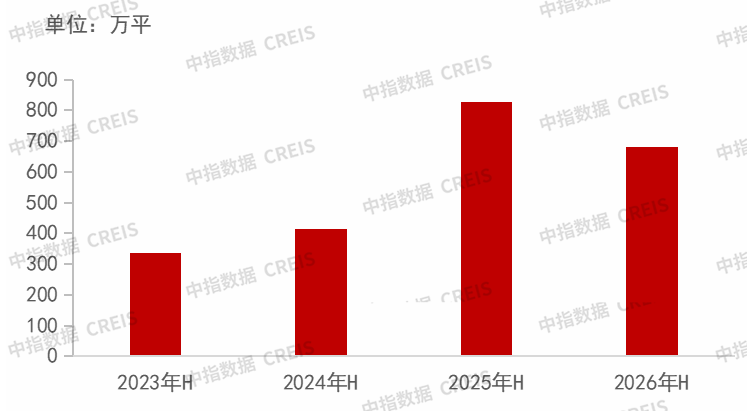
After experiencing rapid growth from 2021 to 2023, China's real estate agency industry has entered a “precipitation period” where the growth rate has slowed since 2024, but the total scale remains high. According to data from the China Index Research Institute, the planned construction area of newly contracted construction enterprises in 2025 was 171.53 million square meters, an increase of 4.3% over 2024. Since 2023, although the growth rate of the newly contracted construction area of contract construction companies has fluctuated slightly, the scale has remained high and stable. According to the “Ranking of China's Real Estate Construction Companies for the First Half of 2026”, the cumulative scale threshold for the top five real estate construction companies is 6.8 million square meters, down 17.7% from the first half of 2025, but it still remains high for nearly 4 years.
Figure: The top five thresholds for the cumulative scale of construction enterprises in the first half of 2023-2026
Data source: Middle Index Data CREIS
(2) Competition pattern: Stable head share, intensified corporate reshuffle, and the entry of central state-owned enterprises changed the pattern
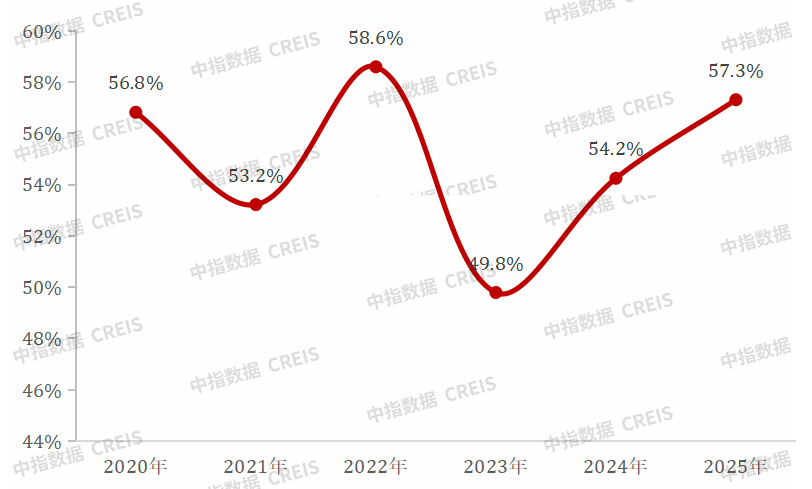
The concentration of contract construction companies has remained high. Judging from the construction area of the newly contracted projects, in recent years, although the market share of the top 5 companies has fluctuated, they are all above 50%. The market concentration of leading DAIJIAN companies has always remained high, and their ability to expand projects is still outstanding.
Figure: Share of the construction area of the top five new contracts signed by the top five enterprises in 2020-2025
Data source: Middle Index Data CREIS
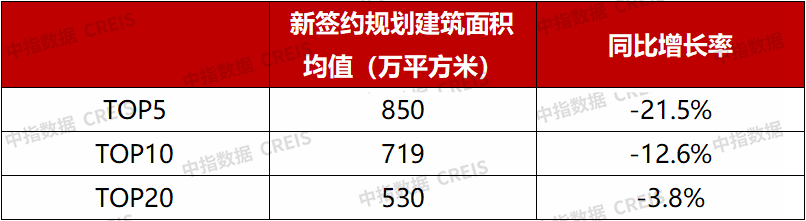
According to the “Ranking of China's Real Estate Construction Companies for the First Half of 2026”, as the number of companies entering the Real Estate Agency increased and competition was fierce, the construction area of the new contract construction plans for all factions declined. Among them, the construction area of the top five newly contracted companies dropped 21.5% year-on-year, the biggest drop. The planned construction area of the top ten enterprises decreased by 12.6% year on year, and the planned construction area signed by the top 20 enterprises decreased by 3.8% year on year. In recent years, real estate agency construction has gradually changed from large-scale competition to “focusing on service and redelivery”. Some companies have voluntarily abandoned scale expansion and focused more on improving the quality of products and services, improving management efficiency, and becoming integrated. These changes also help drive the industry to develop in the direction of high quality.
Table: Average construction area and growth rate of newly signed plans by enterprises in each faction
Data source: Middle Index Data CREIS
It is worth noting that central state-owned enterprises are speeding up their entry into the proxy construction circuit, which is expected to change the competitive landscape of the industry. According to statistics, out of 16 central real estate enterprises, 12 have carried out contract construction business, 4 of which have set up independent contract construction companies. Among the top 50 companies with sales, more than 90% are those that carry out contract construction services. With strong financial strength, resource integration capabilities, and credit endorsements, central state-owned enterprises have obvious advantages in the fields of government construction, affordable housing, and urban renewal. Their large-scale entry may reshape the competitive pattern of the industry and push the contract construction industry from being dominated by private enterprises to diversified competition.
Analysis of the land acquisition situation of enterprises in various urban agglomerations
(1) Analysis of the share of land acquired by urban agglomeration according to the nature of the enterprise
The clients for commercial construction are mainly various types of land holders. Among them, local state-owned enterprises and small and medium-sized private housing enterprises are important sources of demand for commercial construction projects. In order to thoroughly understand the market basis for commercial construction in various urban agglomerations, we measured and analyzed the share of land acquisition by enterprise nature in each urban agglomeration using the 2023-2025 transaction data for residential land, comprehensive land (including residential), and commercial and office land as a sample.
Judging from the proportion of corporate land acquisitions in various urban agglomerations, there are significant regional differentiation characteristics. The details are shown in the following table:
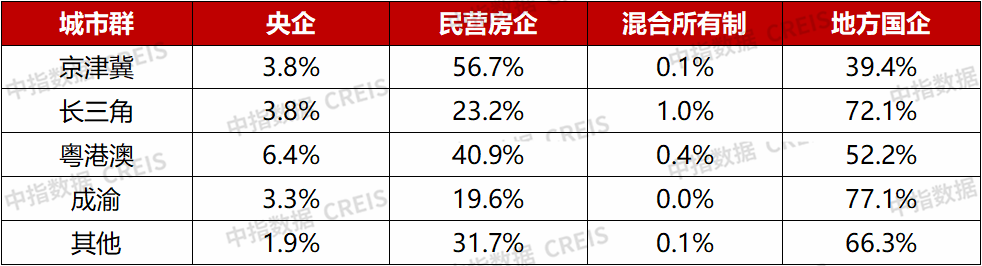
Judging from the data, with the exception of Beijing-Tianjin-Hebei, the share of land acquired by local state-owned enterprises is at a high level. Specifically, the Yangtze River Delta is 72.1%, Guangdong, Hong Kong and Macau is 52.2%, and Chengdu and Chongqing are as high as 77.1%. Land acquisition by local state-owned enterprises is relatively high, which means that a large amount of new land will be developed under the leadership of state-owned enterprises. However, most local state-owned enterprises, especially urban investment platforms, have relatively limited professional capabilities in residential development and commercial operations, which provides a broad market space for professional construction companies. In particular, in the Yangtze River Delta and the Chengdu-Chongqing urban agglomeration, local state-owned enterprises account for more than 70% of land acquisition. Their plight of “having land and no skills” is particularly prominent, and there is huge potential for demand for proxy construction.
The Beijing-Tianjin-Hebei urban agglomeration is dominated by private housing enterprises acquiring land. At the same time, small and medium-sized private housing enterprises are also an important force in the demand for proxy construction. Judging from the data, Beijing-Tianjin-Hebei Province is dominated by private housing enterprises, accounting for 56.7%; private housing enterprises in Guangdong, Hong Kong and Macao also accounted for 40.9% of land acquisition. However, compared to local state-owned assets, private housing enterprises, as clients, also have certain risks. For example, once the client's funds break down and the project comes to an end, the proxy construction brand is treated by the buyer as if the developer's rights are collectively defended and credit is damaged; some clients intervene excessively, and only need to “brand” the proxy construction project, or lie flat and let go, and repeated decisions cause the construction team to lose track and quality.
It should be noted that not all local state-owned enterprises and private housing enterprises with land resources will turn into effective proxy construction requirements. Some local state-owned and private housing enterprises have been deeply involved in the region for a long time. Not only do they have mature development systems and brand accumulation; their projects are recognized even better than foreign state-owned enterprises, have independent management capabilities, and there is no motivation to introduce proxy construction; while another type of local state-owned land acquisition has clear public welfare attributes. The core demands are to improve infrastructure and protect people's livelihood. The project itself is not oriented towards market-based sales or profit returns, nor is there any need for proxy construction.
Central enterprises account for the largest share of land acquisition in the Guangdong-Hong Kong-Macao urban agglomeration. The share of land acquired by central enterprises can reflect the level of activity in the real estate market in the region. Currently, real estate companies, especially central enterprises, invest in land acquisition generally focus on regions with a good economic base, net inflow of population, and strong industrial resource advantages. Therefore, in regions where central enterprises account for relatively high land acquisition, demand in the real estate market is usually relatively strong. The core of commercial construction is still the elimination of sales. Therefore, in regions with a good real estate market, sales elimination is also better. According to data, central enterprises in the Guangdong, Hong Kong and Macao regions accounted for 6.4% of land acquisition, which is significantly higher than in other regions. Central enterprises in other regions outside the four major urban agglomerations account for only 1.9%, which also fully shows that land acquisition by central enterprises is more focused on core urban agglomerations, and the economy within urban agglomerations is more active.
(2) Analysis of the land acquisition rate of local state-owned enterprises in various urban agglomerations
Whether local state-owned enterprises start construction in a timely manner after acquiring land directly affects the supply pace and market opportunities for commercial construction projects. By analyzing the data on the commencement progress of land sold by local state-owned enterprises in the 2023-2025 representative cities of each urban agglomeration, we calculated the unstarted rate of land acquired by local state-owned enterprises in each urban agglomeration. The details are shown in the following table:
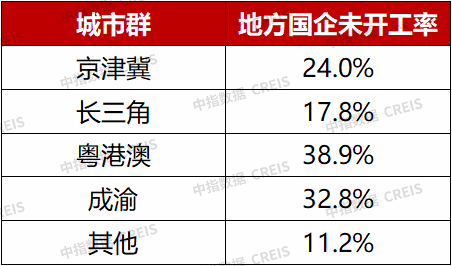
Note: Unstarted rate = number of land plots of local state-owned enterprises that have not started construction/total number of land plots acquired by local state-owned enterprises, based on sample estimates from representative cities.
Data source: Middle Index Data CREIS
The high unstarted rate reflects a clear mismatch in the pace between land acquisition and project development by local state-owned enterprises. On the one hand, local state-owned enterprises acquire large amounts of land based on land reserves and strategic layout, but due to factors such as weak market demand, financial pressure, and project decision-making processes, the actual construction progress of the project is lagging behind; on the other hand, this also means that a large number of existing plots are in urgent need of specialized development, providing huge space for commercial construction companies to intervene.
Judging from the data, there are significant differences in the unstarted rate of land acquisition by local state-owned enterprises in various urban agglomerations. Local state-owned enterprises in the Guangdong-Hong Kong-Macao urban agglomeration had the highest unstarted rate, reaching 38.9%, that is, nearly 40% of local state-owned enterprises have yet to start construction. The Chengdu-Chongqing urban agglomeration followed, with an unstarted rate of 32.8%. Beijing-Tianjin-Hebei was 24.0%, the Yangtze River Delta was 17.8%, the lowest in other regions, only 11.2%. Local state-owned enterprises in the Guangdong-Hong Kong-Macao urban agglomeration have the highest unstarted rate, which is closely related to the relatively high share of high-priced land in the region and the high pressure to adjust the market. After obtaining high-priced land plots, local state-owned enterprises faced the “high cost and low return” development dilemma, and the project was progressing more prudently. The Chengdu-Chongqing urban agglomeration has the second-highest unstarted rate, reflecting that the western core cities are still in the market adjustment cycle, and local state-owned enterprise projects are not motivated enough to start. In contrast, the rate of local state-owned enterprises in the Yangtze River Delta urban agglomeration is relatively low, indicating that the Yangtze River Delta market is relatively active and project promotion efficiency is high.
(3) Analysis of changes in the number of land acquisitions by local state-owned enterprises in various urban agglomerations
In order to assess long-term trends in the commercial construction market in various urban agglomerations, we compared and analyzed the changes in the average number of land acquired by local state-owned enterprises during the period 2021-2022 and 2023-2025. The growth rate reflects dynamic changes in the scale of land acquisition by local state-owned enterprises and is directly related to future supply trends for commercial construction projects.
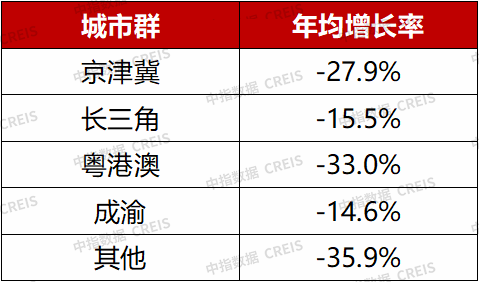
Data source: Middle Index Data CREIS
The number of land acquired by local state-owned enterprises in various urban agglomerations generally declined, reflecting a contraction in the willingness of local state-owned enterprises to invest during the real estate market adjustment period. Judging from the data, the average annual number of land acquisitions by local state-owned enterprises in major urban agglomerations has declined, but there is a clear difference in the decline. The largest decline was 33.0% in the Guangdong-Hong Kong-Macao urban agglomeration; the Beijing-Tianjin-Hebei region declined by 27.9%; and the Yangtze River Delta and Chengdu-Chongqing fell relatively moderately, at 15.5% and 14.6%, respectively. Although the willingness of local state-owned enterprises to invest has shrunk during the real estate market adjustment period, the development demand for existing projects is still huge. Combined with data on the unstarted rate, Guangdong, Hong Kong, Macao, and Chengdu and Chongqing have high unstarted rates, and there is more room for development of existing land. Contract construction companies need to find a strategic balance between incremental reduction and inventory revitalization.
Analysis of commercial construction opportunities in various urban agglomerations
The urban divisions in the Beijing-Tianjin-Hebei urban agglomeration are quite obvious, and each city has different opportunities. The Beijing market is dominated by land acquisition by central state-owned enterprises. Land plots in the core area are scarce. After land acquisition, demand for commercial construction is weak; however, government public construction, university relocation, and non-housing enterprise land acquisition such as science and technology parks, and the renewal of existing buildings in Zhongguancun have become the main battleground, and the direction of proxy construction should target public construction, science and technology innovation parks, and pre-operation renewal of old buildings. Most of the land acquired by Tianjin's central state-owned enterprises is for independent development, and most private enterprises are deeply cultivated locally, but urban renewal policies have been vigorously released, and contract construction opportunities are under the joint brand of urban investment subsidence plots, AMC bailouts, urban renewal, etc. Hebei Construction Agency must do a good job in city screening and client screening, and strengthen risk management and control to avoid possible brand loss, etc.
Local state-owned enterprises in the Yangtze River Delta urban agglomeration have the highest annual number of land acquisitions, the largest market size, and the most commercial construction opportunities. Although the average annual number of land acquisitions by local state-owned enterprises in the Yangtze River Delta urban agglomeration fell by 15.5%, the decline is moderate, and the absolute scale is still among the top of the four major urban agglomerations. The unstarted rate of local state-owned enterprises is only 17.8%, which is the lowest among the four major urban agglomerations, reflecting the high activity of the Yangtze River Delta market, efficient project promotion, and mature development environment. The Yangtze River Delta is also the region with the highest share of new contract area for contract construction companies, accounting for 24.7%. The most tender information is published, and the contract construction market is highly transparent. Cities such as Shanghai, Hangzhou, and Nanjing in the region have a strong industrial base, local state-owned enterprises have a high degree of marketization, and some regions have strong urban investment payment capacity and specialized demand. The market depth and customer quality of commercial construction are at the leading level, and commercial construction opportunities are greatest.
The urban agglomeration of Guangdong, Hong Kong and Macao focuses on stock revitalization and industrial construction opportunities. The average number of land acquired by local state-owned enterprises dropped by 33.0% per year, but the unstarted rate was as high as 38.9%, which meant that a large amount of land that had been acquired but had not yet started construction was awaiting development. Land values in core cities such as Guangzhou and Shenzhen are high, and central state-owned enterprises usually develop their own after acquiring land. However, there are many urban renewal projects in the region, and contract construction companies can focus on revitalizing existing land plots and outsourcing opportunities for urban renewal projects. Other cities in Guangdong Province are the vast majority of third- and fourth-tier cities, but regional economic activity is high, and there is still a lot of unbuilt land in urban investment, which has also become an opportunity for proxy construction. At the same time, industries in the region are developing rapidly, and contract construction enterprises with industrial and commercial operation capabilities can also pay attention to the demand for industrial park construction in the region.
The Chengdu and Chongqing urban agglomeration focuses on local urban acquisitions. Local state-owned enterprises account for 77.1% of land acquisition in the Cheng-Chongqing urban agglomeration, the largest of the four major urban agglomerations, but the unstarted rate is as high as 32.8%, and a large number of local state-owned enterprises have yet to start land acquisition. As the core cities of the two-city economic circle in the Chengdu and Chongqing region, Chengdu and Chongqing have great potential for development with the support of policies such as western development and urban renewal. There are many local urban investment and local state-owned enterprise platforms in the region, but professional development capabilities are relatively weak, and the demand for contract construction enterprises is particularly urgent. Contract construction companies can actively connect with urban investment platforms in Chengdu, Chongqing and other places to expand commercial construction services.