
IMAX (IMAX) Stock Looks Fully Valued Despite Cash Flow Upside
IMAX stock has delivered a very strong 261.7% return over the past 5 years, yet the valuation checks send mixed signals as the Discounted Cash Flow (DCF) estimate points to meaningful upside while market multiples lean expensive.
- Over 5 years IMAX has returned 261.7%, which puts extra focus on whether recent gains are already pricing in much of the long term opportunity.
- The recent record IMAX performance for "Spider-Man: Brand New Day" in China can support expectations for premium format box office revenue. However, reliance on a small number of blockbuster releases may leave cash flows exposed if the pipeline underperforms.
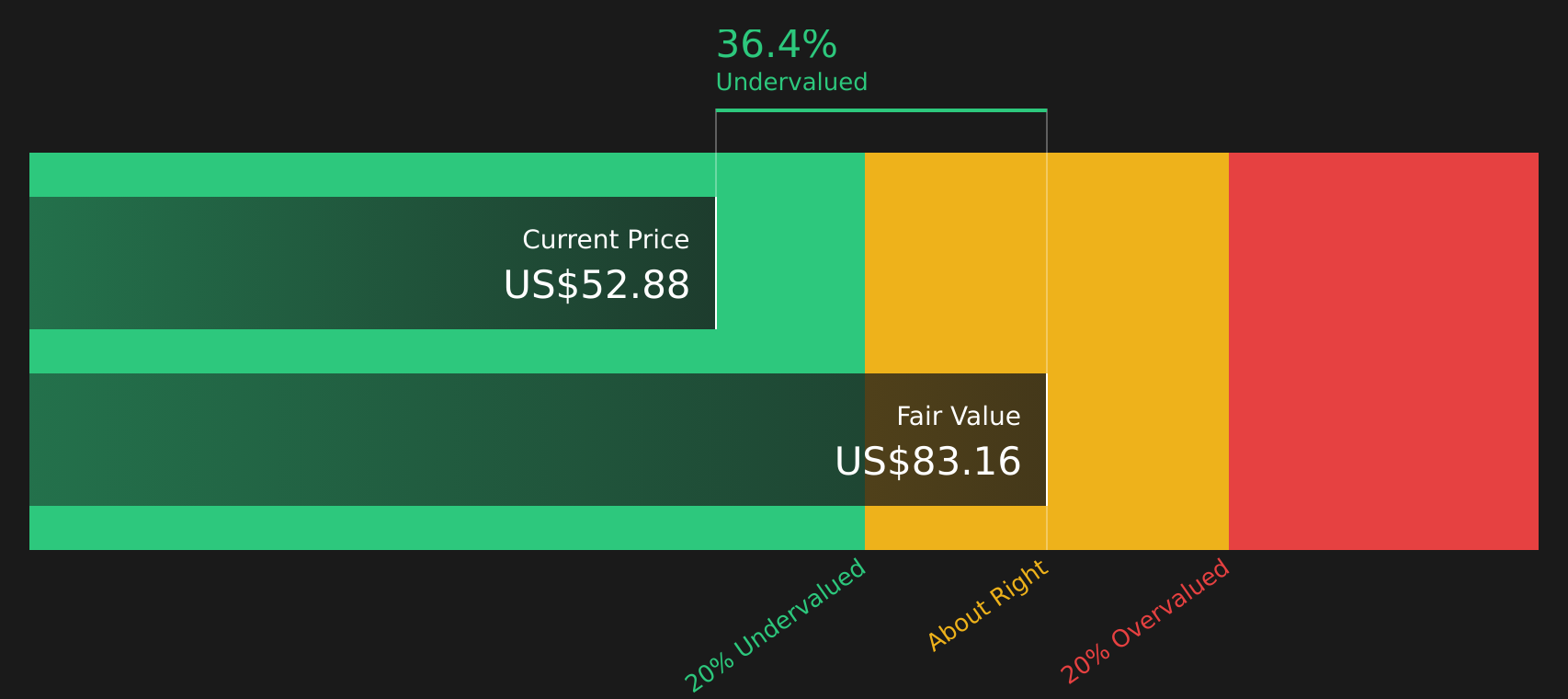
- The stock screens as undervalued on the Discounted Cash Flow (DCF) estimate by about 38.3%, yet it only passes 2 of 6 valuation checks, which points to a company that does not screen as a clear bargain across broader measures.
The issue now is whether IMAX's current share price near US$51.32 reflects a fair balance between that intrinsic value estimate and the more cautious signals from the wider valuation checks.
Is IMAX a Bargain on Cash Flow?
The Discounted Cash Flow (DCF) model here uses projected free cash flows to estimate what IMAX might be worth today. IMAX generated about $88.8 million in free cash flow over the last twelve months, and the model assumes these cash flows continue growing rather than shrinking. On that basis, the DCF points to an intrinsic value of about $83 per share.
With the current share price near $51.32, IMAX screens as roughly 38.3% below that DCF estimate, which is a wide gap for a company with established cash generation. The recent record performance of “Spider-Man: Brand New Day” in China helps explain why cash flow expectations are constructive, even if they remain sensitive to the blockbuster release calendar.
Overall, the Discounted Cash Flow work suggests IMAX stock currently appears undervalued relative to its projected cash flows.
Our Discounted Cash Flow (DCF) analysis suggests IMAX is undervalued by 38.3%. Track this in your watchlist or portfolio, or discover 49 more high quality undervalued stocks.
Does IMAX Look Pricey on Earnings?
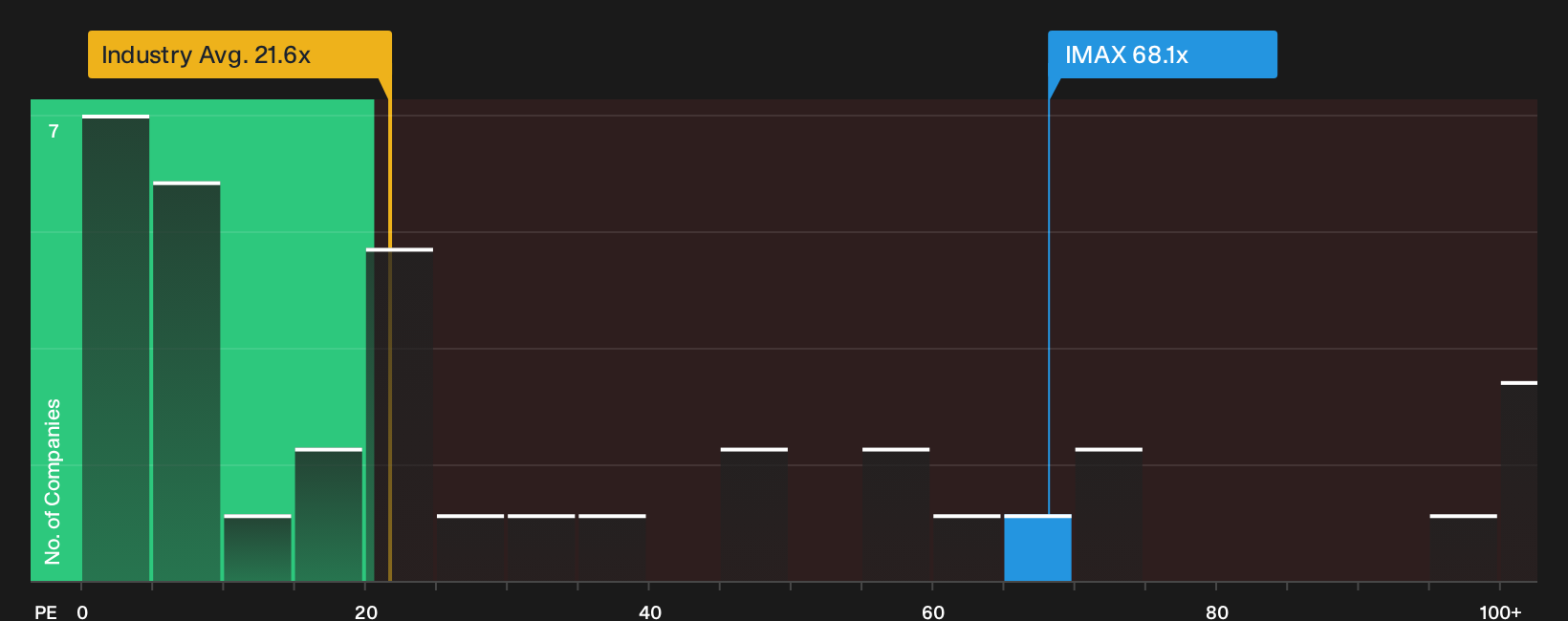
The P/E multiple is a useful check for IMAX because earnings are a key driver of how investors value entertainment stocks. IMAX currently trades on a P/E of about 68.8x, which is far above the Entertainment industry average of roughly 19.7x and the peer group average of about 54.8x. That already puts IMAX at a clear premium to many listed entertainment companies.
A tailored fair P/E ratio for IMAX, which blends factors such as its growth profile, margins, size and risk, sits much lower at about 23.4x. Compared with the current 68.8x, the market is paying almost three times that implied level for each dollar of earnings. This suggests the recent enthusiasm around premium formats and titles such as “Spider-Man: Brand New Day” is reflected in a rich earnings multiple that leaves less room for disappointment.
On the P/E test, IMAX stock currently appears overvalued relative to both its industry and a more tailored fair-value benchmark.
See what the numbers say about this price — find out in our valuation breakdown.
The IMAX Narrative: What Would Justify Today's Price?
Simply Wall St Narratives pick up where the valuation puzzle for IMAX leaves off. They spell out which paths for IMAX's growth, margins and earnings would need to play out for the stock to be worth materially more or less than today's price, and sit on Simply Wall St's Community page. Where a single ratio or model offers one number, the Narratives break that number into the future conditions it rests on so you can watch whether those conditions actually show up.
IMAX investors are weighing two sharply different storylines, one focused on premium format upside and another on content and capital risks.
Bull case: 14% undervalued
"The rapid adoption of IMAX's immersive technology for alternative content, including live concerts, gaming events, and sports, delivered more cost effectively via streaming and new tech partnerships, has the potential to establish IMAX as the de facto premium entertainment platform…"
Read the full Bull Case to see why IMAX could be undervalued
Bear case: roughly fairly valued
"Technological competition from alternative premium large format (PLF) providers (such as Dolby Cinema, as well as exhibitors' own PLF screens) threatens IMAX's market share and pricing power…"
Read the full Bear Case to see why IMAX could be overvalued
Do you think there's more to the story for IMAX? Head over to our Community to see what others are saying!
The Bottom Line
IMAX sits in a grey zone. The Discounted Cash Flow (DCF) work points to meaningful upside on intrinsic value, yet the market multiple view flags the stock as overvalued on earnings and leaves the broader valuation score on the weak side. That split largely reflects a clash between cash flow optimism and rich expectations already embedded in the P/E. The key issue from here is whether IMAX can sustain enough premium format demand and content success to translate that DCF upside into realised cash flows rather than a potential value trap.
This article by Simply Wall St is general in nature. We provide commentary based on historical data and analyst forecasts only using an unbiased methodology and our articles are not intended to be financial advice. It does not constitute a recommendation to buy or sell any stock, and does not take account of your objectives, or your financial situation. We aim to bring you long-term focused analysis driven by fundamental data. Note that our analysis may not factor in the latest price-sensitive company announcements or qualitative material. Simply Wall St has no position in any stocks mentioned.
Have feedback on this article? Concerned about the content? Get in touch with us directly. Alternatively, email editorial-team@simplywallst.com