
The “double throat crisis” is reshaping global energy shipping! Saudi oil is forced to start a “major shift in the Mediterranean”. Oil prices tend to rise and fall in the short term
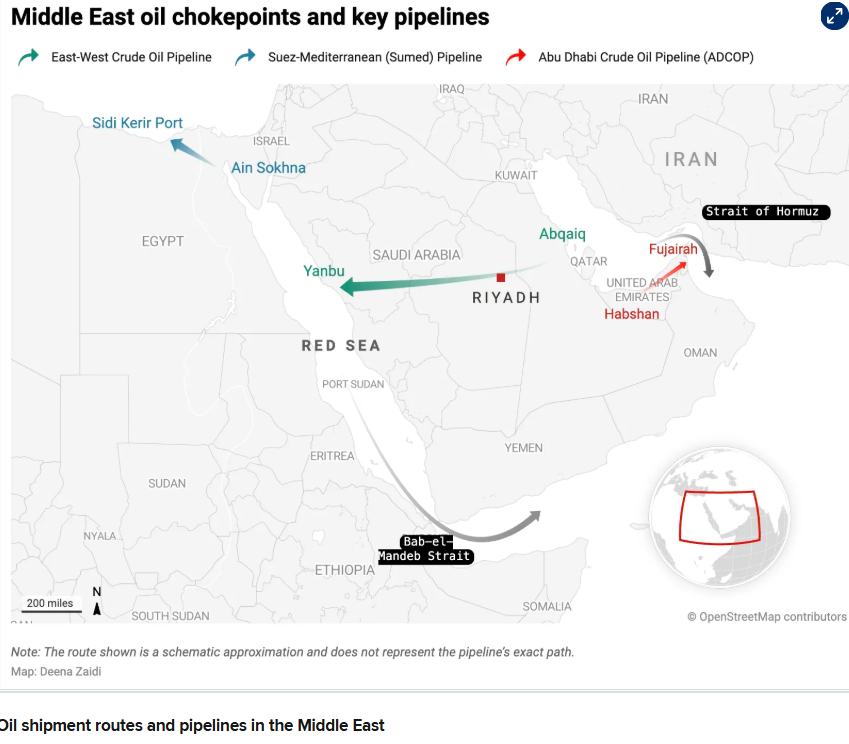
The Zhitong Finance App learned that since the Iran-backed Houthi armed group announced artillery attacks and maritime blockade measures against Saudi energy transportation, Riyadh has been seeking alternative export routes outside the Red Sea. As a result, Saudi Arabia has drastically increased oil export routes through an oil pipeline across Egypt to the Mediterranean region.
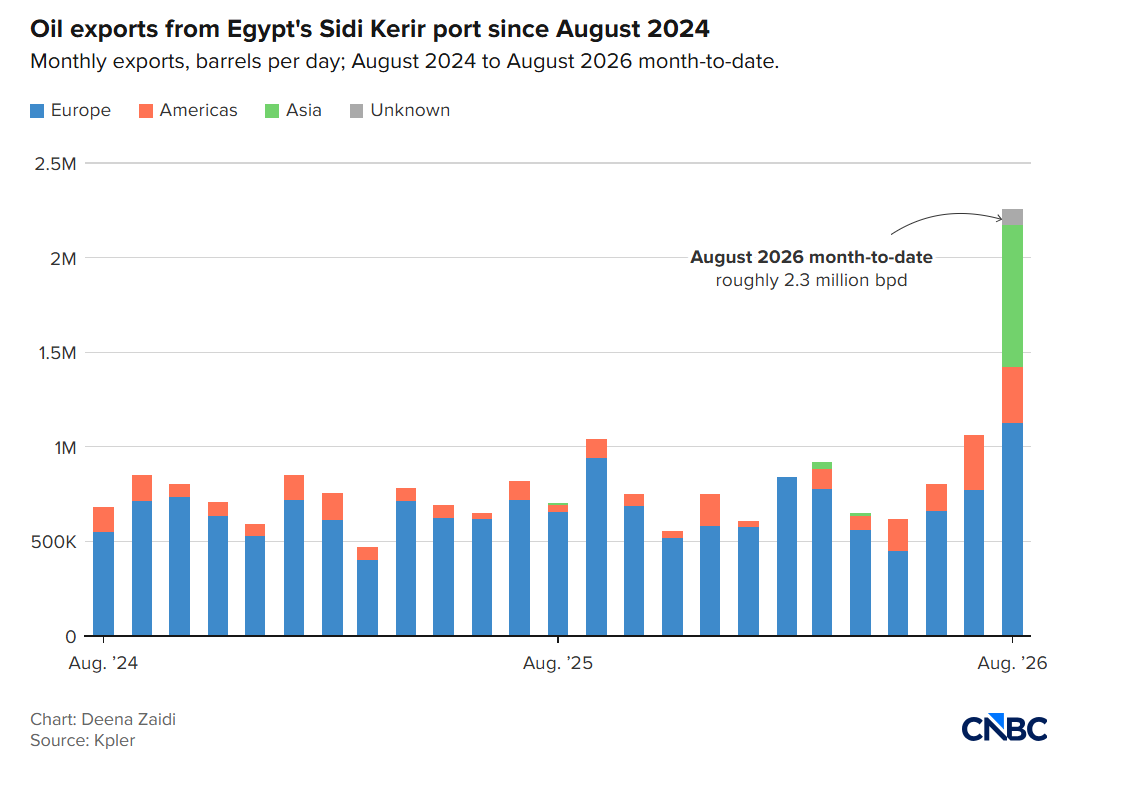
Saudi Arabia's drastic increase in exports to the Mediterranean via Egypt's SUMED pipeline Sidi Kerir (Sidi Kerir) is essentially not “increasing global crude oil supply,” but rather a strategic restructuring of export routes after the Strait of Hormuz was restricted and the Houthis threatened the Mander Strait. In August, the export volume of Sidi Kirill jumped from about 1 million b/d in July to about 2.3 million b/d, the vast majority of which was Saudi crude oil; Reuters independent shipping data showed that the port's loading volume reached a record of about 2.17 million b/d last week, and about 90% was Saudi crude oil.
This route can bypass Saudi crude oil at the southern end of the Red Sea, but the cost is that transportation distance, freight, insurance costs, and delivery times have risen markedly. In particular, if Asian buyers bypass the Cape of Good Hope, the flight range can be increased by an additional month. As a result, SUMED is more like an ultimate “safety valve” for the global energy transportation market, rather than additional production capacity that can eliminate supply risks in the short term.
The international oil price benchmark - Brent crude oil futures prices have accurately reflected the two-way game of “underpinning geographical supply risk and demand disrupting and suppressing the upper edge”. The price of Brent crude oil closed above $100 per barrel on July 23 due to the Houthi attack and the escalation of the US-Iran conflict, but as of August 13, it had fallen back to about 88.56 US dollars/barrel, and WTI crude oil was about 82.72 US dollars/barrel; in addition to deteriorating demand expectations, the unexpected surge in US crude oil inventories of 17.4 million barrels last week also created short-term pressure.
However, the supply side is far from returning to normal: negotiations between the US and Iran are still at an impasse, and shipping volume in the Strait of Hormuz is still far below pre-war levels; after announcing a maritime blockade against Saudi shipping on July 20, the Houthis also claimed to have attacked Saudi oil tankers, Yanbu (Yanbu) facilities, and the Jazan refinery, forcing more and more tankers to shut down AIS “dark flights,” and traffic in the Strait of Mande also dropped markedly. In other words, Saudi Arabia is facing a rare “double throat risk” where exports to the east of Hormuz are blocked and exports to the southwest of the Strait of Mander are threatened. It seems that Sumed exports can only mitigate but not completely replace these two global shipping channels.
The current high oil prices are not a healthy demand-driven supercycle, but rather a supply shock situation shaped by “transportation blockage+inventory consumption+war risk premium”; the surge in SUMED exports itself proves that the global oil logistics system is under pressure. Crude oil still has a strong upward tail risk in the short term, but once the geographical risk is actually lifted, the supply boom that may begin in 2027 will become the strongest force for oil prices to return to the mean.
Red Sea risks force a “major shift in the Mediterranean”! Saudi oil exports have been diverted to Sumed, and the oil market has entered a new high-cost normal of “circumventing the Red Sea”?
According to information, according to data provided by trade intelligence company Kpler, the volume of Saudi oil exported through the Egyptian Mediterranean port of Sidi Kerir in August has more than doubled from the previous month, from about 1 million barrels per day to about 2.3 million barrels per day. Matt Smith, head of commodity research at Kpler, said the vast majority of these are exports of crude oil produced from Saudi Arabia. “It's not a short-term decision,” Smith said. It's a clear shift in strategy or market dynamics.”
Sidi Kerir is connected to the Red Sea port of Ain Sokhna via an oil pipeline called Semed. Smith said that the overloaded supertankers are too deep to pass through the Suez Canal, so these tankers will pump half of the Saudi crude oil cargo into the pipeline in Ain Sokhna, then pass through the Suez Canal and reload this part of the crude oil in Sidi Keril.
As Iran and its allies continue to put pressure on the Strait of Hormuz, the Middle East's main oil transportation port, Saudi Arabia is under increasing pressure. Since this year, due to Iran's restrictions on shipping in the Strait of Hormuz, Riyadh has diverted millions of barrels of crude oil every day through an oil pipeline from eastern Saudi Arabia to Yanbu Port in the Red Sea.
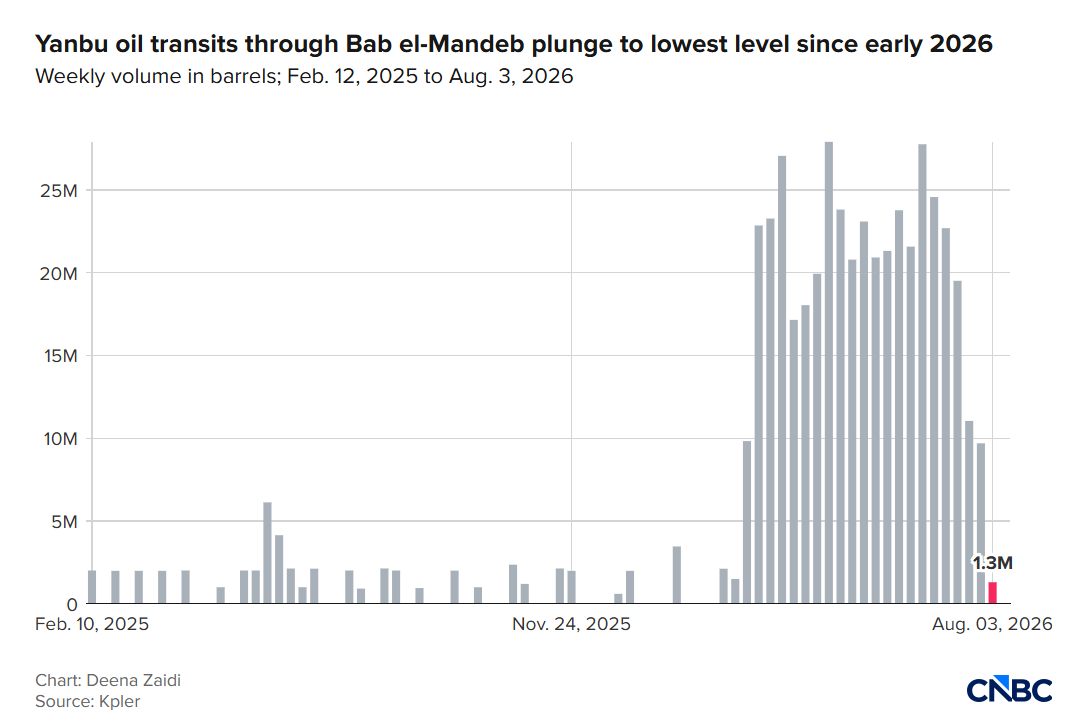
But now, the Houthis attack on Saudi oil tankers in the Red Sea is once again putting pressure on oil exports through the port of Yanbu and across the Mander Strait.
Smith said, “There's a huge transportation misalignment happening here. It's clear that the Saudi Arabian government is not taking this lightly, and they expect this to become a new trend.”
According to Kpler data, in the week ending August 3, Saudi crude oil exported via Yanbu Port and across the Mander Strait fell to 1.3 million barrels, down nearly 90% from 11 million barrels in the week ending July 20; July 20 was the time when the Houthis announced the blockade.
Tankers transporting Saudi crude oil in the Red Sea often shut down transponders to avoid Houthi attacks, so it is difficult to accurately grasp the flow of oil. However, Amin Nasser, CEO of Saudi Aramco (Aramco), an energy giant controlled by the Saudi government, made it clear earlier this month that Riyadh has alternatives to avoid the southern Red Sea and the Strait of Mande.
Nasser said during Saudi Aramco's August 4 earnings call: “As you know, we have a variety of options to enter the Mediterranean via the Sumed pipeline and the Suez Canal through multiple channels and alternative routes.”
However, for Asian customers that Saudi Arabia usually supplies, oil tankers must detour Africa, which is longer and more expensive. Nasser said in a conference call that compared to exiting via the Strait of Mander, this route would take about 25 more days.
Smith said most of the oil exported from Sidi Kirill is currently going to the US and Europe, rather than the energy demand regions of Asia. This seems to indicate that Asian customers are selling these goods because “it's not cost effective to get them all the way around Africa.”
“We're seeing a domino effect,” Smith said. Europe is getting more crude oil from Saudi Arabia, so maybe West African crude oil that originally went to Europe will now go to Asia instead.”
But redirecting Saudi oil flows through Egypt is unlikely to completely eliminate the risk of being attacked. On July 30, two liquefied natural gas carriers in the Egyptian port of Damietta were attacked by large drone swarms with no trace back to the source. So far, no party has claimed responsibility for these attacks.
Behind the IEA and OPEC demand differences, the oil market may usher in a major transformation of “tight first, then loose”
Saudi Arabia has now drastically increased exports to the Mediterranean via Egypt's SUMED oil pipeline, Sidi Kerir. Essentially, after the Strait of Hormuz was restricted and the Houthis threatened the Strait of Mande, they carried out a strategic restructuring of the export route, which is by no means an additional production capacity that can eliminate supply risks.
On the demand side, there was a huge difference between OPEC (OPEC) and IEA (International Energy Agency), which is extremely rare. OPEC recently revised its 2026 demand growth forecast for four consecutive months. Currently, it still expects global oil demand to increase by 580,000 b/d, but further raised the 2027 growth forecast to about 2.16 million to 2.2 million b/d; the IEA is far more pessimistic. It is expected that global demand will directly decrease by 1.6 million b/d in 2026, a further decrease of about 510,000 b/d from the previous month, but it is also expected that demand will rebound strongly in 2027 by 2.4 million b/d.
What really determines why oil prices are still high this year is that supply is falling faster than demand: the IEA expects global supply to drop by 4.3 million b/d to about 102 million b/d in 2026, the supply and demand gap of about 1.8 million b/d in the third quarter, and global observable stocks have been reduced by about 410 million barrels since the outbreak of the war. Therefore, even if the IEA believes that demand has been severely disrupted, the spot market is still a substantial shortage rather than a traditional bear market with declining demand.
The future crude oil price trajectory is more likely to show a very typical “2026 geo-risk bull market, followed by a pressure test of supply normalization in 2027”: in the short term, as long as Hormuz does not open steadily and the Houthis continues to threaten the Mander Strait, there will be a clear war risk premium below Brent crude oil, and any new tanker, port, or pipeline attack may quickly re-trade 95-100 US dollars or more.
However, if the US and Iran reach a credible agreement, the two major straits resume normal shipping, and the Middle East production quickly returns, then weak demand will immediately change from a minor conflict to a major one. The IEA expects global supply to rebound by an astonishing 8.3 million b/d to 100.3 million b/d in 2027, while demand will only increase by 2.4 million b/d. According to its current forecast, the market may once again experience a huge oversupply of about 4.6 million b/d.