
J.P. Morgan's Q2 holdings: increasing the AI hardware chain, Micron Technology (MU.US) and AMD (AMD.US) became the biggest buyers
The Zhitong Finance App learned that according to the US Securities and Exchange Commission (SEC) disclosure, JPMorgan Chase (JPM.US) announced the position report (13F) for the second quarter (Q2) ending June 30, 2026.
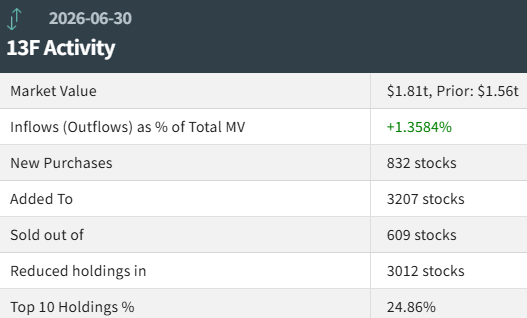
The total market value of J.P. Morgan's Q2 holdings was $1.81 trillion, compared to $1.56 trillion in the previous quarter, an increase of 16% over the previous quarter. J.P. Morgan Chase added 832 new targets to its Q2 portfolio, increased its holdings of 3,07 targets, reduced its holdings of 3012 targets, and cleared 609 targets; of these, the top ten holdings accounted for 24.86% of the total market value.
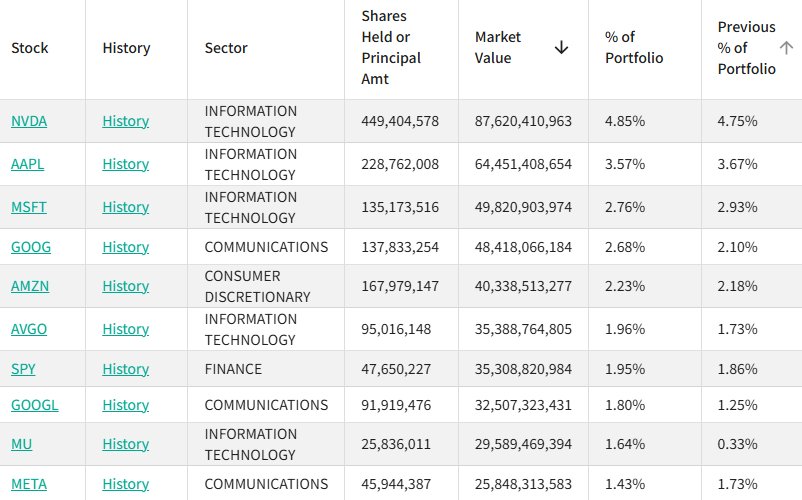
Among the top ten major stocks: Nvidia (NVDA.US) ranked first, holding 450 million shares with a market value of about US$87.62 billion, accounting for 4.85% of the portfolio (4.75% in the previous quarter).
Apple (AAPL.US) ranked second, holding 229 million shares with a market value of about US$64.451 billion, accounting for 3.57% of the portfolio (3.67% in the previous quarter).
Microsoft (MSFT.US) ranked third, holding 135 million shares with a market value of about US$49.821 billion, accounting for 2.76% of the portfolio (compared to 2.93% in the previous quarter).
Google-C (GOOG.US) ranked fourth, holding 138 million shares with a market value of about US$48.418 billion, accounting for 2.68% of the portfolio (2.10% in the previous quarter).
Amazon (AMZN.US) ranked fifth, holding 168 million shares with a market value of about US$40.339 billion, accounting for 2.23% of the portfolio (2.18% in the previous quarter).
Broadcom (AVGO.US), S&P 500 ETF (SPY.US), Google-A (GOOGL.US), Micron (MU.US), and Meta Platforms (META.US) ranked sixth to tenth.
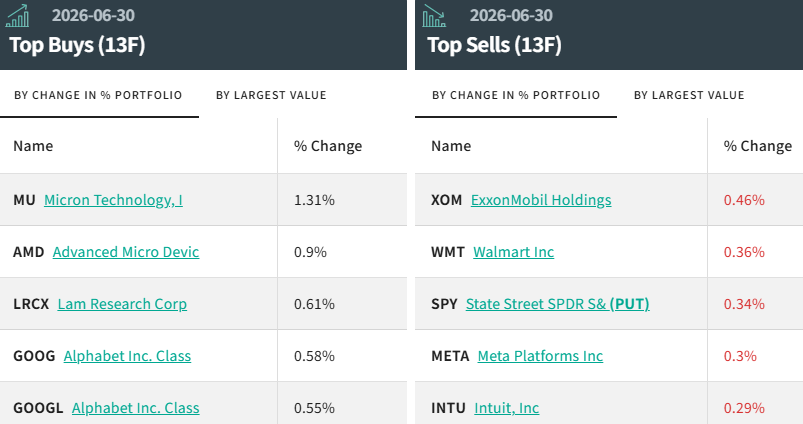
Judging from changes in position ratios, the top five buying targets are: Micron Technology (MU.US), AMD (AMD.US), Fanlin Group (LRCX.US), Google-C (GOOG.US), and Google-A (GOOGL.US).
The top five sales targets were: ExxonMobil (XOM.US), Walmart (WMT.US), S&P 500 ETF put options (SPY.US, PUT), Meta Platforms (META.US), and INTU.US (INTU.US).
J.P. Morgan Chase's position adjustments in the second quarter showed the following characteristics:
Add semiconductor and AI hardware chains
Micron Technology became the biggest target for increasing positions: the share of holdings rose sharply from 0.33% in the previous quarter to 1.64% (a sharp increase of 1.31 percentage points), directly jumping to 9th place in the top ten major stocks, showing strong optimism about the recovery of memory chips and the explosion in AI demand.
In addition to Nvidia's largest stock, which continues to rise to 4.85%, AMD and semiconductor equipment giant Fanlin Group also ranked in the top three in terms of purchase ratio.
Structural differentiation has occurred within tech giants
The share of Google C shares (GOOG) and Class A shares (GOOGL) holdings increased by 0.58% and 0.55% respectively, accounting for a total increase of more than 1.1%, both of which are among the top ten major stocks (ranked 4th and 8th). Among the top five reduction targets, Meta's holdings fell by 0.30%, which indicates that J.P. Morgan has clearly rotated positions among tech giants.
The weight of science and technology dominates absolutely
Among the top ten major stocks, with the exception of the S&P 500 ETF (SPY), the remaining 9 seats were all occupied by technology and communication service giants. The total share of the top five major stocks reached 16.09%, and they are very dependent on the fundamentals of technology stocks.
Defensive targets have been cut, risk appetite has rebounded
Energy giant ExxonMobil and must-choose consumer leader Walmart ranked in the top two sales ratios, reflecting the settlement of profits or the release of positions in the defensive sector.
S&P 500 put options (SPY PUT) ranked third in the holdings reduction list (down 0.34%), indicating that institutional demand for risk hedging on the US stock market has declined, and overall risk appetite has rebounded.