
Japanese Export Stocks Retail Investors Are Watching As The Weak Yen Lifts Margins
Japan’s latest producer price data hints at easing cost pressures for exporters, while the weak yen still keeps imported inputs expensive. That mix can reward or punish different Japanese industrial stocks in very different ways, and ignoring it risks missing opportunities that others spot first. This article breaks down three large export oriented manufacturers that appear especially exposed to this backdrop and explains how the current pricing trends could matter for each stock.
The three stocks below are just a starting sample, and the full screen surfaced 41 more Japanese export oriented industrial and manufacturing companies with equally compelling narratives that are not covered here. To identify and analyze the highest conviction ideas right now, head straight into the Japanese Export-Oriented Industrials and Manufacturers screener.
Renesas Electronics (TSE:6723)
Renesas Electronics is a major Japanese semiconductor company that supplies microcontrollers, processors, power devices, and connectivity chips into automotive and industrial/IoT end markets worldwide. Its revenue is split between the Automotive segment at about ¥682.1b and the Industrial, Infrastructure and IoT segment at roughly ¥785.6b, with only a small contribution from other activities. The company is large in scale, with a market cap of roughly ¥6.96t.
Renesas Electronics sits at the crossroads of two powerful themes that many investors care about today. It supplies key chips for electric and autonomous vehicles and industrial IoT, and is rolling out higher value products for AI and data center use. This comes at a time when Japan’s producer prices are easing and the weak yen supports export margins. At the same time, you are dealing with a stock that has seen a very large one off loss, a patent lawsuit in the U.S. and factory disruption from earthquakes, plus a management team with short tenure and high CEO pay. The mix of improving profitability, FX tailwinds and balance sheet and governance questions is exactly what makes this semiconductor stock worth a closer look.
Renesas Electronics sits where easing producer prices, a weak yen and AI heavy products intersect. Yet the real story may be how these forces meet its balance sheet and governance. Get the full picture in the Renesas Electronics financial health report

Build your own AI and automation shortlist around Renesas Electronics
Renesas Electronics and the two other stocks in this list all surfaced from a single Simply Wall St screen, but the real value comes from tailoring your own filters. Put our customisable Screener to work by combining valuation, growth, balance sheet and risk metrics, or jump straight into any of our curated Investing Ideas.
Mitsubishi Motors (TSE:7211)
Mitsubishi Motors designs, manufactures, and sells a broad range of vehicles, from EVs and hybrids to SUVs, pickups, and minicars, and also runs an auto focused financial services arm. The business is heavily skewed to Automobiles, which produced about ¥2.87t in revenue in the last period, while Financial Services contributed around ¥53.5b and unallocated items reduced the total. The stock sits in mid cap territory with a market value of roughly ¥464.1b.
Mitsubishi Motors is a classic Japanese exporter that now focuses on EVs and hybrids while working to improve margins from a very thin base. The company is rolling out new models, expanding in emerging markets and investing in EV production in Thailand. This is occurring at a time when a weaker yen and easing producer prices can help export profitability and offset past tariff and cost pressures. At the same time, earnings are sensitive to incentives, tariffs and high leverage, so the higher growth outlook and dividend guidance sit alongside balance sheet and execution risks that readers may want to assess more closely.
Mitsubishi Motors’ expansion into EVs and emerging markets may be obscuring a different story, reflected in its thin margins and leverage. See how the full export, EV, and balance sheet picture aligns in the 2 key rewards and 3 important warning signs (1 is major!)

Nissan Motor (TSE:7201)
Nissan Motor is a global auto manufacturer that designs and sells vehicles, parts, and electrified powertrains under the Nissan and Infiniti brands, supported by its in house sales financing arm. Most of its ¥11.1t in revenue comes from the Automobile segment, with Sales Financing contributing about ¥1.4t after inter segment eliminations, and the stock carries a market value of roughly ¥1.17t. This scale and integrated financing platform give Nissan meaningful reach across Japan, North America, Europe, Asia, and other overseas markets.
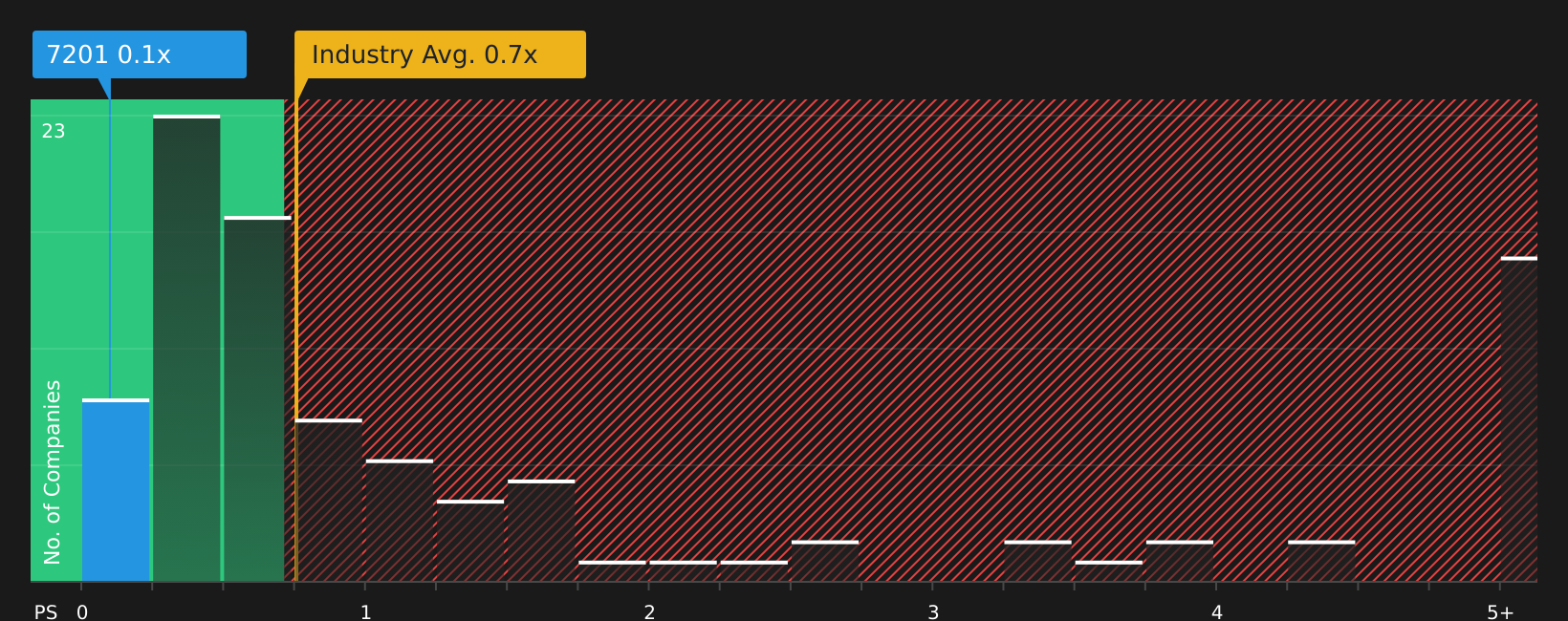
Nissan Motor sits at an interesting crossroads for this screener. The stock screens as heavily undervalued on sales and cash flow estimates, yet the business is still working through losses, weak cash flow cover for debt, and pressure in China. At the same time, management is pushing hard on cost cuts through the Re:Nissan program, shifting towards higher margin EVs and SUVs, and recently returned to quarterly profit with full year guidance reaffirmed around ¥13t of net sales. With Japan’s producer prices easing and a weak yen helping exports, the key question is whether this mix of value and early turnaround progress outweighs the currency, tariff, and governance risks that are still very much in play.
Nissan Motor’s combination of low valuation signals and early turnaround moves has many investors wondering what they are missing. Get the story behind that gap with the 3 key rewards and 1 important major warning sign
Seeking Alternatives Before The Crowd
Fresh stock ideas can move from quiet to flying once momentum builds. Use this window while it matters and before they get fully caught by the crowd, act now.
- Spot cash generative companies before they attract broad attention by scanning the curated 70 profitable AI stocks that aren't just burning cash that already fund their own growth instead of relying only on fresh capital.
- Target companies with staying power by reviewing the hand picked 52 resilient stocks with low risk scores that have historically paired measured risk profiles with business models built to handle pressure.
- Ride long term infrastructure momentum by checking the focused 36 power grid technology and infrastructure stocks featuring companies tied to ongoing upgrades in electricity networks and grid technology.
This article by Simply Wall St is general in nature. We provide commentary based on historical data and analyst forecasts only using an unbiased methodology and our articles are not intended to be financial advice. It does not constitute a recommendation to buy or sell any stock, and does not take account of your objectives, or your financial situation. We aim to bring you long-term focused analysis driven by fundamental data. Note that our analysis may not factor in the latest price-sensitive company announcements or qualitative material. Simply Wall St has no position in any stocks mentioned.
Have feedback on this article? Concerned about the content? Get in touch with us directly. Alternatively, email editorial-team@simplywallst.com