
Pool (POOL) Stock Looks Undervalued On Cash Flow Alone
Pool stock is caught between two different valuation messages. The Discounted Cash Flow (DCF) intrinsic value estimate points to meaningful upside from current levels, while traditional market multiples suggest the shares already trade at a premium and the broader valuation checks remain cautious.
- Pool shareholders have seen the stock fall about 55.0% over the past 5 years, which puts extra focus on whether the current price reflects a reset or lingering overvaluation.
- Future cash generation from Pool's pool equipment and supplies business can support the intrinsic value case, although any sustained pressure on demand or margins may challenge how quickly that value is realised.
- Pool screens as undervalued on only 2 of 6 valuation checks, which points to a stock that does not yet stand out as a clear bargain on the full set of metrics.
The issue now is whether Pool's current share price is closer to the optimistic intrinsic value estimate or to the more cautious signal coming from earnings multiples and the low value score.
Find out why Pool's -38.0% return over the last year is lagging behind its peers.
Is Pool a Bargain on Cash Flow?
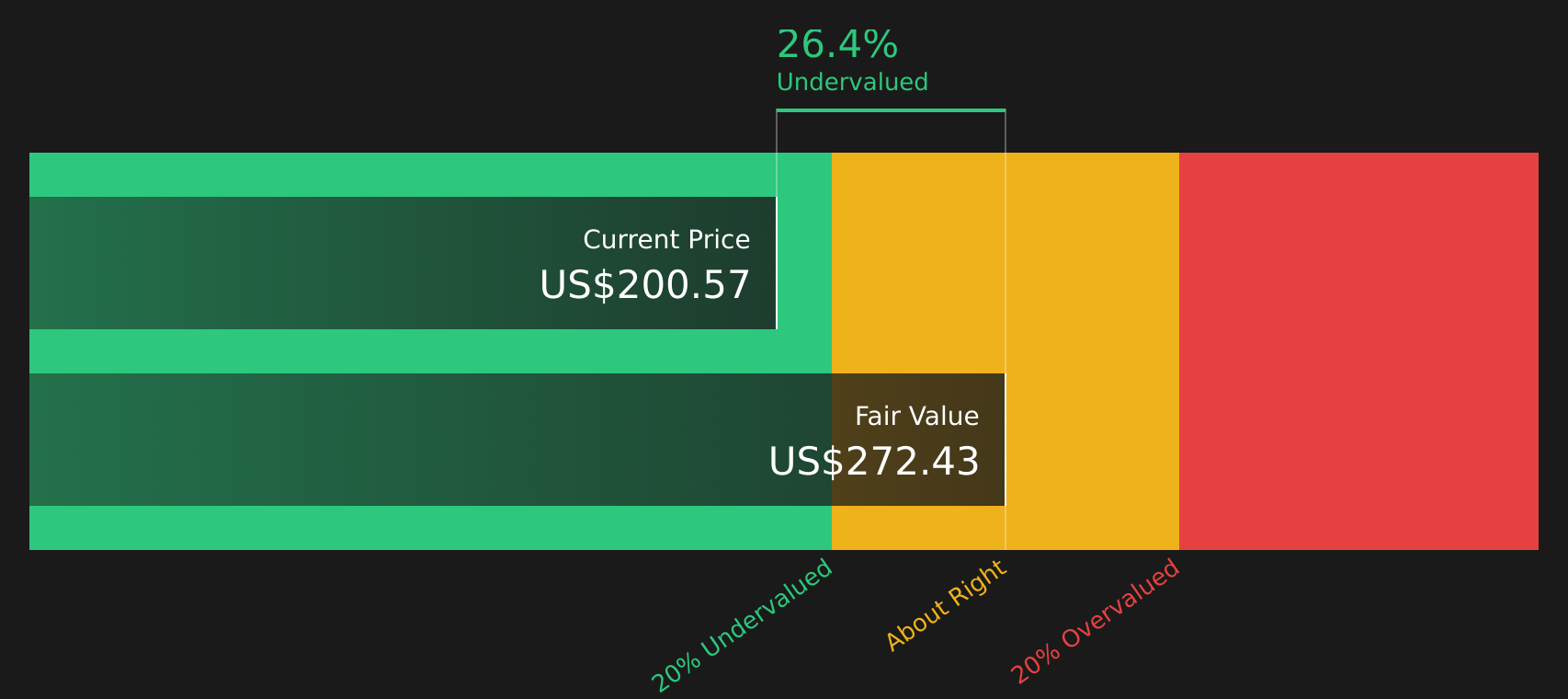
The Discounted Cash Flow model for Pool is built on expected future free cash flows owned by equity holders, brought back to today in dollar terms. Pool generated about $305.3 million of free cash flow over the latest twelve months, and the projections assume that cash flows continue to grow rather than contract over time.
On these assumptions, the model arrives at an intrinsic value of about $272 per share. Compared with the current market price, this implies the stock trades at a discount of roughly 26.8%. That difference indicates the market price does not fully reflect the cash flow profile currently built into the Discounted Cash Flow model for Pool.
On this cash flow view, Pool stock currently screens as undervalued relative to its estimated intrinsic value.
Our Discounted Cash Flow (DCF) analysis suggests Pool is undervalued by 26.8%. Track this in your watchlist or portfolio, or discover 49 more high quality undervalued stocks.
Has Pool Run Too Far on Earnings?
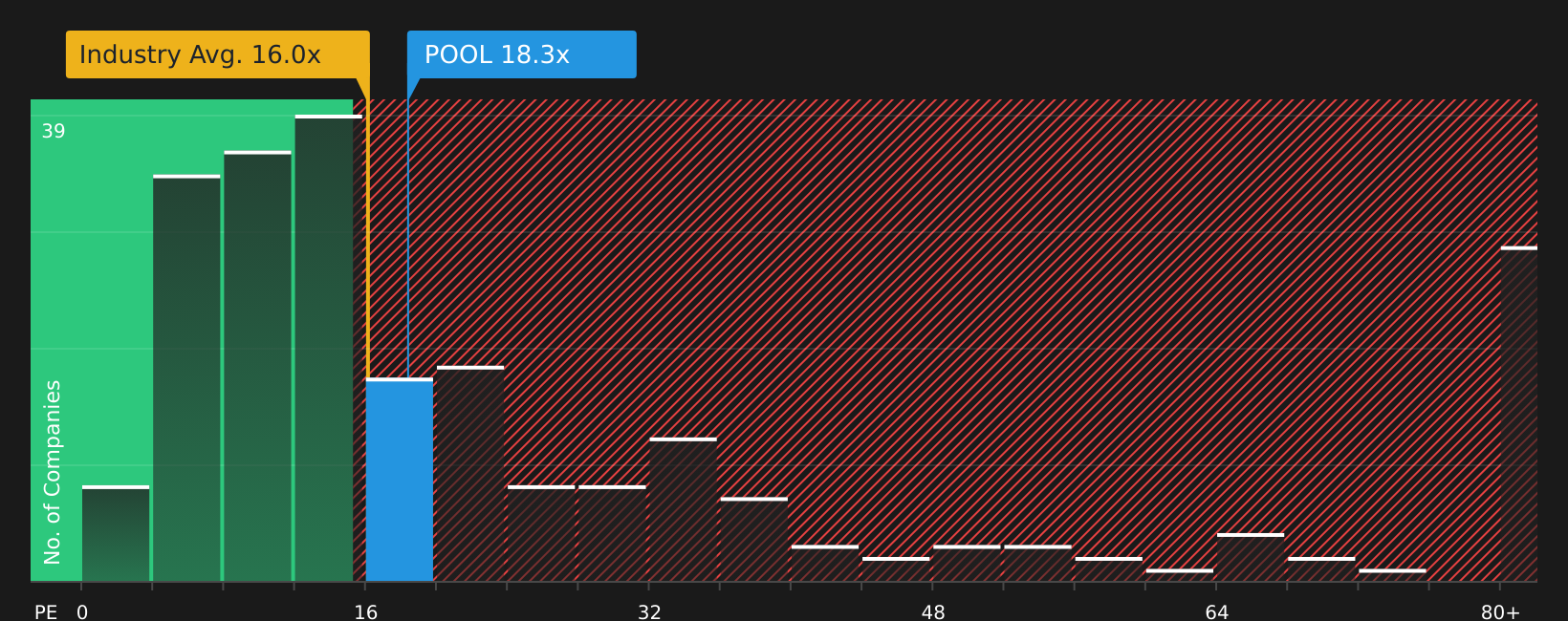
P/E is a good fit for Pool because earnings remain a key anchor for how investors judge mature, profitable distributors like this. On this measure, Pool trades on a P/E of about 18.2x, which sits above the Retail Distributors industry average of roughly 16.1x and also above the peer group average of about 13.5x.
The tailored fair P/E for Pool, which blends its growth profile, margins, size and risk, is estimated at about 14.9x. That is below the current 18.2x level. This gap suggests investors are paying a premium to what the model sees as a more balanced earnings-based valuation.
On the P/E multiple, Pool stock currently appears overvalued relative to both its fair ratio and sector peers.
See what the numbers say about this price — find out in our valuation breakdown.
The Pool Narrative: What Would Justify Today's Price?
Simply Wall St Narratives for Pool take the valuation tension between discounted cash flow and earnings multiples and turn it into clear, testable stories about Pool's future growth, margins and earnings. Instead of stopping at a single ratio or model output, they lay out the business conditions those numbers rely on so you can watch how Pool's actual progress compares with the assumptions set out on the Community page.
Community views on Pool are wide apart, with one side leaning on resilient maintenance demand and the other focused on margin and inventory risk.
Bull case: 34% undervalued
"Resilient maintenance demand, which represented about 64% of 2025 pool product sales, together with an installed base that grew by an estimated 60,000 new U.S. pools in 2025, supports a larger recurring revenue pool that can feed both top line and more stable earnings over time..."
Read the full Bull Case to see why Pool could be undervalued
Bear case: 8% overvalued
"BofA, which keeps an Underperform rating, lowered its Pool Corp. price target first to US$206 from US$226, then again to US$191 from US$206..."
Read the full Bear Case to see why Pool could be overvalued
Do you think there's more to the story for Pool? Head over to our Community to see what others are saying!
The Bottom Line
Pool sits in a grey zone where the Discounted Cash Flow (DCF) intrinsic value estimate points to upside, while the P/E based view still flags the stock as overvalued against peers. The low overall value score suggests that most traditional checks do not yet confirm a clear bargain despite the DCF discount. The gap largely reflects different views on how durable Pool's cash flows are versus what investors are currently willing to pay for its earnings stream. The crux from here is whether demand and margins hold up well enough for the intrinsic value case to win out rather than the current multiple proving too rich.
This article by Simply Wall St is general in nature. We provide commentary based on historical data and analyst forecasts only using an unbiased methodology and our articles are not intended to be financial advice. It does not constitute a recommendation to buy or sell any stock, and does not take account of your objectives, or your financial situation. We aim to bring you long-term focused analysis driven by fundamental data. Note that our analysis may not factor in the latest price-sensitive company announcements or qualitative material. Simply Wall St has no position in any stocks mentioned.
Have feedback on this article? Concerned about the content? Get in touch with us directly. Alternatively, email editorial-team@simplywallst.com