
Why doesn't the European AI market lose less than 10% of the weight of technology stocks
Although technology stocks are not heavily weighted in the European stock market, there is no shortage of winners in the field of artificial intelligence (AI), which is enough to make up for this shortcoming.
The Zhitong Finance App learned that the European version of the AI market is driving the Stoxx 600 Index to achieve an unexpectedly strong performance this year. Although the share of technology stocks in the index was only 9%, far lower than the 44% of the S&P 500 index, their growth kept pace with the latter. Considering that Europe is more sensitive to rising oil prices and a slowdown in economic and profit growth, this achievement is particularly remarkable.
A European AI enabler index compiled by Citigroup has risen 46% over the past year. Although not as high as the 60% increase of the US AI winner group, the volatility was significantly lower during the period. Semiconductors are certainly the main driving force, but Europe's focus is far more than just a few direct AI leaders. Its industrial sector is highly correlated with data center demand, and the widespread application of AI technology is expected to inject new momentum into the next stage of the AI market.
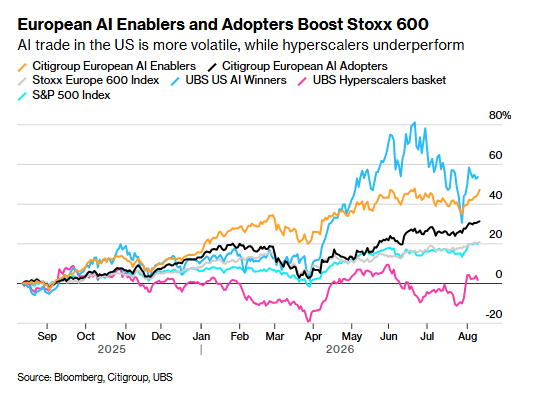
Citigroup strategist Beata Mantey's team stated, “Europe is still in the very early stages of the AI application cycle.” They believe industries such as industry, healthcare, IT, communications services, and finance will be the first to benefit. “So far, AI's increase in real GDP and labor productivity seems insignificant, but it has the potential to attract large-scale investment in the future to drive AI implementation.”
Industrial stocks account for one-fifth of the Stoxx 600 Index and are second only in weight to financial stocks. The recently concluded earnings season confirms that large European industrial companies have become important participants in the AI market. The performance in the power infrastructure sector was particularly outstanding — electrical equipment manufacturer Schneider Electric SE (Schneider Electric SE) and industrial automation supplier ABB Ltd., both revealed a three-digit increase in data center demand while raising performance guidelines.
Cable manufacturer Prysmian SpA (Prysmian SpA) has been benefiting from European and American electrification demand for a long time, and new winners are still emerging. Building materials company Kingspan Plc's stock price soared this week, after the company raised its performance outlook due to strong momentum in data center construction and mergers and acquisitions. Even software companies SAP (SAP.US), Capgemini SE (Capgemini SE), and advertising group Publicis Group SA (Publicis Group SA), which are seen as AI “losers,” have recently reported accelerated revenue growth related to AI demand.
Strong gains brought about by AI have made valuations of some industrial stocks unaffordable. Meanwhile, recent fluctuations in the semiconductor sector have made investors cautious about the most direct capital expenditure beneficiaries, and the market's risk pricing for future growth and profits is rising.
However, considering that the investment cycle is expected to peak in 2028, the valuation of some individual stocks is still attractive. Barclays Industrial analysts believe that selecting individual stocks will be the key to identifying investment targets.
After evaluating about 500 data center projects, the Barclays team selected Belimo Holding AG (Belimo Holding AG) and Alfa Laval AB (Alfa Laval AB) in the field of cooling systems, as well as Atlas Copco AB (Atlas Copco AB) and VAT Group AG for semiconductor-related needs, all of which gave them an “overrated” rating. Among the reasonably valued electrical companies, they mentioned Schneider Electric and Legrand SA (Legrand SA), while being cautious about power generation equipment suppliers Siemens Energy AG (Siemens Energy AG) and Wartsila OYJ Abp (Wartsila OYJ Abp), and gave them a “low performance” rating.
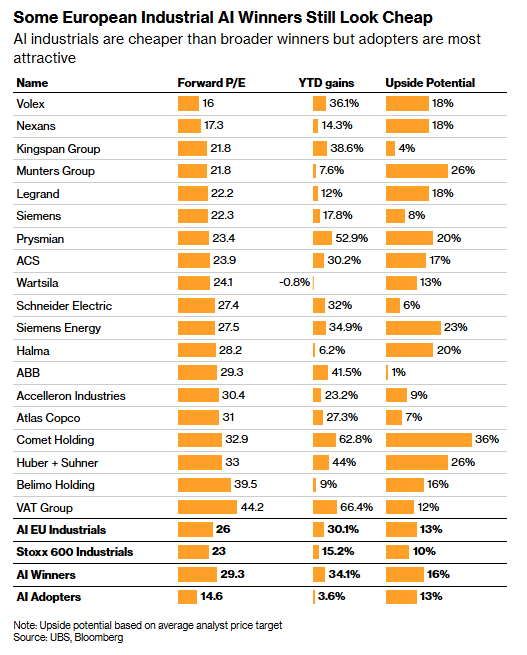
An analysis of the minutes of the earnings conference call shows that the benefits brought by AI are becoming more and more widespread. Barclays strategist Magesh Kumar Chandrasekaran's team said, “The quantifiable benefits of AI are spreading to multiple industries. Notably, quantifiable cost and efficiency improvements have become the focus of discussion, and there are more and more substantial comments on realized benefits.”
Europe is probably in a good position right now. The company's balance sheet is healthy, and the return on free cash flow is much higher than in the US. While S&P 500 companies are busy with capital expenditure rather than share buybacks, European peers have a good card — higher shareholder returns, fewer stock issuances, a more stable financial position, and AI-related risks far lower than semiconductor fluctuations or competition in China.
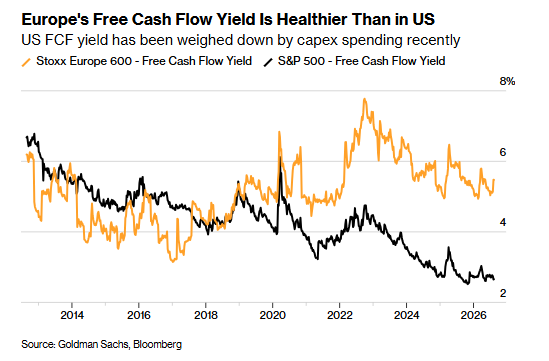
Goldman Sachs strategist Sharon Bell's team believes that although Europe clearly lags behind in the early stages of AI innovation, this is not necessarily a bad thing. Instead, Europe needs to ensure that it seizes the potential for productivity gains from AI, especially given the region's rapidly aging population structure. Europe's pace of data center deployment is slow, and future investment in energy infrastructure is needed to support AI development. This is expected to launch a “supercycle” for its utilities sector.
They said, “In the many waves of technology in history, pioneers and innovators are often overinvested, and in the end, it is companies that can use the results of the initial investment rather than the people who pay for it.”