
You have to pay even if it has nothing to do with AI! US tech giants have overflowed in debt, and CDS of stable companies such as luxury goods and pharmaceuticals rose more than 10%
The Zhitong Finance App notes that as the flood of US technology companies' debt issuance continues to spread in the credit market, the risk indicators of some of the world's most secure companies are being inadvertently boosted.
According to BNP Paribas strategists, these changes are a ripple effect of the intensification of the battle for cash in the top credit sector. As tech giants set off a multi-billion dollar borrowing frenzy, this competition is even driving up the cost of credit default swaps (CDS) for companies unrelated to data centers or artificial intelligence.
Although Bank France and Pakistan did not disclose the specific companies used in its analysis, the consolidated data shows that since the end of last year, interest spreads on default swaps for companies such as luxury goods giant LVMH (LVMH), pharmaceutical company Sanofi, and defense company British Aerospace Systems have risen by more than 10%.
Josh Faber, head of European credit strategy at BNP Paribas, said, “All high-quality credit entities are competing with hyperscale technology companies for capital,” and added that sovereign debt may eventually be affected.
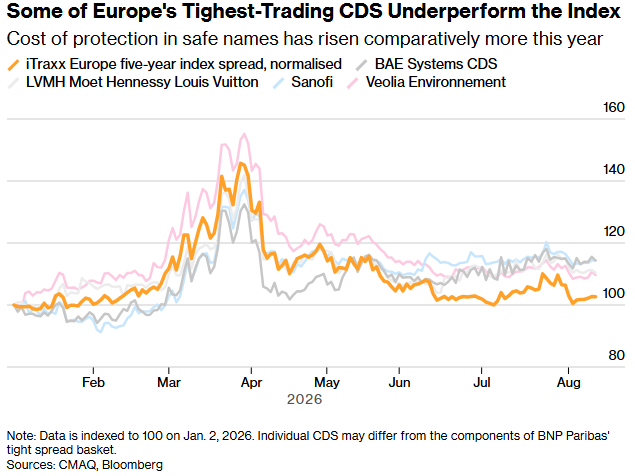
The CDS underperformance index with the narrowest spread in some parts of Europe
Faber's analysis of the iTraxx European High Rated Enterprise CDS Index shows that competition for investors' capital may be spawning a “super trend” — interest spreads of various entities converge towards the average value of the index. The bank recommended a two-pronged trading strategy to clients: buy a basket of low interest spreads and sell index default protection at the same time.
Looking at the risk premium of the CDS index alone, this trend is not intuitive — the index premium is currently approaching its narrowest level in 20 years. This is partly due to overcrowded transactions in the low-rated credit sector, which depresses the cost of default protection.
However, at the top of the corporate bond market, competition for investors' attention has become heated. Meta, Alphabet, and Amazon have issued tens of billions of dollars in bonds and other currencies this year to raise capital for AI business expansion. Among this group of large-scale technology companies, only Oracle's rating is lower than AA.
The CDS index covers a basket of constituent entities. Its transactions are independent of the underlying single borrower contract. It is one of the most liquid instruments in the credit market. It has tens of billions of dollars of swap transactions every day to hedge risks or express directional views.
Interest spreads converge to the average of the index, which means that when the market turns negative, the buffer space for these key risk indicators will be greatly compressed.
AI companies are among the top borrowers overnight
Although the Franco-Brazilian study focuses on the European CDS Index, Faber said that capital competition is a global phenomenon. Large-scale technology companies eager to expand rapidly on the AI circuit attacked on all sides to raise funds and became top borrowers in markets such as the UK, Japan, and Switzerland almost overnight.
For some market participants, the surge in debt supply from tech giants and its ripple effect on interest spreads may be the catalyst needed to break the current calm in the credit market.
Andrea Seminara, CEO of hedge fund Redhedge Asset Management, said, “Compared to the past few years, this is a real wake-up call for the credit market. Interest spreads in the market continue to narrow, and the state of no turbulence is unlikely to continue.”
According to the Bloomberg Index, interest spreads on global investment-grade corporate bonds are currently reported at about 80 basis points, which is only about 6 basis points higher than the post-financial crisis low hit earlier this year.
The corporate bond risk premium and the corresponding default protection cost are usually linked in the same direction; there is only an occasional difference in the magnitude of change. As capital competition pushes up the financing costs of global security companies, their CDS spreads will inevitably follow the upward trend.
Seminara said, “If interest spreads on new US corporate bonds widen, it may drive the entire investment-grade market to reprice.”
What needs to be clarified is that bankers who underwrite new hyperscale technology bonds to investors have taken steps to ensure the steady performance of bonds after entering the open market, such as avoiding fast money buyers such as hedge funds.
However, Wall Street analysts generally expect that technology companies will issue more bonds later this year or next year, which may put further pressure on their stock bonds, related CDS, and the overall market.
Farber said, “The broader question is, how should investors view this group of players with extremely narrow interest spreads?” “This has sobered up the market: taking the current level of risk is not worth much in return.”