
Here's Why I'm Not Buying SpaceX Stock Quite Yet
Key Points
SpaceX trades at a huge premium to its megacap peers and the broader market.
As the post-IPO lockup periods expire, large additions to the stock's float could result in messy supply-and-demand dynamics.
Patient investors knew to avoid Space Exploration Technologies (NASDAQ: SPCX) stock in the period shortly after the company's IPO, as it was expected that early demand for the shares would be high, then falter as the weeks dragged on. That thesis has proven correct, and the stock now trades below the price at which it opened its first trading session. But there are a handful of reasons why I'm not considering buying SpaceX stock yet.
Image source: The Motley Fool.
Missed Nvidia in 2009? This Rare Signal Is Flashing Again. In 2009, a "Double Down" signal flashed for a little-known chipmaker called Nvidia. For the first time in years, that same "Total Conviction" signal is flashing for a company 1/100th the size of Nvidia. Continue »
SpaceX is too expensive
On the surface, a price of $135 per share doesn't seem that expensive, but that's not the point. What really matters with any stock is its valuation. While investors don't have a full year's worth of SpaceX's public results to look at yet, we do have some estimates about how it will perform this year. The consensus among Wall Street analysts covering the company is that it will generate around $44.25 billion in revenue during 2026.
SpaceX isn't profitable, so the price-to-sales ratio is the best valuation measure investors can use to weigh the stock, and based on that revenue estimate, its forward price-to-sales ratio is 41. Most investors would call a stock trading at 41 times earnings expensive, let alone sales.
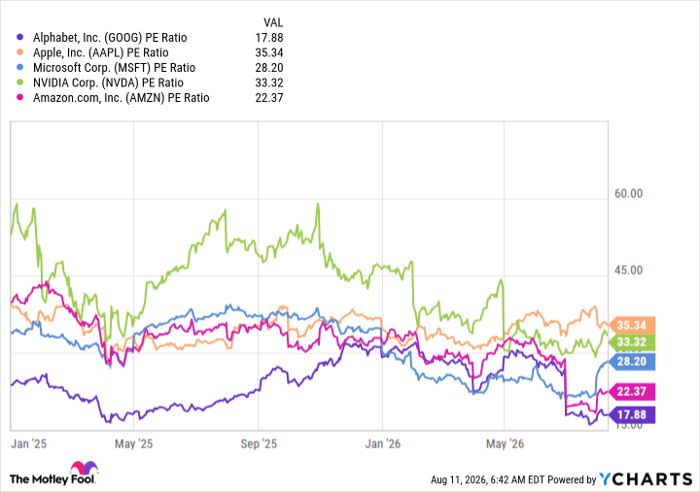
For reference, some of the largest companies in the world trade at far lower price-to-earnings ratios.
GOOG PE Ratio data by YCharts.
This shows how expensive SpaceX stock is, which is one of the reasons why I'm avoiding it for now.
Another reason is that the lockup periods preventing pre-IPO insiders from selling their shares will end in phases throughout the coming year. Those early shareholders will be permitted to sell ever-growing fractions of their holdings as a set of key dates pass. The last of those dates will come one year after the IPO, when CEO Elon Musk (the company's largest shareholder) will finally be allowed to start selling some of his own shares -- if he chooses.
In the meantime, the phased end of the lockup could mess with the supply-and-demand dynamic for the stock, as a growing float of available shares could meet lackluster demand and crater the stock price. Earlier this month, the first of the lockup periods ended and the stock price did not tank, so this issue may not have a big impact on the shares after all, but I still think it's a risk that investors should keep in mind.
Lastly, would-be SpaceX investors need to continue watching its results. It's relatively easy for a company's management team to do things that artificially boost its results for a quarter or two to keep the stock elevated, but keeping the numbers strong over a year requires a real business that's seeing strong success. I'm confident that SpaceX can do that, but I want to see proof of it before I buy.
So a year after SpaceX's IPO, I'll start to consider buying the stock. Until then, I think most investors would be better off watching it from the sidelines.
Keithen Drury has positions in Alphabet, Amazon, Microsoft, and Nvidia. The Motley Fool has positions in and recommends Alphabet, Amazon, Apple, Microsoft, and Nvidia. The Motley Fool has a disclosure policy.