
H&R Block Posted Strong Earnings and Boosted Its Dividend by Nearly 10%. What This Means for HRB Stock.
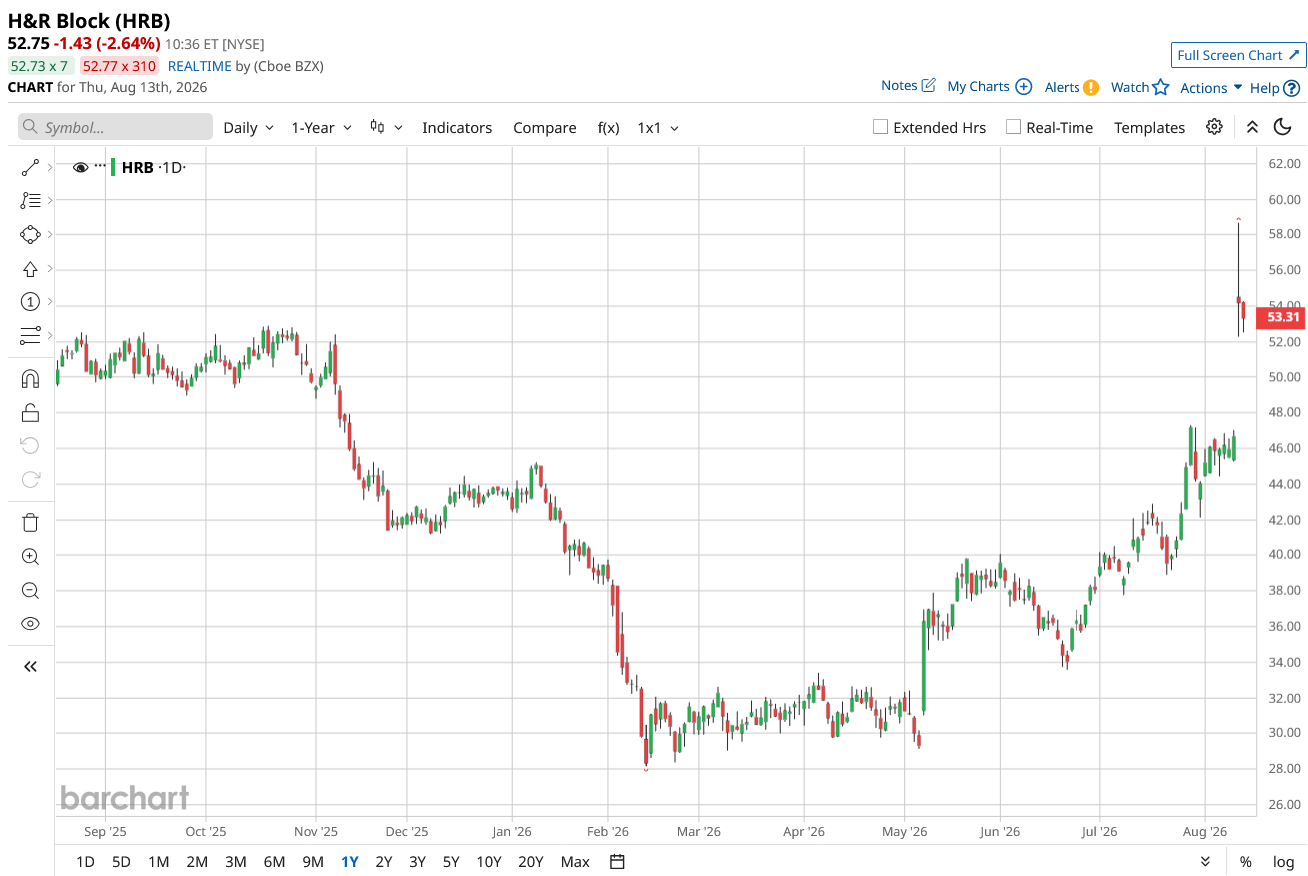
H&R Block (HRB) rose about 16% on Wednesday, Aug. 12, after reporting fiscal 2026 fourth-quarter results that beat Wall Street expectations. Adjusted EPS came in at $2.38, above the $2.21 consensus estimate, while revenue increased to $1.14 billion from $1.11 billion a year earlier. H&R Block also issued fiscal 2027 guidance that exceeded analysts’ expectations.
The company raised its quarterly dividend by 10% to $0.46 per share, extending its streak of annual dividend increases to nine years. H&R Block previously declared a $0.42 quarterly dividend in February 2026.
Since 2016, the company says it has raised its dividend by 110% and returned more than $5 billion to shareholders through dividends and stock buybacks. The rally also pushed H&R Block to a new 52-week high.
H&R Block has long been seen as a seasonal tax-preparation stock. But with its latest earnings, stronger guidance, and higher dividend, could the stock offer more than just a tax-season trade? Let’s find out.
A Closer Look at the Quarter
H&R Block makes money through its company-owned and franchised tax offices, do-it-yourself tax software, and its Wave platform for small businesses. The stock is up 8% over the past 52 weeks and 23% so far this year.
Despite that gain, H&R Block still trades at 8.12x forward earnings, about half the 16.22x average for the consumer discretionary sector.
H&R Block also raised its quarterly dividend by 10% to $0.46 per share. The dividend will be paid on Oct. 6 to shareholders of record on Sept. 3. It is the company’s ninth straight annual dividend increase and brings the annual payout to $1.84 per share.
Before the increase, H&R Block paid $0.42 each quarter, or $1.68 annually, for a 3.10% yield. That is above the sector average yield of 1.89%, while the forward payout ratio stands at 30.37%.
H&R Block finished fiscal 2026 on a strong note. Adjusted EPS came in at $2.38, beating estimates by $0.17, while Q4 revenue rose 3.1% to $1.145 billion. Full-year revenue increased 4.9% to $3.95 billion, adjusted EBITDA rose 8.3% to $1.06 billion, and adjusted EPS grew 13.9% to $5.31. Operating expenses rose 3.6% to about $3.0 billion, helping EBITDA margin improve by 80 basis points.
Net income from continuing operations climbed 20.8% to $736.3 million, though that included an $84.1 million one-time IRS tax benefit worth $0.65 per share. Adjusted net income, excluding that item, rose 6.9% to $688 million. H&R Block repurchased 10.5 million shares for $500.3 million and returned $713.7 million to shareholders.
It still has about $600 million available for further buybacks. For fiscal 2027, H&R Block expects revenue of $4.11 billion to $4.16 billion, adjusted EBITDA of $1.11 billion to $1.14 billion, and adjusted EPS of $6.04 to $6.24.
What Can Keep Growth Moving
H&R Block is using AI tools to help its tax professionals work faster and support clients more easily. Its Sidekick assistant, built with OpenAI, gives tax pros answers based on H&R Block’s Tax Institute information in two to three seconds during appointments.
Its AI Tax Assist tool has handled 6.45 million client messages since launching in 2023, with usage up 152%. During the 2026 tax season, clients sent 1.91 million messages, up 85% from a year earlier, and received answers in an average of 2.2 seconds. H&R Block also added the tool to its Desktop Software for the first time. CNET named the platform Best Overall Tax Service and Best Use of AI for 2026.
H&R Block is also buying back more franchises and turning them into company-owned offices. It completed 160 franchise buybacks in fiscal 2026, up from 124 a year earlier, spending about $58 million versus $36 million. The company expects to complete another 100 to 125 franchise acquisitions in fiscal 2027. These deals often happen when franchise owners do not have succession plans, allowing H&R Block to take over the offices and keep more of the revenue. Management expects this strategy to add about 1 percentage point to annual growth.
In Canada, H&R Block partnered with Affirm (AFRM) to let clients pay for professional tax services in interest-free installments. It is the first major Canadian tax-preparation provider to offer this option.
HRB Stock: Guidance and Analyst Views Ahead
H&R Block is set to report its September 2026-quarter results on Nov. 5. Analysts expect a loss of $1.28 per share, compared with a $1.20 loss in the same quarter last year. That would be a 6.67% year-over-year (YoY) decline.
For the fiscal year ending in June 2027, analysts expect H&R Block to earn $6.14 per share. That would be 15.63% higher than its fiscal 2026 adjusted EPS of $5.31. It also falls right at the middle of management’s $6.04 to $6.24 guidance range.
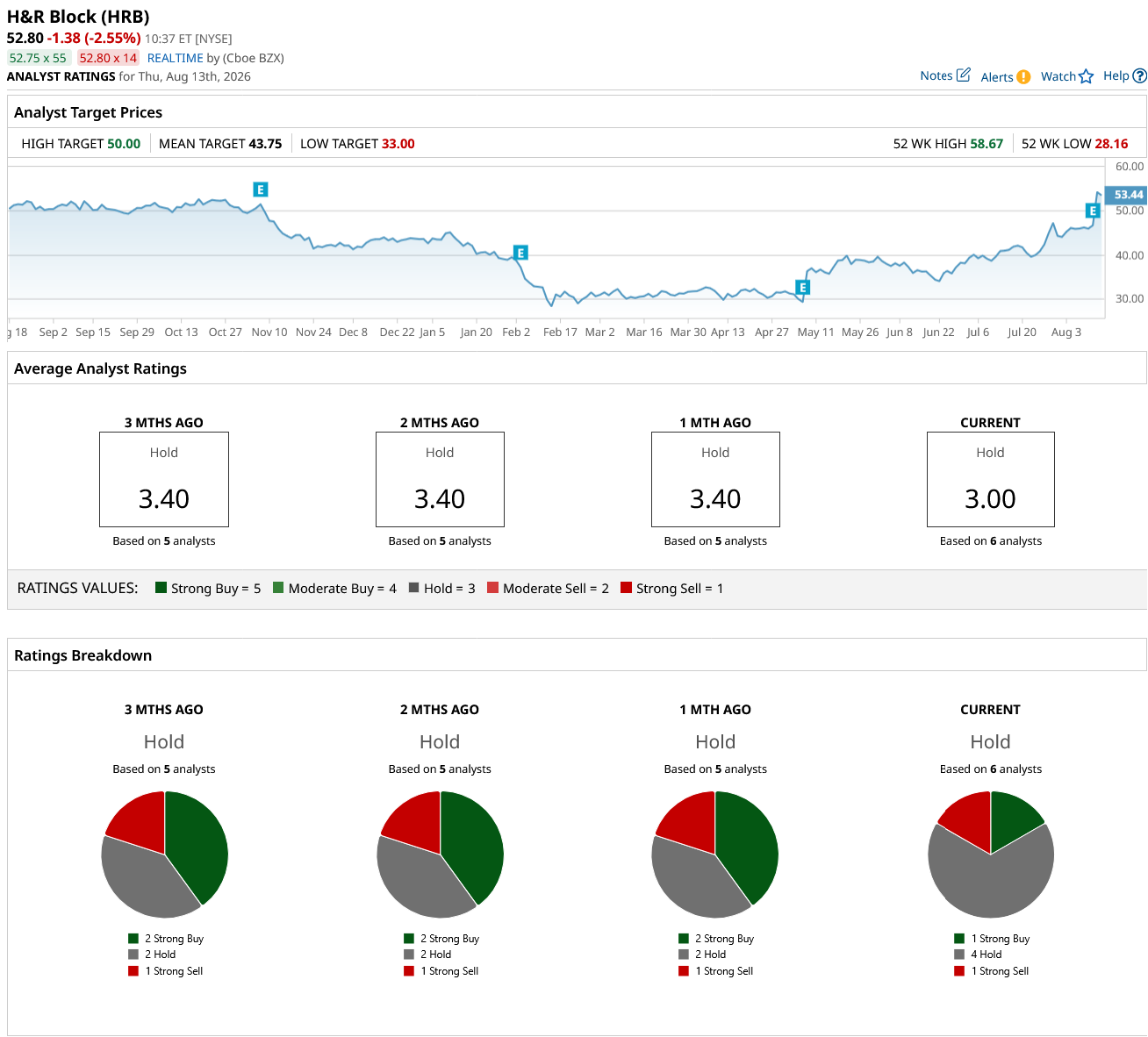
Wall Street remains divided on HRB stock. Barrington Research raised its price target to $60 from $50 and kept its “Outperform” rating, pointing to about 11.7% upside from the prior closing price. Goldman Sachs kept a “Sell” rating and a $33 target, while Stephens started coverage on July 28 with an “Equal Weight” rating and a $47 target.
Overall, the six analysts covering HRB stock rate it a consensus “Hold.” Their average target price is $43.75, which is 17% below the current share price of $52.80.
Conclusion
H&R Block’s earnings beat, stronger fiscal 2027 outlook, rising dividend, and continued buybacks make the investment case more compelling than it was before the report. The company is pairing steady tax-preparation demand with AI tools, franchise acquisitions, and disciplined capital returns, while its forward valuation remains modest. Still, the 16% post-earnings rally has pushed HRB above Wall Street’s average target, so near-term upside may be limited after the surge. Shares are most likely to consolidate near current levels, but sustained delivery on the $6.04 to $6.24 fiscal 2027 EPS outlook could support a further move higher over time.
On the date of publication, Ebube Jones did not have (either directly or indirectly) positions in any of the securities mentioned in this article. All information and data in this article is solely for informational purposes. For more information please view the Barchart Disclosure Policy here.