
Motivation for US stocks to continue to rise: S&P 500's profit margin hit a record record of 16.9%, not only did 80% of the industry's profit margins rise sharply due to “giants dancing alone”
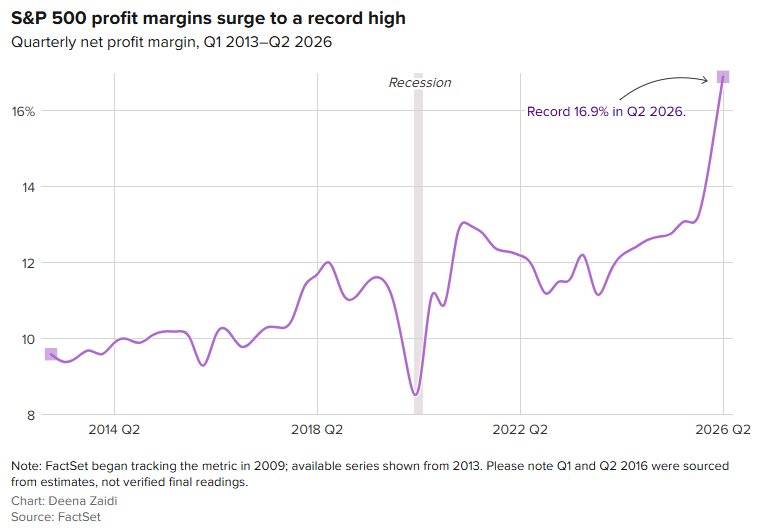
The Zhitong Finance App learned that the ratio of profit retained by S&P 500 companies per dollar of sales reached a record high, adding another positive trend to the rise in US stocks. Based on FactSet data, John Butts, senior profit analyst and vice president of FactSet, the mixed net profit margin of the S&P 500 index rose to 16.9% in the second quarter, significantly higher than 14.8% in the first quarter and 12.9% in the same period last year, and far above the five-year average of 12.4%.
The net profit margin measures the proportion of profit actually retained by an enterprise in each unit of revenue after deducting all expenses.
Butts pointed out that if 16.9% of the final data were confirmed, this would be FactSet's highest record since tracking this indicator in 2009.
Tech duos contributed the most, but the gains were not limited to giants alone
According to Butts, Alphabet (GOOGL.US) and Amazon (AMZN.US) are the biggest drivers of the S&P 500 index's record net profit margin.
Alphabet's second-quarter operating margin increased to 34% from 32% in the same period last year, while other revenue recorded $98 billion, mainly from unrealized gains from equity securities.
Amazon's other net revenue reached $53.4 billion, mainly due to changes in the valuation of its investment in Anthropic; its operating margin for the second quarter also rose to 13.7% from 11.4% in the same period last year.
However, the breadth of profit margin expansion extends far beyond these two super-capitalization stocks. Even excluding Alphabet and Amazon, the remaining S&P 500 shares still have impressive profit margins of 15% — also the highest in history since 2009.
The general rise in the sector: 80% of the industry's profit margins improved year-on-year
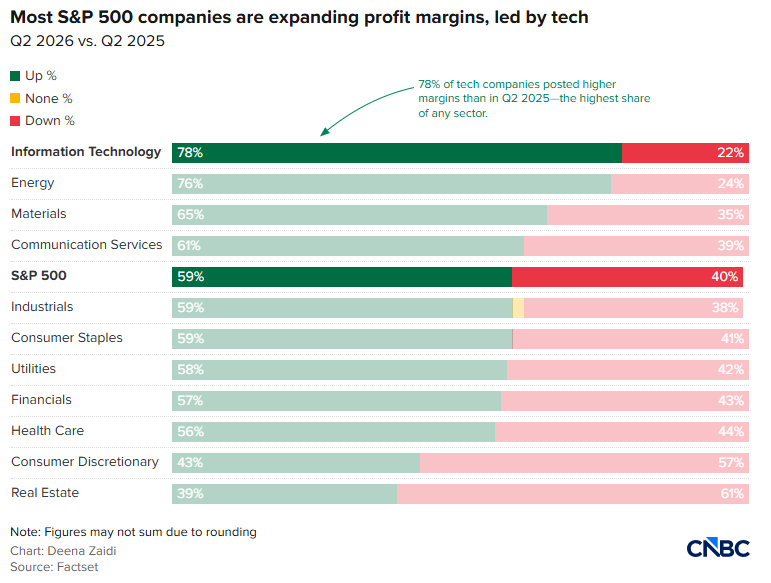
At the industry level, the improvement in profit margins has spread to most segments of the market. Eight of the top 11 industries in the S&P 500 had higher profit margins than the same period last year. Among them, the technology, communications services, non-essential consumption, and energy sectors registered the highest increases.
Adam Hicklin, a senior economist at Vanguard Group (Vanguard), said that strong demand and operating leverage effects help companies turn more revenue into profit. “Busy businesses tend to be more profitable,” Hicklin said. “Businesses operate more saturated and efficient, which naturally translates into higher profit margins.”
Hicklin pointed out that technology companies have historically benefited from a “low-cost expansion” business model — adding new customers or users does not require an equal increase in costs. “Technology companies' profit margins are naturally higher than in sectors such as materials, industry, and energy,” he said. “This is essentially an industry with high profit margins, especially because it is historically relatively light in assets and can expand in scale with extremely high efficiency.”
However, Hicklin also warned that the technology industry is currently facing intense competitive pressure, with a large influx of new entrants, which may pose a potential risk to future profit margins in this field.