
State Post Office: China's express delivery development index in July was 424.2, up 2.4% year-on-year
The Zhitong Finance App learned that on August 14, data from the State Post Office showed that according to estimates, China's express delivery development index for July 2026 was 424.2, an increase of 2.4% over the previous year. Among them, the development scale index, service quality index, and development capacity index were 603.5, 566.8, and 224.3, respectively, up 5.8%, 0.1%, and 1.6% from the previous year; the development trend index was 58.5. In July, the industry operated smoothly and in an orderly manner, the market size continued to expand, service quality and efficiency improved steadily, innovation momentum continued to accumulate, and comprehensive competitive strength increased markedly, strongly supporting the quality and expansion of consumption, and adding strength to economic and social development.
The full text is as follows:
July 2026 China Express Delivery Development Index Report
According to estimates, in July 2026, China's express delivery development index was 424.2, up 2.4% year on year. Among them, the development scale index, service quality index, and development capacity index were 603.5, 566.8, and 224.3, respectively, up 5.8%, 0.1%, and 1.6% from the previous year; the development trend index was 58.5. In July, the industry operated smoothly and in an orderly manner, the market size continued to expand, service quality and efficiency improved steadily, innovation momentum continued to accumulate, and comprehensive competitive strength increased markedly, strongly supporting the quality and expansion of consumption, and adding strength to economic and social development.
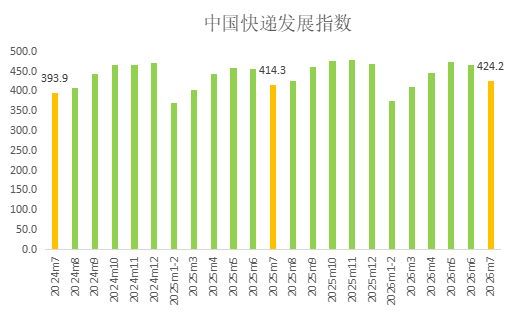
Figure 1 China Express Delivery Development Index from July 2024 to July 2026
In July, the development scale index was 603.5, up 5.8% year on year. Looking at the sub-indicators, express delivery business volume is expected to increase by about 4% year on year in July, and express delivery business revenue is expected to increase by about 8% year on year. In July, the industry continued to make efforts to segment sectors, continuously activate the growth momentum of domestic demand, keep abreast of special service scenarios such as trade-in, agricultural product growth, cultural tourism events, graduation mail, etc., and continue to sink service networks, unblock distribution channels, meet the diverse consumer needs of the market through customized and refined services, and drive the steady expansion of the market size. The average daily business volume is about 550 million units, creating a solid circulation guarantee to smooth the economic cycle and activate people's livelihood consumption.
In July, the service quality index was 566.8, a slight increase over the previous year. Judging from the sub-indicators, public satisfaction with express delivery services is expected to be 85.3 points, an increase of 0.1 points over the previous year. The 72-hour turnaround rate for key regions is expected to be 86.7%, an increase of 0.4 percentage points over the previous year. The industry is deeply involved in the real economy and strengthens emergency support service capabilities. The first is emergency protection to protect people's livelihood. In July, the typhoon triggered heavy rainfall in many places, increasing pressure for flood control and maintenance. Relying on flexible network scheduling capabilities, intelligent technical equipment, and mature emergency response experience, express delivery companies actively participate in flood control and disaster relief and post-disaster recovery, and the livelihood security value of delivery channels is fully highlighted. On the one hand, express delivery companies immediately initiated emergency response mechanisms to fully ensure the safety of operators and the integrity of shipments through measures such as pre-distribution of express shipments, adjustment of transportation routes, enhanced dynamic monitoring in transit, investigation of hidden vehicle network hazards, and installation of waterproof and damage prevention facilities; gave full play to the advantages of technical equipment such as unmanned warehouses, drones, unmanned vehicles, etc., quickly restored warehousing and distribution capabilities, and effectively met the surging demand for delivery services in key regions. On the other hand, express delivery companies actively participate in emergency rescue, urgently dispatch donated household items, carry rescue equipment such as assault boats and dinghies, etc., and open up “water, land and air” multi-dimensional delivery channels to ensure the rapid and accurate distribution and safe and efficient delivery of relief supplies. Second, delivery escorts to help agriculture develop industries. In July, express delivery companies accurately met agricultural product delivery needs and comprehensively upgraded the service guarantee system. Through the construction of fresh preservation facilities such as sorting warehouses, microwarehouses, mobile refrigerators, and mobile freezers, etc., seasonal products such as freshwater crab, matsutake mushrooms, and crispy plums can be quickly locked in, and the quality loss and quality of seasonal products such as freshwater crabs, matsutake mushrooms, and crispy plums has been built; a “water, land, air rail+low-altitude unmanned equipment” global three-dimensional logistics system has been built to effectively improve the timeliness and safety of fresh products. Focus on the export needs of agricultural products from Xinjiang, strengthen advance services, add temporary delivery points in production areas, provide standardized packaging to guarantee “first kilometer” delivery quality; actively connect with agricultural cooperatives, breeding bases and live e-commerce platforms to build a “origin enabling+channel matching+quality logistics” multi-party collaborative ecosystem to open up production and marketing barriers with customized supply chain solutions to help export high-quality products from Xinjiang to the whole country. The third is to enable manufacturing transformation and quality improvement. In July, express delivery companies collaborated deeply with characteristic industrial clusters, and relied on intelligent and integrated supply chain service capabilities to help upstream and downstream enterprises transform and upgrade. Set up an international network in Haining, Zhejiang to explore the “logistics+training+resource docking” integrated and innovative service model to enable home textile companies to expand the global market. In Xinhui, Guangdong, the government and enterprises jointly built a public supervision warehouse for tangerine peel. Relying on one item, one code, AI dynamic control, remote supervision, immediate collection and direct delivery terminals when leaving the warehouse, a full-chain traceable quality assurance system was built. Set up a global smart central warehouse for electronic products in the Greater Bay Area to automate the entire process through human-computer collaboration, greatly improving work efficiency. At the same time, by using energy-saving equipment, paperless operation, and environmentally friendly consumables, etc., it effectively reduces costs and carbon, and realizes two-way empowerment for quality improvement and green development. Express delivery companies are adopting precise policies based on industry needs, and empowering the high-quality and sustainable development of characteristic industries through digital logistics innovation.
In July, the development capacity index was 224.3, up 1.6% year on year. The infrastructure of the industry is constantly being improved, and the operating efficiency is steadily improving. The first is speeding up the expansion of facility construction. In July, express delivery companies accelerated the implementation and construction of projects such as the Urumqi Smart Logistics Park, Langfang Handling Center, and the Nanchong Warehouse Distribution Center, continuing to make up for infrastructure shortcomings and effectively improving distribution and transit efficiency. The second is the expansion of aviation network encryption. In July, the industry's own airlines launched a new “Chengdu-Yangon” freighter route. The framework of the air delivery network continues to be consolidated, further increasing its radiation capacity to Southeast Asia. The third is diversified expansion of transportation channels. In July, express delivery companies actively developed cross-border land transportation channels, opened international freight carts between China, Kazakhstan, China and Vietnam, improved flexibility in capacity scheduling, unblocked two-way material distribution channels between the Yangtze River Delta, Central Asia and ASEAN, and continued to enhance the stability and resilience of the cross-border supply chain. The “unmanned vehicle+subway” same-city distribution model was innovated and implemented in Shenzhen to revitalize idle rail transit capacity and promote the development of the urban distribution system in an intensive, efficient, and low-carbon direction.
In July, the development trend index was 58.5. The comprehensive capacity of the industry has been steadily expanded, service quality and efficiency in multiple scenarios have been improved, industrial chain collaboration has been advanced in depth, and emergency support capabilities have been enhanced comprehensively. Looking ahead to August, the industry is expected to continue its steady and positive development trend.
This article was selected from the WeChat account of the “State Post Office”; Zhitong Finance Editor: Huang Xiaodong.