
Amgen (AMGN) Stock Looks Below Fair Value As Caution Lingers
Amgen stock has delivered a strong 116.3% return over the past 5 years, while the current checks show a mixed picture and the Discounted Cash Flow (DCF) intrinsic value estimate still points to meaningful upside compared with the market price.
- Over 5 years, Amgen has returned 116.3%, which puts more focus on whether the recent share price now already reflects much of the long term opportunity.
- The planned Science and Innovation Center in Hyderabad can support expectations for future research productivity and cash flow. At the same time, the recent data breach and questions around Tavneos create uncertainty that may weigh on how investors price those future cash flows.
- Amgen scores 4 out of 6 on the valuation checks, which points to a mixed picture rather than a clear bargain or clear overvaluation.
The issue now is whether the current price around US$417.84 still leaves enough upside relative to the DCF based intrinsic value estimate to justify taking on the company specific risks that are back in focus.
Is Amgen a Bargain on Cash Flow?
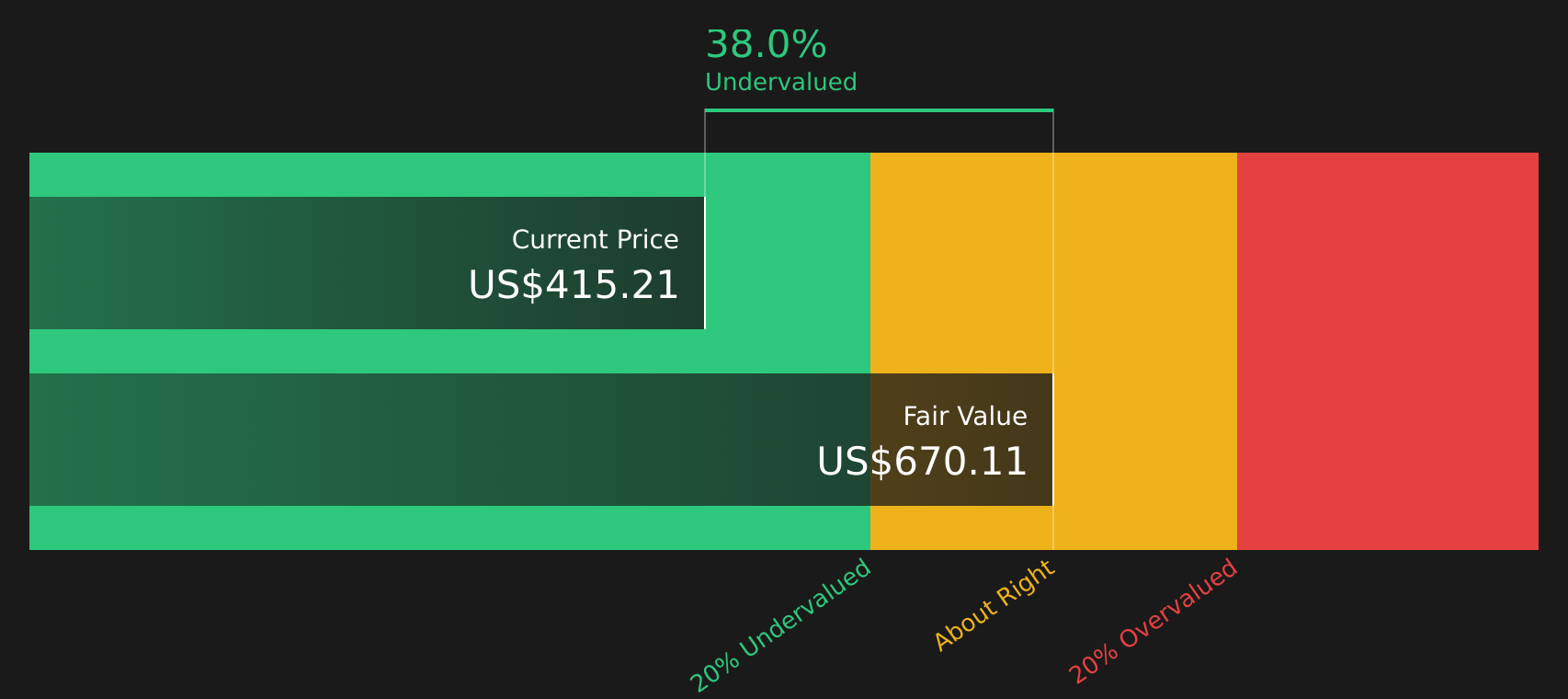
The Discounted Cash Flow (DCF) model values Amgen by projecting its future cash generation and discounting it back to today. Amgen currently produces last twelve month free cash flow of about $10.8b, and the model uses a pattern of growing cash flows to reflect a large, mature business that is still investing in its pipeline and facilities such as the planned Hyderabad Science and Innovation Center.
On this basis, the DCF model arrives at an estimated intrinsic value of about $668 per share, compared with the recent share price around $417.84. That implies the stock screens around 37.4% undervalued on these cash flow assumptions. The recent data breach and questions around Tavneos may help explain why the price sits below the DCF estimate, as investors weigh potential operational and regulatory risks against Amgen’s current cash generation.
Overall, the DCF work suggests Amgen stock appears undervalued relative to the cash flows implied in this model.
Our Discounted Cash Flow (DCF) analysis suggests Amgen is undervalued by 37.4%. Track this in your watchlist or portfolio, or discover 51 more high quality undervalued stocks.
Is Amgen Fairly Priced on Earnings?
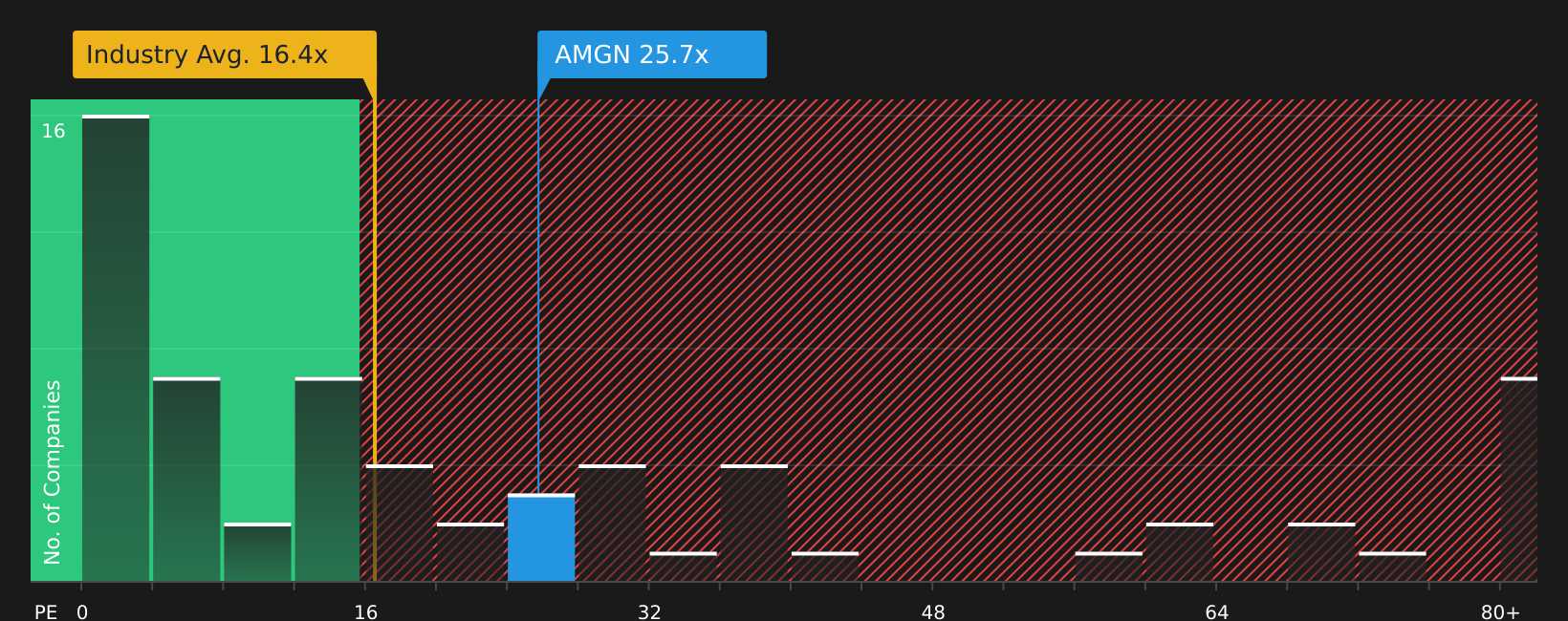
P/E is a useful cross check for Amgen because earnings remain a key focus for many investors in large, profitable biopharma companies. Amgen currently trades on a P/E of about 25.8x, compared with an average of 15.9x for the broader biotechs group and a peer average around 39.1x. That means the stock sits above the wider industry but below closer peers on earnings.
The Fair P/E Ratio for Amgen is estimated at about 26.0x, which reflects what investors might typically pay given the company’s size, margins and risk profile. The current 25.8x level is very close to this fair multiple, so the market pricing does not suggest a clear discount or premium on earnings alone. This is consistent with the mixed picture from other valuation checks, where Amgen does not come across as either an obvious bargain or an obviously stretched stock.
Taken together, Amgen appears roughly fairly valued on its P/E multiple at current levels.
See what the numbers say about this price — find out in our valuation breakdown.
The Amgen Narrative: What Would Justify Today's Price?
Simply Wall St Narratives pick up where Amgen's valuation puzzle leaves off. They spell out what would need to happen to Amgen’s future growth, margins and earnings for the stock to be worth much more or much less than today’s price, and they sit on Simply Wall St’s Community page. Each Narrative links a specific fair value to a particular set of catalysts and risks, so you can track which story about Amgen is actually unfolding over time.
The community is split on Amgen, with one camp leaning into its breadth and pipeline and the other focused on erosion risks and execution hurdles.
Bull case: roughly fairly valued
"Expanding product volumes and AI-driven R&D advancements position Amgen to exceed revenue and margin expectations through frequent, high-impact new launches across key therapeutic areas..."
Read the full Bull Case to see why Amgen could be undervalued
Bear case: 16% overvalued
"MariTide's commercial ramp-up will take years post-launch, while Amgen’s high-margin legacy moats (Prolia and Enbrel) are already eroding at a brutal -30%+ YoY clip right now..."
Read the full Bear Case to see why Amgen could be overvalued
Do you think there's more to the story for Amgen? Head over to our Community to see what others are saying!
The Bottom Line
For Amgen, the Discounted Cash Flow (DCF) work points to meaningful upside, while the P/E view suggests the stock is priced about right relative to peers. That split largely comes down to how much weight you place on Amgen’s future cash generation versus current sentiment and earnings expectations. The broader checks look mixed rather than strongly cheap, so the key question is whether current concerns around data security and products like Tavneos prove temporary issues or signal more persistent pressure on cash flows. That is the crux of whether today’s discount is an opportunity or a fair reflection of company specific risk.
This article by Simply Wall St is general in nature. We provide commentary based on historical data and analyst forecasts only using an unbiased methodology and our articles are not intended to be financial advice. It does not constitute a recommendation to buy or sell any stock, and does not take account of your objectives, or your financial situation. We aim to bring you long-term focused analysis driven by fundamental data. Note that our analysis may not factor in the latest price-sensitive company announcements or qualitative material. Simply Wall St has no position in any stocks mentioned.
Have feedback on this article? Concerned about the content? Get in touch with us directly. Alternatively, email editorial-team@simplywallst.com