
Damo Q2 holdings: increase AI hardware chains such as Micron Technology (MU.US) and reduce holdings of S&P and traditional industry targets
The Zhitong Finance App learned that according to the US Securities and Exchange Commission (SEC) disclosure, Morgan Stanley submitted a position report (13F) for the second quarter ending June 30, 2026. Overall, the changes in Damo's Q4 holdings showed the characteristics of “maintaining the main line of core technology, reducing exponential exposure, and strengthening active selection capabilities”.
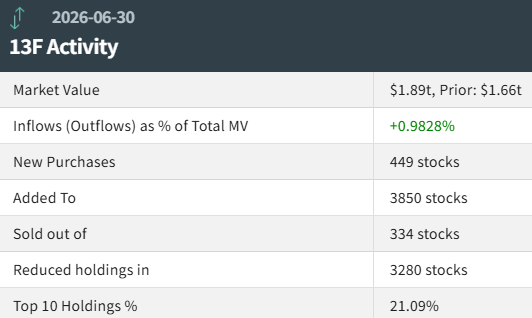
According to statistics, the total market value of Damo's holdings in the second quarter was 1.89 trillion US dollars, and the total market value of the previous quarter was 1.66 trillion US dollars, up 13.9% from the previous quarter. The fund added 449 new shares to its portfolio in the second quarter, increased its holdings by 3,850 shares, reduced its holdings by 3,280 shares, and cleared 334 stocks. Among them, the top ten holdings account for 21.09% of the total market value.
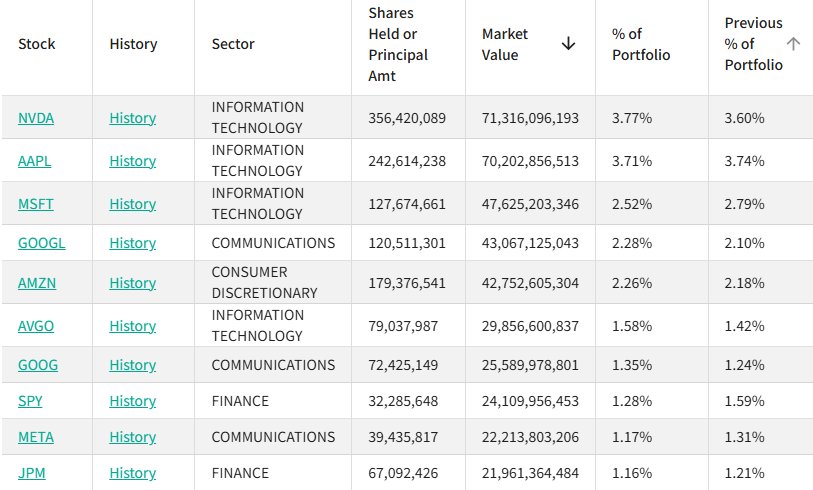
Among the top ten largest stocks: NVDA.US (NVDA.US) ranked first, holding 356 million shares with a market value of about US$71,316 billion, accounting for 3.77% of the portfolio (3.60% in the previous quarter).
Apple (AAPL.US) ranked second, holding 243 million shares with a market value of about US$70.203 billion, accounting for 3.71% of the portfolio (compared to 3.74% in the previous quarter).
Microsoft (MSFT.US) ranked third, holding 128 million shares with a market value of about US$47.625 billion, accounting for 2.52% of the portfolio (2.79% in the previous quarter).
Google-A (GOOGL.US) ranked fourth, holding 121 million shares with a market value of about US$43.067 billion, accounting for 2.28% of the portfolio (2.10% in the previous quarter).
Amazon (AMZN.US) ranked fifth, holding 179 million shares with a market value of about US$42.753 billion, accounting for 2.26% of the portfolio (2.18% in the previous quarter).
Broadcom (AVGO.US), Google-C (GOOG.US), S&P 500 ETF (SPY.US), Meta Platforms (META.US), and JPMorgan Chase (JPM.US) ranked sixth to tenth.
Judging from changes in position ratios, the top five buying targets are: Micron Technology (MU.US), AMD (AMD.US), Intel (INTC.US), Applied Materials (AMAT.US), and Fanlin Group (LRCX.US).
The top five sales targets are: S&P 500 ETF (SPY.US), SAFTSE (CRM.US), Russell 2000 ETF (IWM.US), Chevron (CVX.US), and Honeywell (HON.US).
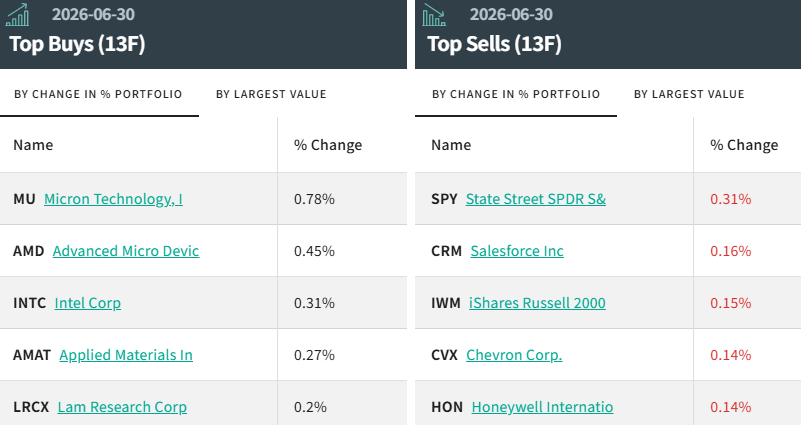
Morgan Stanley aggressively increased the semiconductor and AI hardware chain this quarter. Among the top five buyers to increase their holdings, all 5 seats were clearly semiconductor and chip upstream equipment giants. This shows that Damo is extremely optimistic about the explosion in demand for AI computing power, the recovery of the memory chip cycle, and the certainty of semiconductor infrastructure construction.
At the same time, Dama is also reducing its holdings in index ETFs, reducing macro-hedging and broad-based exposure. Among the top five sales targets, the S&P 500 ETF became the target with the biggest reduction in holdings, and the share of Russell 2000 ETFs representing small and medium capitalization stocks also fell by 0.15%. The reduction in exponential broad-based instruments reflects that Morgan Stanley is shifting from “indexed allocation/macro-hedging” to more targeted alpha opportunities in “structural high-certainty industries (such as semiconductors)” in terms of investment strategies.
Morgan Stanley's position adjustment logic in Q2 was very clear: “fully embrace chip/AI hardware and moderately shrink large-cap ETFs and traditional defense/software targets.” By extracting capital from broad-based indices and some traditional industries and concentrating on injecting it into the upstream semiconductor industry chain, it has shown a positive and focused aggressive attitude.