
Is “horror data” adding another spark to the AI bull market? US retail sales hit the biggest drop in more than a year, and expectations of interest rate hikes were hammered again
The Zhitong Finance App learned that the US retail sales data, which has the title of “horror data,” fell far short of market expectations, driving the financial market to drastically cool down expectations of the Federal Reserve's interest rate hike before the beginning of 2027, and the dovish Federal Reserve expectations brought about by “horror data,” adding fuel to the recent resurgence of the AI super bull market dominated by the global semiconductor counterattack market. The latest set of US economic data has clearly pushed the Federal Reserve's monetary policy balance from “the path of interest rate hikes must be restarted as soon as possible” to “the Fed continues to stand still (that is, keep interest rates unchanged)”. Instead, the Fed is no longer facing “overheating demand+re-acceleration of inflation,” but inflation is still above target, but it has cooled marginally, while consumption and employment have begun to lose momentum.
Retail sales in the US unexpectedly recorded the biggest drop in more than a year in July, highlighting the pace at which American consumers reduced consumer shopping expenses at online stores and car dealerships. According to data released by the US Census Bureau on Friday, the amount of retail purchases not adjusted for inflation fell 0.6% month-on-month, the biggest decline since May 2025. It fell below the market's unanimous expectations of a slight increase of 0.1% month-on-month, and a sharp drop from the previous value of 0.2%. Excluding automobiles and gasoline, retail sales statistics declined by 0.2%.
“Following strong consumer spending in the second quarter, retail sales declined in July, and in particular, the performance of the control group directly included in GDP was unexpectedly weak. This decline was compounded by a drop in spending during Amazon's Prime Day campaign in June, but restaurant sales — a key measure of non-essential consumer spending — remained stable.” Andrew Sacher, senior economist at Bloomberg Economics, said.
Since about 70% of US GDP is driven by consumer projects, retail sales data is an important guide for investors to judge the current state of the US economy and monetary policy prospects. The reason why this data is called “horror data” by the market is mainly because it is critical to macroeconomic expectations and the Fed's monetary policy path outlook, and can easily cause sharp fluctuations in financial markets, including the stock market, after publication.
American consumption suddenly “hit the brakes”! Soft landing deals face key stress tests
This US retail sales data report shows that after experiencing strong consumption in the first half of 2026, consumers temporarily slowed the pace of spending last month. However, some analysts also warned that this data may be affected to some extent by the early release of consumer spending, mainly because the US e-commerce and cloud computing giant Amazon (Amazon.com Inc.) moved the Prime Day promotion from July to June this year.
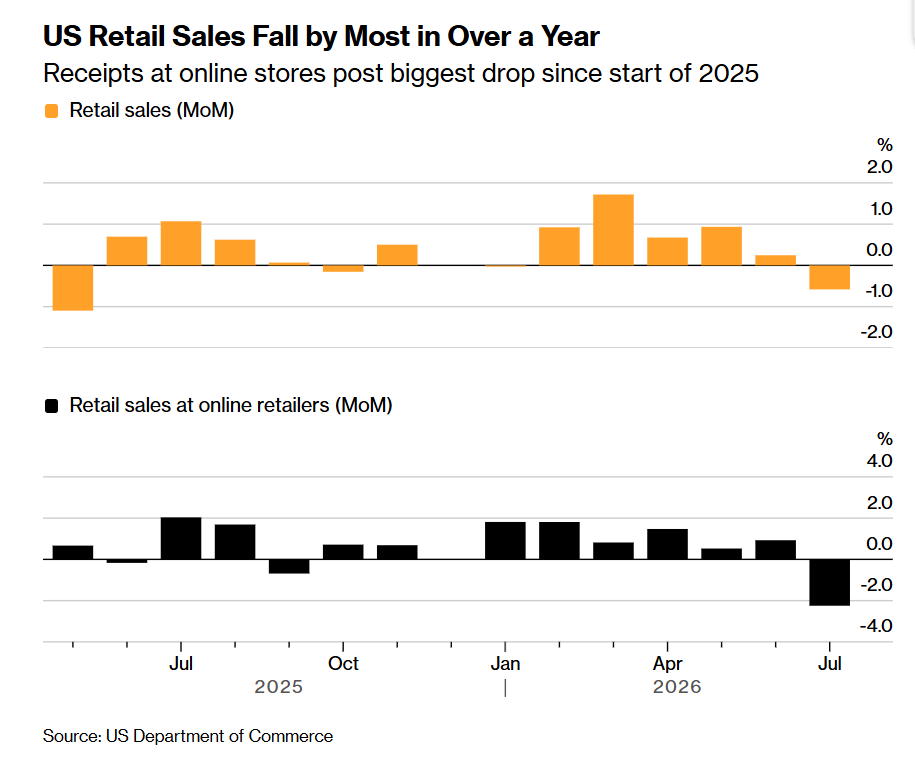
As shown in the chart above, retail sales in the US recorded the biggest drop in over a year — in particular, online store sales recorded the biggest drop since the beginning of 2025.
Of the 13 categories covered by the report, 5 experienced declines, led by a 2.2% drop in sales of non-physical retailers such as Amazon. Auto and parts dealer sales fell 1.8%. Meanwhile, restaurant and bar revenue grew 0.5%; this was the only service category in the retail sales report.
So-called “control-group sales (control-group sales)” — this indicator is included in the government's calculation of commodity consumption expenditure in gross domestic product (GDP) — fell 0.4%, the biggest drop since the beginning of 2025. This indicator excludes food services, car dealerships, building materials stores, and gas stations.
After large tax rebates boosted consumption at one time in early 2026, and the personal savings rate fell to a four-year low in June, economists are generally still cautious about future consumer spending prospects.
Independent bank card statistics from Bank of America and PNC Financial Services Group Inc. show that after Amazon Prime Day promotions and the World Cup jointly boosted sales in June, the overall consumer spending growth rate slowed in July. However, according to statistics from the Bank of America Research Institute, the overall financial situation of consumers appears to be stable. In particular, savings levels independently compiled by the agency are still higher than pre-pandemic levels, and the proportion of households that can fully repay their credit card bills is rising.
CPI+PPI+non-agricultural productive+retail sales can be described as attacking the hawkish stance of monetary policy with four arrows. Interest rate futures market pricing shows that the probability of the Fed's interest rate hike in September falls below 30%, falling sharply by more than 50% before the CPI data was released.
The latest data set has clearly pushed the policy balance from “interest rates must be raised again as soon as possible” to “the Federal Reserve is in a position to continue to wait.” Retail sales unexpectedly fell 0.6% month-on-month in July, not only far below market expectations of +0.1%, but control group sales, which is the closest to GDP consumption accounting, fell 0.4%, while the market originally expected a 0.3% increase; this combined with a decrease of 23,000 non-farm accidents in July, a 0.1% increase in CPI, a 0.2% increase in core CPI, and zero month-on-month growth in PPI. This combination of “cooling demand+weak employment+no second acceleration in inflation” has directly weakened the urgency of hawkish voting committees such as Cleveland Federal Reserve Chairman Beth Hammack (Beth Hammack) who recently voted against it called “interest rates must be raised now.”
About 5 minutes after the retail data was released, based on the pricing of federal funds futures, the probability of maintaining 3.50% to 3.75% in September rose to 70.4%, and the probability of a 25 bp rate hike was only 29.6%. A week ago, the latter still had more than 50% hawkish expectations; however, by December, the current probability of interest rates remaining unchanged was about 38.1%, and interest rate hikes were about 44.0% once, which means that the interest rate futures market is still very divided on interest rate hikes at least once during the year and remaining on hold throughout the year.
The latest retail data also makes what senior Goldman Sachs economist Matheus Dibo's prediction logic of “the Federal Reserve remains on hold for the whole year” more persuasive than a few days ago: the key now is not that inflation has returned to 2%, but whether previous supply shocks such as oil prices and tariffs have formed a real “second-round effect (second-round effects).”
Dibo believes that housing inflation has room to continue to decline, the labor market is not overheated, and that the wage-price spiral has not formed, so the Federal Reserve has time to wait for more data; the latest CPI/PPI just reinforces this judgment. What is more noteworthy is that this is not a completely isolated reverse view of Goldman Sachs — in a previous consultation and survey of economists conducted by Bloomberg Intelligence, the median forecast is still that the Federal Reserve will keep interest rates unchanged for the rest of 2026. In contrast, the three voting commissioners Hamak, Kashkari, and Logan advocated a rate hike of 25 bps in the July FOMC vote of 9-3, and they still believe that the policy is not sufficiently restrictive and should “act now.”
“Bad news” is fueling the AI bull market again! Retail sales hit the biggest decline in more than a year, expectations of the Fed's interest rate hike subsided sharply, and the global AI computing power theme began a new round of emptying?
As for the “AI super bull market” storm that recently started again in the stock market, this retail data has indeed added another spark, but it is mainly burning on the “valuation and liquidity” side, that is, the denominator side of the DCF valuation model rather than the numerator side profit index. This is not to say that these economic data prove that AI demand itself has suddenly become stronger, but rather that it is constructing the stock market's favorite “soft and unabated” neutral macro combination.
US economic data, such as inflation, non-agricultural, and retail data, is gradually driving what the market defines as the “valuation fuel” of the AI bull market. As long as consumption cools down and oil prices do not re-ignite inflation, the Federal Reserve remains on hold may be the most ideal macro environment for AI assets at present.
If the economy only declines from overheating to moderate growth, and there is no need for the Federal Reserve to further raise risk-free interest rates, then AI computing power infrastructure-themed stocks and the semiconductor sector, the discount rate and financing cost risk premiums will decline, and the AI CapEx expected trajectory (AI capital expenditure trajectory) of Hyperscalers (cloud computing giants), GPU/ASIC, HBM/DRAM/NAND, and the scale of data center optical interconnection infrastructure deployment will also be strongly driven by structured AI computing power investments. Therefore, the “soft and unabated” macro environment is a major positive catalyst for AI computing power infrastructure stocks and the semiconductor sector, which have had a major impact on global stock markets in recent years, second only to actual AI computing power demand.
The Philadelphia Semiconductor Index once plummeted nearly 29% from its historical high on June 22 to a low on July 29, but as of August 13, it had rebounded about 20% from its low, which meant that the round of sell-off that occurred in July was more and more like the “AI congested positions+extreme leveraged position liquidation storm”, and the strong fundamental profit trend in the AI computing power industry was reversed; the KOSPI benchmark stock index of the Korean stock market, which has a “AI computing power investment trend vane,” rebounded about 24.7% this week. At 11.5%, Samsung Electronics and SK Hynix achieved weekly gains of 19% and 16%, respectively, and foreign capital returned on a large scale in a single week.
In other words, a series of recent industrial chain data shows that the fundamentals of AI computing power have not collapsed and continue to be strengthened, the current market investment phase is increasing the “declining risk of the Federal Reserve's interest rate hike” as a valuation catalyst — increasing profits and easing interest rate pressure are beginning to have a double impact.
CPI, PPI, non-agricultural, and retail sales have jointly reduced the right-tail risk of interest rates. Strong profits in the semiconductor sector and strong computing power demand shown at the AI computing power industry chain level strengthened the fundamental base, so previously low position capital began to be forced to catch up again. However, it also explains why the current stock market is getting closer to “FOMO+ re-leveraging (re-leveraging)” surrounding the AI bull market, and is no longer a cheap reverse transaction. Citadel Securities statistics show that on August 4, the S&P 500 index's bullish options trading volume set a record, nearly double the average daily level of the past year, and about 10% higher than the previous record; from July 30 to August 5, it also recorded the largest five-day Call (call option) trading volume in history, and about 35% of the S&P 500 constituent stocks have already experienced a three-month Call Skew inversion — investors are actively paying premiums for the “risk of shorting.”