
Chiba Kogyo Bank (TSE:8337) Following New Guidance And Dividend Lift, Does Valuation Still Fit
Chiba Kogyo Bank (TSE:8337) drew investor attention after issuing new earnings guidance alongside first quarter results and a higher dividend forecast, including a planned doubling of the year end dividend for ordinary shares.
See our latest analysis for Chiba Kogyo Bank.
At a share price of ¥2,815.0, Chiba Kogyo Bank has seen strong momentum this year, with a 62.34% year to date share price return and a very large 5 year total shareholder return. Recent gains, including a 25.33% 90 day share price return and 80.88% 1 year total shareholder return, suggest investors are reacting to the updated earnings guidance and dividend outlook as a meaningful shift in the risk and reward profile.
If this kind of rerating catches your interest, it can be useful to see what else is moving in related areas of the market. Take a look at the 11 top founder-led companies
Chiba Kogyo Bank now trades well above some intrinsic value estimates, yet the earnings and dividend guidance paint a different picture. Where does fair value truly sit in that spread, and what does today’s price imply?
Price-to-Earnings of 19.1x: Is it justified?
Chiba Kogyo Bank currently trades on a P/E of 19.1x, which sits above several valuation markers and may reflect how the market is weighing its recent guidance.
The P/E ratio compares the current share price to earnings per share and is often used for banks because earnings are a key focus for equity holders. A higher P/E can suggest investors are willing to pay more for each unit of earnings, while a lower P/E can indicate more modest expectations.
For Chiba Kogyo Bank, there are a few moving parts behind that 19.1x figure. Earnings have grown 11.6% per year over the past 5 years, with 15.1% earnings growth over the most recent year. Earnings are also described as high quality. At the same time, return on equity sits at 5.2%, which is considered low. Current net profit margins of 13.1% are slightly below last year’s 13.4%, and the bank has a low 17% allowance for bad loans.
Compared to peers, the premium stands out. Chiba Kogyo Bank is described as expensive relative to the peer average P/E of 16.2x and also expensive versus the broader JP Banks industry average P/E of 15.4x. That places the stock on a materially higher multiple than many domestic banking peers, which suggests the market is assigning a richer price for its current earnings profile than the sector overall.
See what the numbers say about this price — find out in our valuation breakdown.
Result: Price-to-Earnings of 19.1x (OVERVALUED)
However, Chiba Kogyo Bank still faces risks if earnings quality weakens or credit conditions change, which could challenge current valuation and dividend expectations.
Find out about the key risks to this Chiba Kogyo Bank narrative.
Another View On Chiba Kogyo Bank’s Value
The P/E discussion paints Chiba Kogyo Bank as expensive, and the SWS DCF model points in the same direction. At a share price of ¥2,815, the stock trades above an estimated future cash flow value of ¥2,061.53. If both earnings and cash flow views lean rich, what factors could change that story over time?
Look into how the SWS DCF model arrives at its fair value.
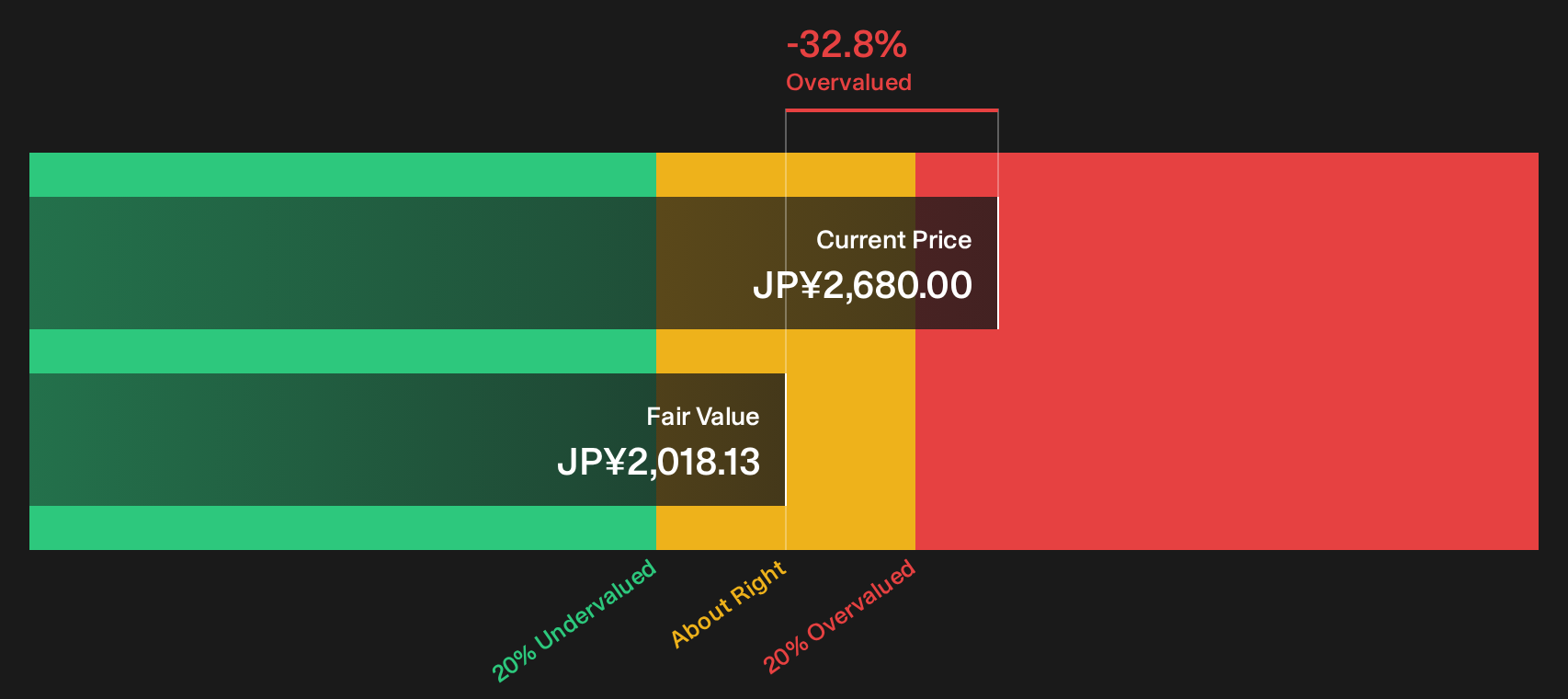
Simply Wall St performs a discounted cash flow (DCF) on every stock in the world every day (check out Chiba Kogyo Bank for example). We show the entire calculation in full. You can track the result in your watchlist or portfolio and be alerted when this changes, or use our stock screener to discover 26 high quality undervalued stocks. If you save a screener we even alert you when new companies match - so you never miss a potential opportunity.
Next Steps
With both risks and rewards in focus for Chiba Kogyo Bank, now is the moment to review the facts for yourself and decide how the balance stacks up in your view by checking the 1 key reward and 1 important warning sign.
Looking for more investment ideas beyond Chiba Kogyo Bank?
If you are serious about building a stronger portfolio, now is the time to widen your watchlist with other focused ideas before the next move happens.
- Spot potential growth stories early and scan through 1 elite penny stocks with strong financials that already show stronger balance sheets and earnings profiles than many investors expect from this corner of the market.
- Zero in on quality at a sensible price by reviewing the 26 high quality undervalued stocks, which filters for companies pairing sturdy fundamentals with prices that may not fully reflect them yet.
- Strengthen your income stream and check the 33 dividend fortresses to see which higher yielding stocks also back those payouts with resilient financials.
This article by Simply Wall St is general in nature. We provide commentary based on historical data and analyst forecasts only using an unbiased methodology and our articles are not intended to be financial advice. It does not constitute a recommendation to buy or sell any stock, and does not take account of your objectives, or your financial situation. We aim to bring you long-term focused analysis driven by fundamental data. Note that our analysis may not factor in the latest price-sensitive company announcements or qualitative material. Simply Wall St has no position in any stocks mentioned.
Have feedback on this article? Concerned about the content? Get in touch with us directly. Alternatively, email editorial-team@simplywallst.com