
Is Viasat (VSAT) A Bargain On Reaffirmed 2027 Growth Guidance?
Viasat (VSAT) has drawn fresh attention after reporting first quarter 2026 results on 4 August and reaffirming its fiscal 2027 earnings guidance, including an outlook for mid single digit revenue growth.
See our latest analysis for Viasat.
Viasat's reaffirmed 2027 guidance comes after a strong run in the stock, with the share price up 120.22% year to date and a 1 year total shareholder return of 205.79%, which suggests momentum has been building over both shorter and longer periods.
If Viasat's recent move has you rethinking satellite and connectivity themes, this can be a good moment to widen your radar with 55 AI infrastructure stocks
After a rapid share price move, Viasat now sits at the crossroads of ongoing losses and reaffirmed mid single digit revenue growth guidance. Does that balance of risk and potential reward still look appealing at this level?
Most Popular Narrative: 14.6% Undervalued
Viasat's most followed narrative pegs fair value at $97.04 per share, above the last close at $82.87, which puts the current rally in a different light.
The focus on operational efficiency, portfolio review, and progressing integration with Inmarsat, in addition to CapEx peaking with the ViaSat-3 program, sets up Viasat for positive free cash flow inflection, deleveraging, and earnings improvement as major investment cycles wind down. Rising government and commercial interest in bridging the digital divide, especially in underserved and remote areas, provides a multi-year tailwind through subsidy programs and public/private contracts, supporting stable, recurring revenue streams and margin visibility.
Want to see what sits behind that $97.04 fair value for Viasat? The narrative leans heavily on specific revenue growth, margin expansion and capital intensity assumptions. Curious which of those inputs really does the heavy lifting in the model? The full story is in the detailed forecasts and the discount rate that turns them into today’s value.
Result: Fair Value of $97.04 (UNDERVALUED)
Have a read of the narrative in full and understand what's behind the forecasts.
However, the Viasat narrative still hinges on heavy capital spending and rising competition, either of which could pressure cash flow and challenge those fair value assumptions.
Find out about the key risks to this Viasat narrative.
Another View on Viasat: Market Pricing Signals
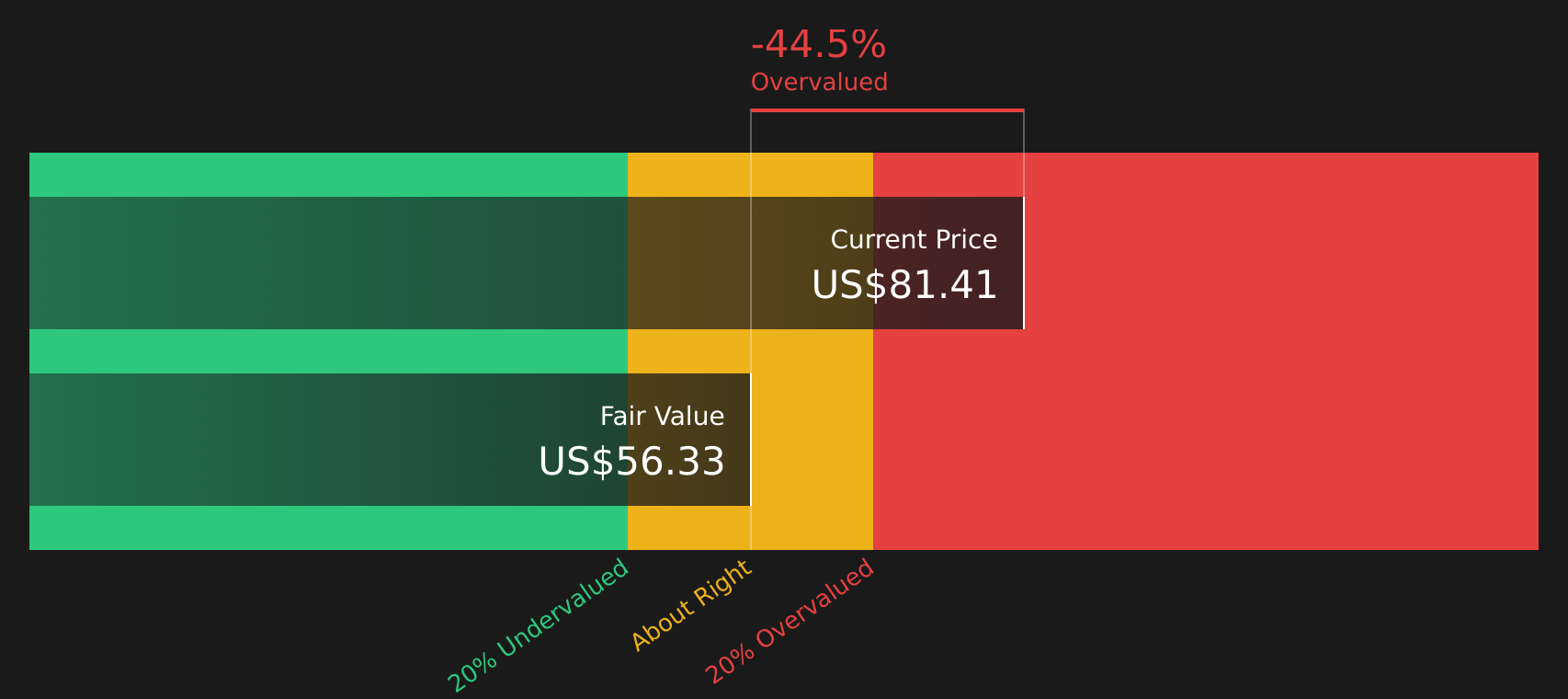
The analyst narrative suggests Viasat is 14.6% undervalued at $97.04 per share, but the SWS DCF model points a different way. On that measure, Viasat at $82.87 is above an estimated future cash flow value of $56.33, which frames the stock as overvalued. Which lens do you trust more for a cash hungry satellite business?
Look into how the SWS DCF model arrives at its fair value.
Next Steps
With sentiment clearly mixed on Viasat, this is a moment to move quickly and review the details that matter most to you, starting with 4 important warning signs
Looking for more investment ideas beyond Viasat?
If the Viasat story has your attention, do not stop with one stock. Use targeted screens to quickly surface other ideas that match what you are really after.
- Zero in on potential mispricings and shortlist companies with quality fundamentals using 52 high quality undervalued stocks
- Strengthen your watchlist with businesses that carry lower overall risk profiles by scanning through 80 resilient stocks with low risk scores
- Broaden your opportunity set with underfollowed companies that still show solid financial traits via the screener containing 20 high quality undiscovered gems
This article by Simply Wall St is general in nature. We provide commentary based on historical data and analyst forecasts only using an unbiased methodology and our articles are not intended to be financial advice. It does not constitute a recommendation to buy or sell any stock, and does not take account of your objectives, or your financial situation. We aim to bring you long-term focused analysis driven by fundamental data. Note that our analysis may not factor in the latest price-sensitive company announcements or qualitative material. Simply Wall St has no position in any stocks mentioned.
Have feedback on this article? Concerned about the content? Get in touch with us directly. Alternatively, email editorial-team@simplywallst.com