
Why are tech stocks “cheaper as they rise”? With 80% profit jumps to support valuations, AI expectations will instantly become expensive if they fail
The Zhitong Finance App noticed that bear markets usually have to use a hammer ball to smash stock prices to shreds in order to make stocks cheaper. However, tech stocks have found another path.
At the low in July of this year, the forward price-earnings ratio of technology stocks (that is, the price investors pay for expected returns) fell by about 30% from a year ago. This decline occurred during the bursting of the internet bubble and the financial crisis.
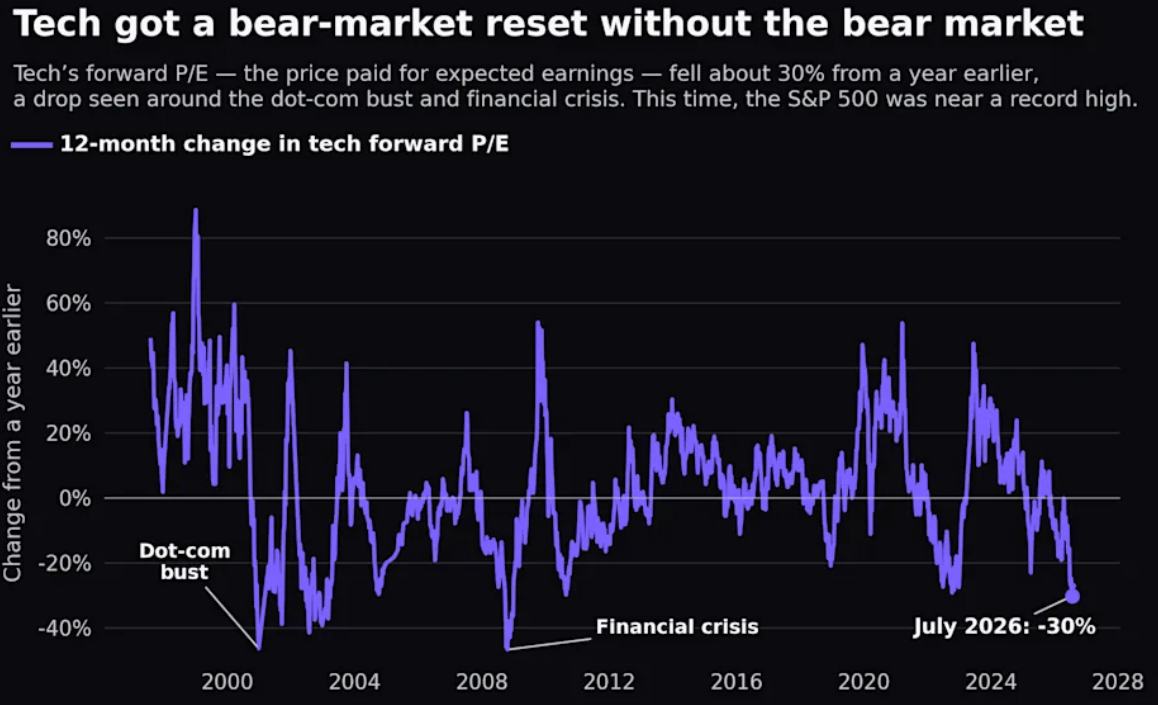
But this time around, the S&P 500 index is close to an all-time high. This timing made the situation even more bizarre.
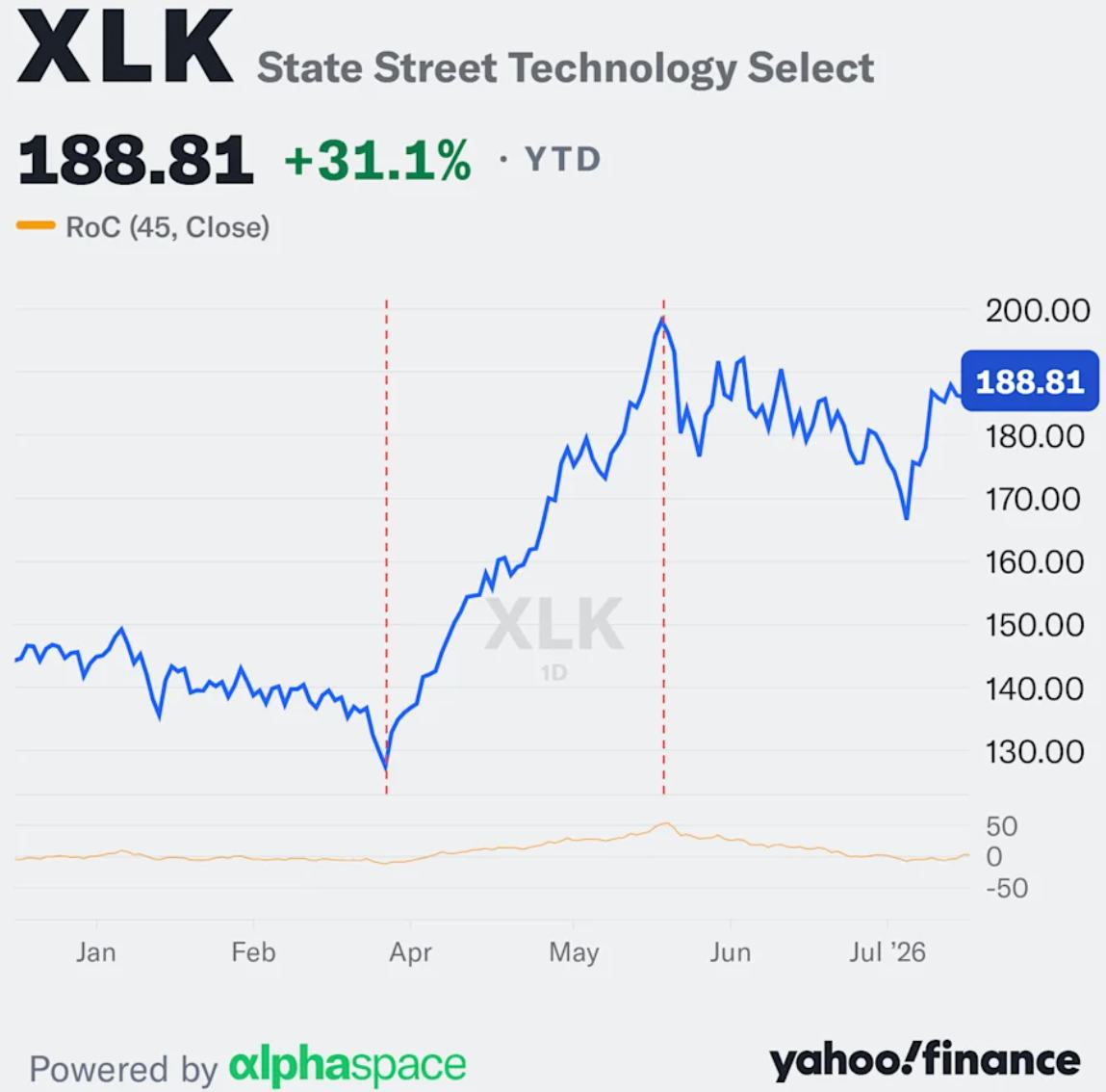
The tech industry's select SPDR fund has just rebounded strongly from its March 30 low. If measured by its 45-day rate of change (that is, the increase or decrease in price over the past 45 trading days), this is the strongest surge in XLK history since records began in 1999.
For the Philadelphia Semiconductor Index, in historical data dating back to 1994, only the sharp rise in March 2000 was stronger than this time.
So how can stocks soar to the sky and become cheaper?
Let's start with a stock with a share price of $100 and an expected return of $5. Investors are paying $20 for every $1 of expected profit, so their forward price-earnings ratio is 20 times.
If the stock rises 40% to $140, it sounds like it will become more expensive.
But let's say its expected earnings soar 80% to $9. At this point, investors are only paying around $16 for every $1 of expected profit.
The stock price went up, but it got cheaper.
A similar phenomenon is playing out across the technology sector. Over the past year, the price of technology stocks has risen by about 40%, while expected earnings have soared by about 80%. Earnings growth outperformed the rise in stock prices.
A bear market usually accomplishes this through pain. Stock prices plummeted and economic recession cut profit expectations, driving optimism away from investors' minds. By the time the smoke clears, buyers can often buy surviving profits at a much lower price.
This helps explain why some of the strongest rebounds often start when economic news headlines still look really bad. Even before the economy recovered, the stock market had already begun to anticipate recovery.
However, this time, technology stocks reaped most of the benefits without pulling the entire market into the rubble demolition site.
But there is an obvious way to unravel this situation.
Only when these expected profits actually materialize can lower price-earnings ratios remain low.
Big tech companies are investing huge sums of money in chips, data centers, networks, and electricity. Investors are already asking who will make money from this boom in AI spending, and who will be forced to pay the bill.
If AI production capacity is overbuilt, customer spending slows, chip pricing weakens, or the economy impacts companies' technology budgets, analysts may begin to lower these future profit expectations.
At that point, this trick will be rehearsed in reverse.
It is also the same stock that sells for $140 and has an expected return of $9, with a price-earnings ratio of about 16 times. If the forecast were lowered to $6, the stock's price-earnings ratio would suddenly soar more than 23 times when the stock price remained unchanged.
Nothing happened to the stock itself, it just suddenly became much more expensive. Now, the bullish logic boils down to one thing: profits must be cashed out.