
Earnings Forecast | A safe haven under the consumer downgrade storm, can Walmart (WMT.US) Q2 earnings support Wall Street's overvaluation?
The Zhitong Finance App learned that global retail giant Walmart (WMT.US) will announce its results for the second quarter of fiscal year 2027 (corresponding to the natural year of May to July 2026) before the US stock market on August 20. As a super retail terminal that covers the consumer needs of more than half of the US population, Walmart's report card has always been regarded as the most critical “barometer” for observing US residents' spending intentions and macroeconomic temperatures.
According to Wall Street consensus expectations, the market expects Walmart's second-quarter revenue to reach US$188.8 billion, up 6.45% year on year; adjusted earnings per share are expected to be $0.75, up about 10.3% year over year. The market's expectations for Walmart's performance guidance for this quarter are high, even higher than the official target limit announced by management in the first quarter.
Core performance expectations: expected to exceed the upper limit of the guideline
Notably, Walmart's own guidelines are conservative; it expects Q2 fixed exchange rate net sales to increase by 4% — 5% (lower than Q1's 5.7%), and adjusted EPS of $0.72 to $0.74. This leaves room for the traditional script of “exceeding expectations+raising guidelines for the whole year”. Bank of America analyst Christopher Nardone expects Walmart to return to this rhythm this season.
However, detailed expectations have diverged. Deutsche Bank analyst Krisztina Katai predicts sales growth of 3% to 3.5% at Walmart's US comparable stores, lower than the 3.7% expected by the Wall Street consensus.
As for the full year of fiscal year 2027, Wall Street generally expects its adjusted EPS to reach around $2.89, which is significantly higher than the company's official guidance of $2.75 to $2.85. This means that before the opening of the market, Wall Street already predicted that management would raise its full-year performance targets this quarter.
Inflation and Consumption: Structural Pressures Under K-Type Differentiation
The biggest variable in Walmart's performance comes from the continued deterioration of the US consumer environment. In July, the US CPI rose 3.4% year on year, and the core CPI rose 2.5% year on year. Although down from the previous high, it was still significantly higher than the Federal Reserve's 2% target.
What worries the market even more is that retail sales in the US fell 0.6% month-on-month in July, the biggest monthly decline since May 2025, far below the 0.1% increase expected by the market. According to the University of Michigan's August consumer confidence survey, consumer sentiment declined significantly due to the war, rising bond yields, and geopolitical uncertainty, particularly among low-income groups and the elderly.
As a “barometer” of the US consumer economy, Walmart has observed clear signs of consumer differentiation. Chief Financial Officer John David Rainey pointed out during the May earnings call that consumers showed typical K-type characteristics under financial pressure: strong consumer confidence in high-income households with an annual income of more than $100,000 is becoming the main source of growth in Walmart's market share; while low-income consumers are “more tight on budgets and may be experiencing financial difficulties.”
One very alarming detail is that this spring, a single refueling volume of customers at Walmart and Sam's Club gas stations fell below 10 gallons for the first time, the first time since the COVID-19 pandemic in 2022. “It's a sign of stress,” Rainey said bluntly. At the same time, the one-time consumption stimulus effect brought about by large personal tax rebates in the first half of the year has completely subsided. In June, the personal savings rate fell to a four-year low, residents continued to consume preventive funds, and the flexibility to freely dispose of spending was drastically reduced.
The pressure on the cost side should also not be ignored. In the first quarter, the sharp rise in fuel and transportation logistics costs had a negative impact of about 250 basis points on Walmart's operating margins, and the company was forced to absorb $175 million in additional fuel costs. Although management said the cost shock was temporary and expected normalization to return to normal in the second quarter, fluctuations in oil prices due to geopolitical risks are still a sword hanging over Damocles.
The “Double Effect” of Inflation: Increased Passenger Flow vs. Profit Squeeze
Although the overall CPI in the US is moderating, the sticky inflation accumulated over the past few years has kept the prices of groceries and core living materials high.
With its huge procurement scale and supply chain management capabilities, Walmart has strong negotiation and pricing power, and can keep prices at the lowest level in the industry. As a result, Walmart's market share in the grocery sector continues to grow.
Continued high prices have taken up space in the average household's budget, causing consumers to allocate more of their budget to essential foods, thereby reducing the more profitable purchases of clothing, electronics, and household items. This “deterioration in product mix” poses a phased challenge to the overall gross margin of retailers.
Wall Street Perspective: The game between valuation premiums and transformation dividends
In the face of macro headwinds, Wall Street analysts' attitude towards Walmart showed a clear “bullish but cautious” character. Among the 48 analysts covering the company, the average target price is $140.85, implying 22% upward space compared to the current share price of about $115, and the consensus rating is “Strong Buy.” Institutions such as BTIG, UBS, RBC Capital, and Morgan Stanley have maintained buy or increase holdings ratings in recent months.
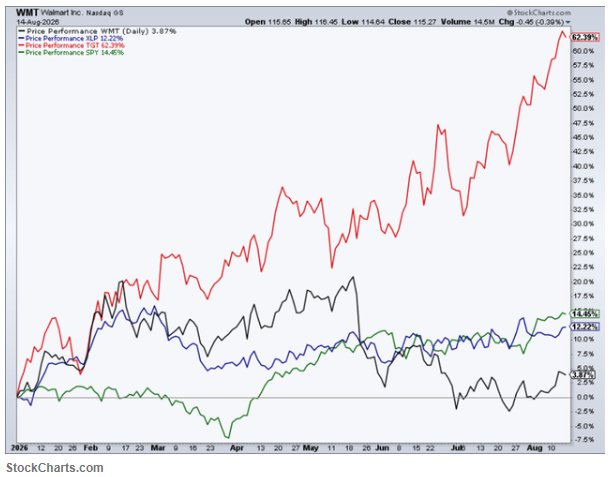
Walmart's stock price outperforms S&P 500 and rival Target this year
However, valuation disputes are heating up. Currently, Walmart's price-earnings ratio is about 40 times, at an all-time high. This pricing fully reflects the market's expectations for the transformation of its “technology-driven retailer.” Erste Group analyst Hans Engel downgraded the rating from “buy” to “hold” in early June because the valuation was significantly higher than its retail peers. Jefferies analyst Corey Tarlowe is relatively optimistic, believing that conservative performance guidelines instead create room for future performance to exceed expectations. “Walmart will continue to compete for market share through price investment in 2026.”
The market's core focus is on whether the second-quarter operating profit growth can fall within the 7-10% high range of the guideline. If actual data verifies management's judgment that “the impact on fuel costs is only temporary,” the channel for the stock price to rise back from $120 to the Wall Street average target price will open; conversely, if the data falls at the low end and the third quarter guidelines tend to be cautious, the investment logic supporting this retail giant with a price-earnings ratio of 40 times will weaken.
In addition to macro-fluctuations, Walmart's business model is undergoing structural evolution, which provides a buffer against cyclical fluctuations. Chief Financial Officer Rainey clearly stated in May that the combined revenue from the advertising business and membership fees already accounts for about one-third of Walmart's total operating profit, “this is completely different from Walmart ten years ago.”
In the first quarter, global e-commerce sales increased 26%, US delivery business increased 45%, third-party platform sales increased nearly 50%, and advertising business increased 37%. The expansion of these high-margin businesses is changing Walmart's traditional grocery business model, which relies on small profits to sell more.
The deeper changes are taking place at the level of operational efficiency. Currently, about 60% of Walmart stores accept goods from automated distribution centers, and about half of the e-commerce fulfillment center's processing capacity is fully automated. Investments in supply chain automation not only cut labor costs, but also improved inventory turnover efficiency. Against the backdrop of consumers shifting more to low-margin necessities and weak sales of high-margin optional consumer goods, this “volume compensation, efficiency in exchange for profit” strategy has become the key for Walmart to maintain profit margins.