
Steel giant Bluescope unravels the “resource layer” of AI computing power infrastructure with soaring profits: industrial metals such as steel, copper and aluminum become the “second battleground” of the AI supercycle
The Zhitong Finance App learned that in the context of the surge in AI computing power demand, strong metal demand brought about by the North American AI data center construction process is in full swing. This latest trend also highlights that demand for key industrial metals and minerals that must be continuously consumed to build artificial intelligence data centers has surged under an unprecedented wave of AI. As the power density of AI GPU/AI ASIC computing power cluster cabinets continues to increase, AI computing power expansion will simultaneously drive physical infrastructure requirements such as data center project construction structures, power distribution, and thermal management systems, which in turn will drive demand for metals such as copper, aluminum, and steel, rather than just amplifying the demand for chips.
BlueScope Steel Ltd.'s sharp rise in profits. One important driving factor is that the data center construction boom has driven record sales growth in its North American industrial metals business. AI capital expenditure is accelerating the spread from “silicon-based computing power layers” such as GPU/HBM to physical infrastructure layers composed of steel, copper, aluminum, electricity, and engineering equipment. The Melbourne-based steelmaker said on Monday that for the full fiscal year ending June 30, the underlying net profit more than doubled to 8512 million Australian dollars ($604 million). Revenue increased by 9% in North America, offsetting a series of negative effects caused by a 4% decline in revenue in Asia.
From an engineering perspective, a large AI data center is first a highly industrialized “computing power factory”: steel enters the main body of the building, prefabricated steel structures, equipment supports, racks and peripherals; copper, a critical industrial metal, enters high-voltage/low-voltage distribution, cables, busbars, grounding, transformer connections, and liquid-cooled cold plates and heat exchangers. Aluminum, a lightweight industrial metal, has long been regarded as an alternative metal to copper, especially in cost- and weight-sensitive application scenarios where conductivity requirements are relatively relaxed. This substitution trend has been around for more than 10 years, and has been accelerated in recent years due to the promotion of resource safety and the new energy industry, but copper is still irreplaceable in high-reliability and high-power application scenarios.
Industrial metals such as steel, copper, aluminum, nickel, and tin can be described as an “AI core investment trend” covering AI GPU/ASIC, data center CPUs, HBM/NAND/HDD storage, 2.5D/3D advanced packaging, liquid cooling systems, optical interconnection supply chains, data center power chains, etc. -- building AI applications and data centers not only requires buying models, chips, and high-performance AI cloud computing servers, but also spending huge sums of money to buy the underlying energy, metals, chemicals and secure resources to support the expansion of AI computing power infrastructure production capacity .
The AI data center boom is starting to “eat steel”! BlueScope doubles profits, and North America becomes a new growth engine
BlueScope CEO Tania Archibald said in an interview with the media that the North American market remains the company's “primary performance growth engine.” “We are benefiting from data center requirements, and we are seeing strong performance in data center requirements,” she said.
Tania Archibald, managing director and CEO of BlueScope Steel, said the company is currently highly focused on the pace of endogenous growth and plans to continue improving overall shareholder returns over a longer period of time.
But on the other hand, Archibald said that as the company strives to control energy costs, BlueScope is also “highly alert to the impact data centers may have on broader energy supply issues.”
In February of this year, BlueScope rejected a takeover offer from Steel Dynamics Inc. and SGH Ltd., which valued BlueScope's equity at around $15 billion. BlueScope said at the time that the offer undervalued the company. Since then, its stock price has risen by about one-fifth. BlueScope shares fluctuated between gains and losses on Monday, falling 0.8% as of 2:25 p.m. Sydney time.
Archibald said, “We haven't had any contact with the consortium for quite some time. We very clearly rejected their last proposal because the offer simply did not represent fair value for BlueScope's shareholders.”
The Australian company's North Star steel mill in Ohio is also benefiting from the Trump administration's 50% tariff on imported steel, a measure aimed at dealing with overcapacity issues from the Asian region.
Archibald said in an investor conference call on Monday that BlueScope expects “the North American market to continue to be strong, the Australian demand environment is steady, and New Zealand has shown initial signs of recovery.” “In some Asian markets, overcapacity continues to suppress regional steel price differences,” she added.
BlueScope's FY2026 (full fiscal year 2026) PPT presentation materials for shareholders clearly listed “data centre and AI infrastructure build-out demand” (large-scale construction of data centers and artificial intelligence infrastructure is driving demand for related products, materials, electricity, or equipment) as an important support for North American demand; its North American business unit's annual basic EBIT profit reached 1,034 billion Australian dollars, YoY With a 101% increase, North Star Steel's EBIT reached 805 million Australian dollars and maintained 100% capacity utilization. However, profit growth was also driven by stronger steel price spreads, capacity utilization, and the macroeconomic growth environment in the North American market, so 100% of the profit cannot be attributed entirely to AI.
BlueScope's profit doubles to unlock the computing infrastructure resource layer. Energy and industrial metals are becoming the underlying hard assets in the “AI computing power arms race”
From the perspective of AI engineering, AI data centers are not abstract “clouds,” but rather highly physicalized capital expenditure systems: GPU/ASIC computing power infrastructure clusters require an almost endless supply of high-efficiency electricity, HBM/SSD capacity expansion requires huge semiconductor materials and chemicals, and the underlying construction of AI data center computer rooms requires copper, aluminum, steel, and underlying core infrastructure support such as gas turbines, transformers, energy storage, cooling systems, and power grid systems driven by natural gas energy.
A team led by Bank of America strategist Michael Hartnett (Michael Hartnett), who has the title of “Wall Street's Most Promising Strategist,” recently released a research report saying that investors will continue to pour into the commodity exchange market in the next few years; even if a new round of the Middle East War is temporarily over, the rise in the global commodity market will continue for many years until the end of 2030.
According to Bank of America strategists led by Hartnett, commodities around industrial metals have the clearest logical hierarchy and the highest level of “geospatial post-war transactions”. They are betting that commodities will replace stocks and become the biggest winners in the next few years; the core reason is that investors urgently need to hedge against risks, inflation, and the weakening dollar, while geopolitics and global AI competitions are essentially strengthening competition for energy, rare earths, minerals, and key commodity resources. He even summed up the core logic as: Whoever controls chips, rare earths, metals, minerals, and high-efficiency energy will win this global AI war. This means that in the Bank of America's view, the core of pricing in the post-war world is no longer just interest rates and profits, but commodity supply system security, supply chain control, and fiscal expenditure expansion.
BlueScope's profit has improved dramatically. What really reveals is that the AI data center construction process has moved from a “large-scale purchase of GPU/ASIC cabinets” to a new stage of “large-scale acceleration of the construction of industrial-grade infrastructure”, which highlights the critical industrial metals and is accelerating the formation of an “AI computing power infrastructure resource layer.” In other words, the end of AI is not just electricity, but “electricity+metal+engineering capacity” — when computing power resources change from silicon wafer systems to GW-level infrastructure, industrial metals begin to acquire some structural AI attributes from traditional cyclical products.
Among them, steel, copper, and aluminum are the most direct AI data center physical capital expenditure beta, while lithium, nickel, and tin are the second tier with varying degrees of correlation. Copper is the most typical “AI electrified metal”, covering high-speed copper interconnections within data centers, power distribution systems, external grid expansion, and liquid cooling; aluminum is widely used in transmission and distribution, busbars, cables, and some cooling and structural systems; steel is compatible with CFC/data center buildings, substations, power generation facilities, racks, and large-scale non-residential facility construction. The logic of tin comes more from solder, PCB, and electronics manufacturing, and the absolute scale of use is far less than that of steel, copper and aluminum; lithium and nickel mainly benefit from UPS, energy storage systems (BESS), and energy storage chains supporting additional electricity in data centers, so their “AI purity” is significantly lower than copper, and is also strongly affected by EV demand, battery chemistry systems, and mine supply cycles.
Wall Street financial giant Goldman Sachs predicts that global data center electricity demand will increase by 220% by 2030 compared to 2023, which is equivalent to adding one of the world's top ten electricity consumers. The IEA (International Energy Agency) predicts that global data center electricity consumption will increase from about 415 terawatt-hours in 2024 to about 945 terawatt-hours in 2030, accounting for an average annual increase of about 15%, accounting for nearly 3% of global electricity consumption. Among them, AI accelerated server electricity consumption will increase by about 30%, and the electricity consumption of US data centers will increase by about 240 terawatt-hours compared to 2024, an increase of about 130%, and contribute nearly half of the new electricity demand in the US by 2030.
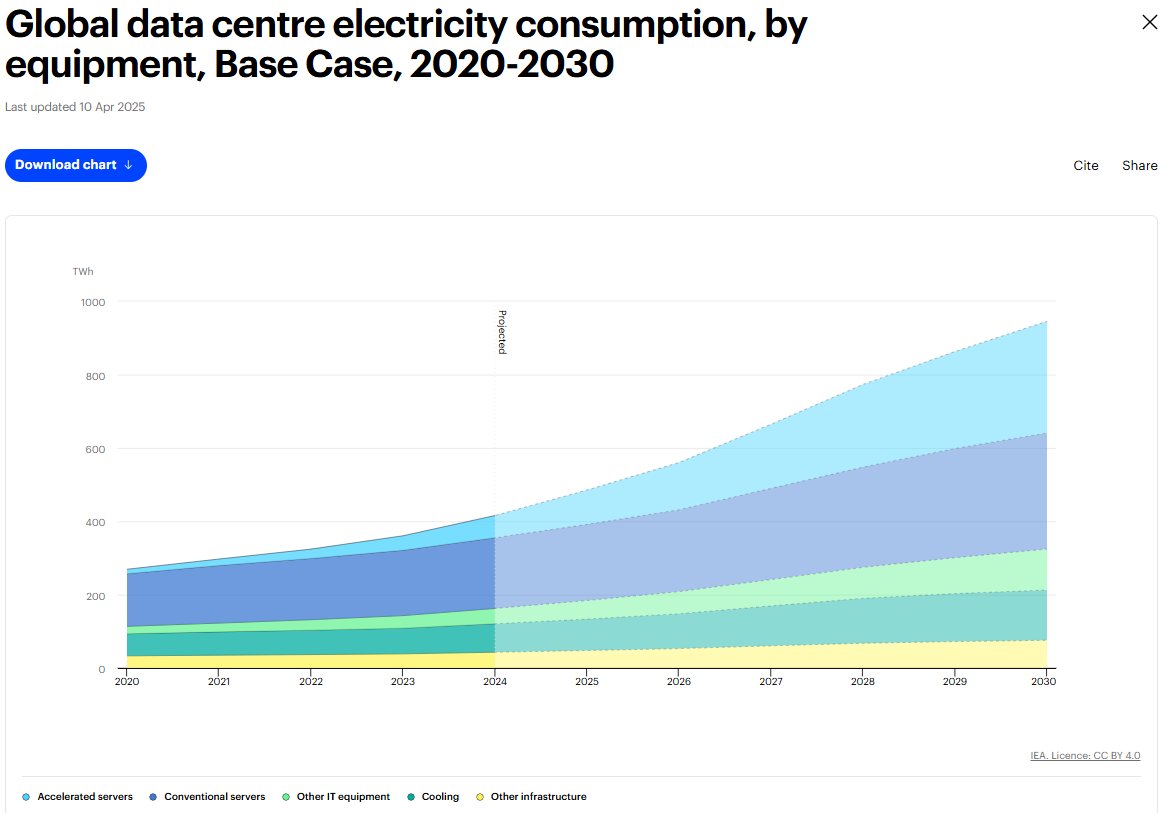
The IEA predicts that the electricity consumption of data centers at the global level will roughly double by 2030, and the electricity consumption of data centers at the AI training/inference level will grow faster; at the same time, power grid bottlenecks may cause delays in connecting to the grid by about 20% of the planned pre-2030 data center capacity. These all together indicate that the scarce resources in the next phase of AI-themed investment are spilling out of “chips” to electricity, conductors, structural materials, and energy infrastructure.