The more you earn, the worse you lose! Under the AI computing power carnival, how many “debt thunder” is buried behind CoreWeave (CRWV.US)?
The Zhitong Finance App learned that Credit Strategist columnist Michael Levitt warned that investors in the emerging cloud vendor CoreWeave (CRWV.US) are rejoicing at the blowout demand for computing power, but have overlooked that their balance sheets may contain “huge thunder” that could threaten the company's survival.
The hidden worries behind doubling revenue: the more you earn, the harder you lose
CoreWeave recently announced second-quarter earnings that exceeded expectations. According to the data, the company's Q2 revenue increased 112% year-on-year to 2.58 billion US dollars, the backlog of orders broke through the 100 billion US dollar mark, and the stock price rose 20% in response to subsequent performance, and the increase increased to 47% during the year. The market is clearly more concerned about its growing backlog of orders and management's optimistic expectations of the demand outlook.
However, the market overlooked the same doubling of net losses — Q2 net loss increased from $290 million in the same period last year to $626 million. Levitt believes that the company's rapid growth overshadows its highly leveraged financial structure, which requires more and more external capital.
In an August 13 article, Levitt wrote, “These numbers depict a company with astonishingly high leverage, and it must miraculously reverse the situation to survive.”
Debt is “under a lot of pressure”
According to financial data disclosed by CoreWeave, the company's debt-to-equity ratio is over 800% (including long-term debt and operating leases), the working capital gap exceeds $10 billion, and interest expenses in a single quarter are about US$640 million. The risk factors disclosure section of its quarterly earnings report is 50 pages long, which shows that it has many hidden operating risks.
CoreWeave faces tremendous debt repayment pressure: it will have to repay $20.6 billion in debt by 2030, including $4.4 billion for the remainder of 2026, $6.2 billion in 2027, $4.4 billion in 2028, $2.4 billion in 2029, and $3.2 billion in 2030.
More worryingly, CoreWeave still has at least $10 billion in operating lease obligations during this period. The company's annual interest expenses have exceeded 2.5 billion US dollars, and this is still without taking into account the $2.6 billion additional financing completed in August and the $1.2 billion loan drawn from the revolving credit line.
Levitt estimates that CoreWeave needs to generate or raise at least $10 billion a year to cover its financing obligations, not including day-to-day operating expenses and huge capital expenses.
Financing costs soar and ratings are being questioned
CoreWeave's latest $2.6 billion loan had an interest rate of around 9.875%, indicating that its capital costs have risen sharply. Levitt warned that as CoreWeave competes with larger, higher-scale tech giants with higher credit ratings, future debt financing costs could reach 10% or more.
Levitt also criticized ratings agencies for being too laid-back on CoreWeave and underestimating its financial risk. Currently, S&P gives a global rating of B+, Moody's gives Ba3, Fitch gives BB-, and some transactions supported by specific assets and customers receive even higher ratings.
Levitt said that until CoreWeave can prove it can be profitable and reduce its debt burden, it should be reasonably rated between B- and CCC+. He wrote, “This company is still far short of a B+/ba3/bB- rating. Its market value could evaporate overnight.”
Levitt believes investors are paying too much attention to CoreWeave's income statement and revenue growth, while not paying enough attention to its balance sheet, cash flow statement, and financial statement notes. He said these disclosures revealed the risks overshadowed by the company's rapidly growing sales.
The bond market has issued a severe warning: CoreWeave's credit default swap (CDS) spread rose to 855 basis points in July, implying a five-year default probability of up to 50%.
Equity financing may be the way to break the siege
Levitt said CoreWeave should use its high share price to sell as many shares as possible. Although issuing additional shares may dilute existing shareholders' holdings, the move will give the company an opportunity to repay its debts and reduce its reliance on high-cost loans.
He described Coreweave as a financing-driven product of the AI infrastructure investment boom. Although the company received support from Nvidia and investment firm Magnetar, its expansion depended mainly on debt rather than equity financing. This makes CoreWeave more vulnerable than tech giants, who can use their cash flow to fund data center construction and borrow at much lower interest rates.
Levitt warned that if investment in AI infrastructure slows down, or if the industry builds computing power that exceeds the actual needs of customers, the risk will increase further. In this case, CoreWeave may have to take on expensive data center and financing obligations while competing with larger companies with more robust balance sheets.
He said, “The last situation a company wants to face is to become the most leveraged player in an overexpanding industry. That's where CoreWeave is right now.”
Wall Street analysts are cautiously bullish
While Levitt issued a stern warning, Wall Street investment bank Morgan Stanley also maintained a cautious stance on CoreWeave.
Morgan Stanley maintains CoreWeave's “same as market” rating and a target price of $99, believing that demand for GenAI data centers is strong, but high debt and customer concentration are key constraints that cannot be broken through in the valuation. The bank expects CoreWeave's free cash flow to remain negative until 2028, and debt is expected to rise to about $38 billion by the end of 2026.
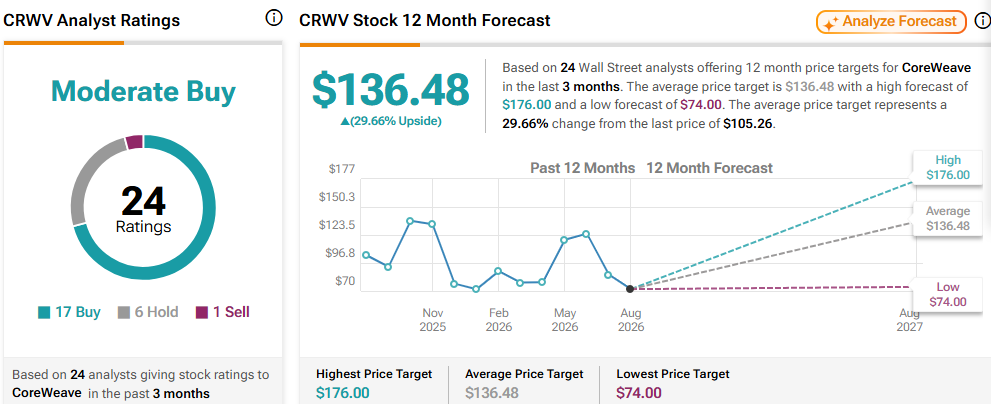
Overall, Wall Street analysts rated CoreWeave a “moderate buy”, with an average target price of $136.48, which is 30% higher than the latest closing price.