
The bottom card before the storm: On the eve of the “AI stock god” bursting out, SA was betting big on memory chips, the castle fully hedged, and the 100 billion hedging of Jane Street Sky still couldn't escape the huge loss of 10 billion dollars
The Zhitong Finance App learned that the “protagonist” of the hedge fund Situational Awareness (SA), the “protagonist” in the “AI Stock God” liquidation incident at the end of July, Citadel Advisors (Citadel Advisors), which took over most of the fund's stock portfolio, and Jane Street (Jane Street), which suffered huge losses due to investing in SA, recently released their position reports (13F) for the second quarter ended June 30, 2026.
Through these underhand positions at the end of the second quarter, we can clearly see how aggressive these top giants actually placed their chips in the AI computing power industry chain on the eve of this earth-shattering storm.
Situational awareness
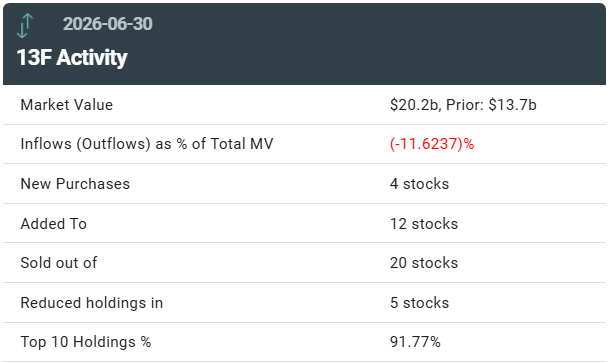
Statistics show that the total market value of SA's positions in the second quarter was 20.2 billion US dollars, and the total market value of the previous quarter was 13.7 billion US dollars. SA added 4 new shares to its portfolio in the second quarter and increased its holdings by 12 shares. Meanwhile, SA reduced its holdings by 5 shares and cleared 20 shares. Among them, SA's top ten holdings accounted for 91.77% of the total market capitalization.
Among the top five major stocks, SanDisk (SNDK.US) ranked first, holding about 2.495 million shares, with a market value of about US$5.67 billion, accounting for 28.52% of the portfolio, an increase of 118.87% over the number of holdings in the previous quarter.
Micron Technology (MU.US) ranked second, holding about 4.829 million shares, with a market value of about US$5.57 billion, accounting for 28.01% of the portfolio, an increase of 27712.38% over the previous quarter.
Bloom Energy (BE.US) ranked third, holding about 6.273 million shares with a market value of about US$1.90 billion, accounting for 9.54% of the portfolio, a decrease of 3.28% from the number of positions held in the previous quarter.
TSM.US (TSM.US) ranked fourth, holding about 2.649 million shares, with a market value of about US$1.27 billion, accounting for 6.36% of the portfolio, an increase of 11713.92% over the previous quarter.
Nebius (NBIS.US) ranked fifth, holding about 4.464 million shares, with a market value of about US$1.23 billion, accounting for 6.20% of the portfolio, creating new holdings for the fund.
The sixth to tenth largest stocks are: CoreWeave (CRWV.US), Seagate Technology (STM.US), Applied Materials (APLD.US), Riot Platforms (RIOT.US), and SharonAI Holdings (SHAZ.US).
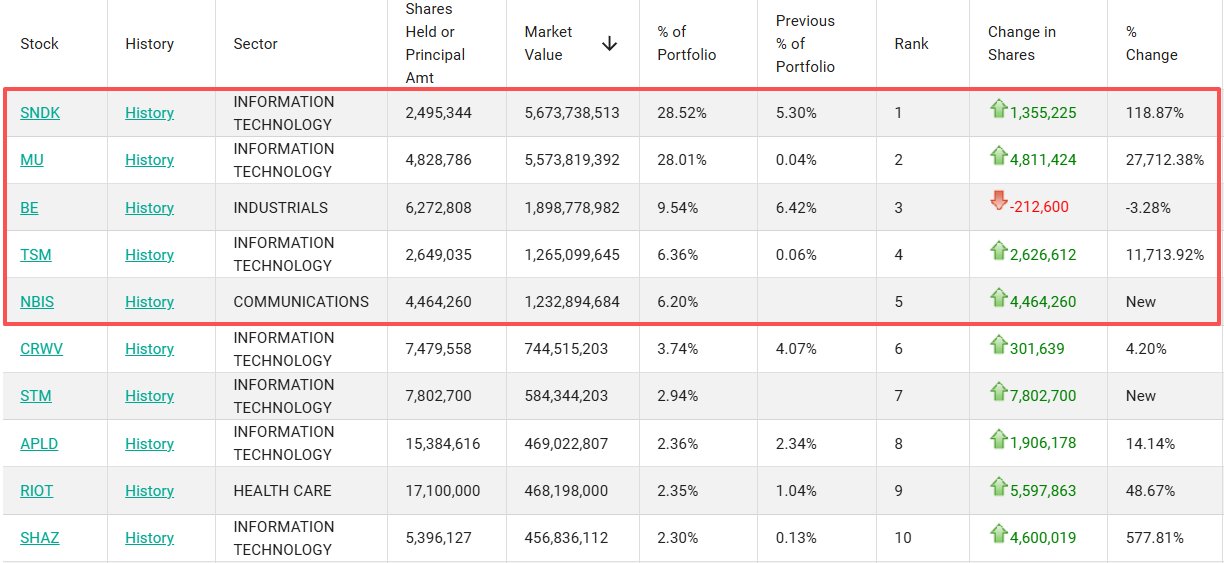
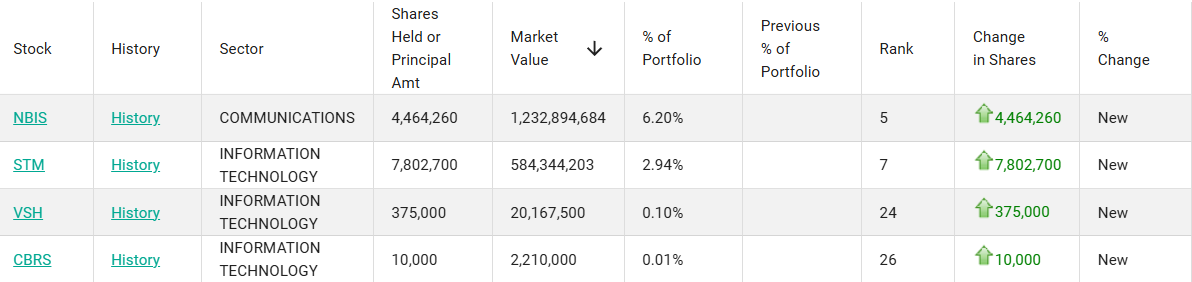
As can be seen, SA's holdings up to the second quarter were basically built around the AI computing power industry chain. In addition to Nebius, Seagate Technology, VSH.US (VSH.US), and Cerebras Systems (CBRS.US) also created new positions for the fund in the second quarter. It is worth mentioning that the fund also cleared Nvidia (NVDA.US), Intel (INTC.US), Corning (GLW.US), AMD (AMD.US), and ASML.US (ASML.US) in the second quarter, concentrating all of its ammunition on storage and computing infrastructure. Judging from trading changes, the biggest increase in positions in the second quarter was Micron, SanDisk, and TSMC.
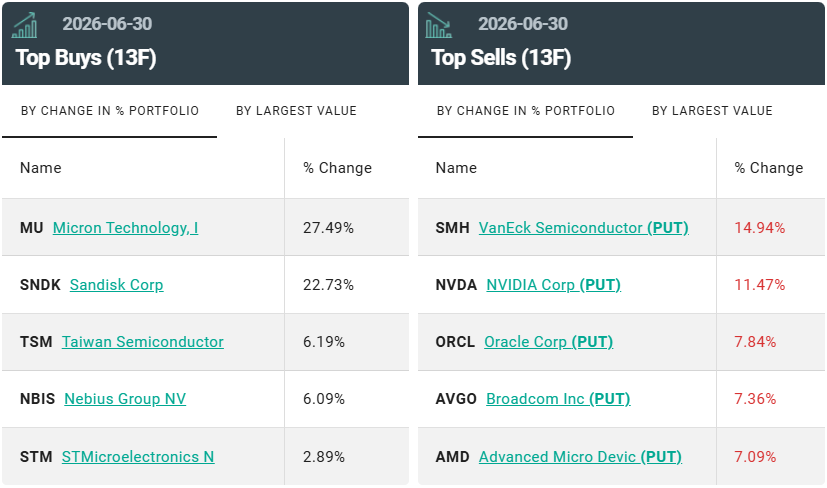
Judging from changes in position ratios, the top five buying targets are: Micron Technology, SanDisk, TSMC, Nebius, and Seagate.
The top five selling targets are: Vaneck Semiconductor Index ETF (SMH.US), Nvidia Put Options (NVDA.US, PUT), Oracle Put Options (ORCL.US, PUT), Broadcom Put Options (AVGO.US, PUT), and AMD Put Options (AMD.US, PUT).
Castle investment
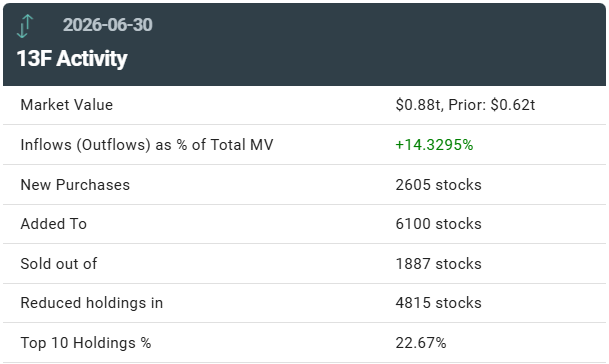
Statistics show that the total market value of Castle Investment's positions in the second quarter was 88 billion US dollars, and the total market value of the previous quarter was 62 billion US dollars. Castle Investment added 6,100 shares to its portfolio in the second quarter and increased its holdings by 2,605 shares. Meanwhile, Castle Investment reduced its holdings by 4,815 shares and cleared 1,887 stocks. Among them, the top ten positions held by Castle Investment accounted for 22.67% of the total market value.
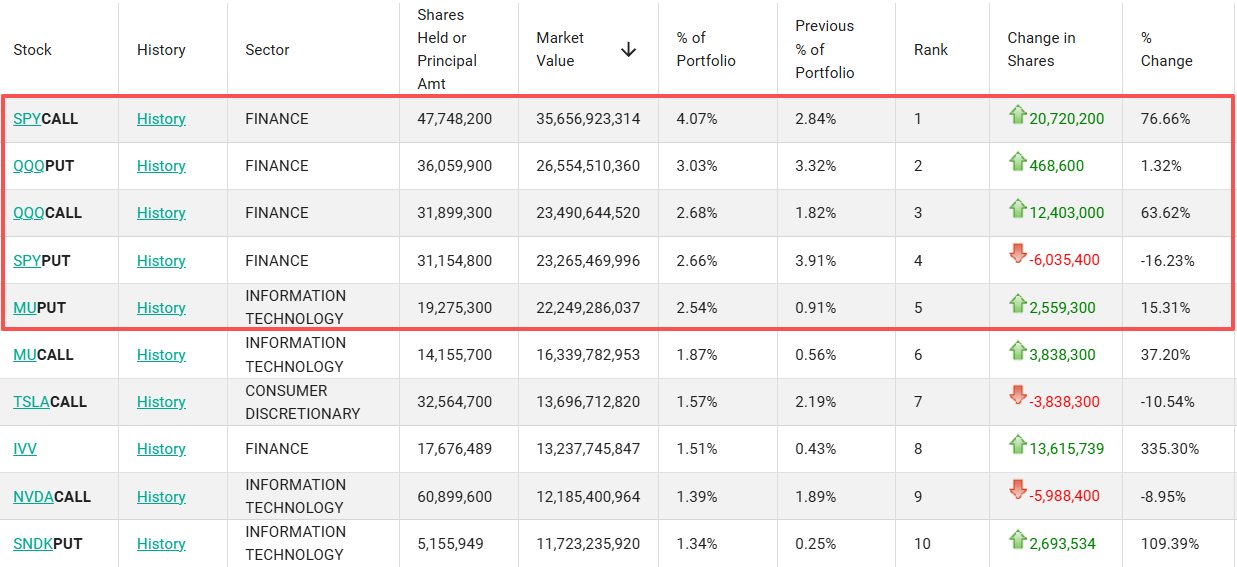
Among the top five major stocks, SPDR S&P 500 ETF bullish options (SPY.US, CALL) ranked first, holding about 477.48 million shares, with a market value of about US$35.66 billion, accounting for 4.07% of the portfolio, an increase of 76.66% over the number of positions held in the previous quarter.
NASDAQ 100 ETF put options (QQQ.US, PUT) ranked second, holding about 36.60 million shares with a market value of about US$26.55 billion, accounting for 3.03% of the portfolio, an increase of 1.32% over the previous quarter.
Nasdaq 100 ETF bullish options (QQQ.US, CALL) ranked third, holding about 31.9 million shares, with a market value of about US$23.49 billion, accounting for 2.68% of the portfolio, an increase of 63.62% over the previous quarter.
The SPDR S&P 500 ETF put options (SPY.US, PUT) ranked fourth, holding about 31.155 million shares, with a market value of about US$23.27 billion, accounting for 2.66% of the portfolio, a decrease of 16.23% from the number of positions held in the previous quarter.
Micron Technology's Put Options (MU.US, PUT) ranked fifth, holding about 19.2754 million shares, with a market value of about US$22.25 billion, accounting for 2.54% of the portfolio, an increase of 15.31% over the previous quarter.
The sixth to tenth largest stocks are: Micron Technology's bullish options (MU.US, CALL), Tesla bullish options (TSLA.US, CALL), iShares S&P 500 ETF (IVV.US), Nvidia bullish options (NVDA.US, CALL), and Sandisk put options (SNDK.US, PUT).
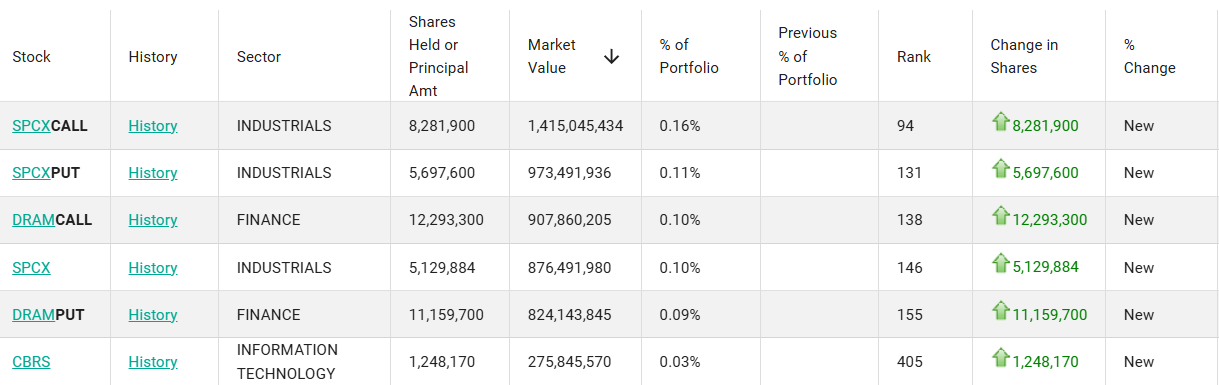
It is worth mentioning that commercial space giant SpaceX (SPCX.US), which went public in June, also attracted the attention of Castle Investors. The fund not only created a new position in SpaceX, but also bought bullish and bearish options on the stock. In addition, Castle Investment also established a new position in Cerebras Systems in the second quarter. Its huge options matrix with long and short directions (such as Micron and SanDisk's Put/Call combination) shows its top-level risk hedging capabilities.
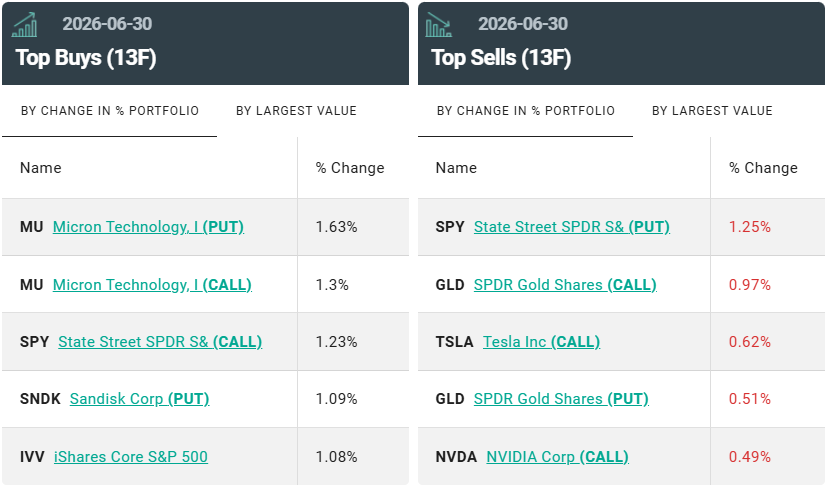
Judging from changes in position ratios, the top five buying targets are: Micron Technology put options, Micron Technology bullish options, SPDR S&P 500 ETF bullish options, SanDisk put options, and iShares S&P 500 ETF.
The top five selling targets were SPDR S&P 500 ETF put options, SPDR gold ETF call options (GLD.US, CALL), Tesla call options, SPDR gold ETF put options (GLD.US, PUT), and Nvidia call options.
Jianjie Capital
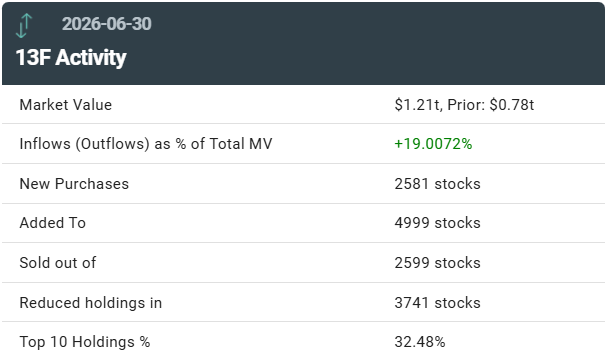
Statistics show that the total market value of Jianjie Capital's positions in the second quarter was 1.21 trillion US dollars, and the total market value of the previous quarter was 780 billion US dollars. Jianjie Capital added 2,581 shares to its portfolio in the second quarter and increased its holdings by 4,999 shares. Meanwhile, Jianjie Capital reduced its holdings by 3,741 shares and cleared 2,599 stocks. Among them, the top ten holdings of Jianjie Capital account for 32.48% of the total market value.
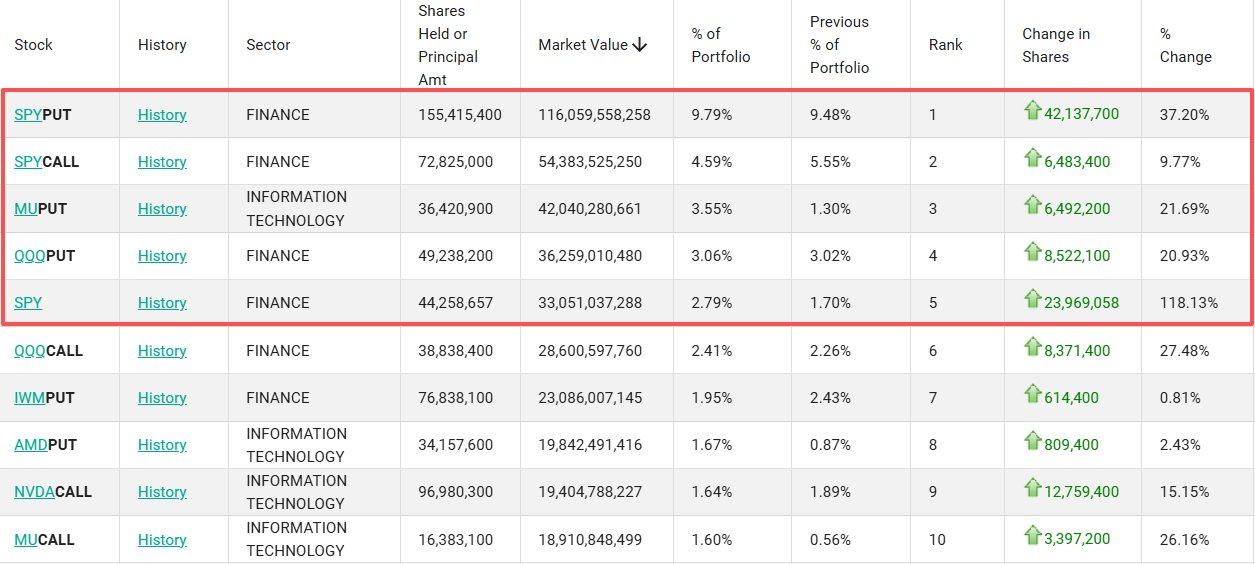
Among the top five major stocks, SPDR S&P 500 ETF put options (SPY.US, PUT) ranked first, holding about 150 million shares with a market value of about US$116.10 billion, accounting for 9.79% of the portfolio, an increase of 37.20% over the number of positions held in the previous quarter.
SPDR S&P 500 ETF bullish options (SPY.US, CALL) ranked second, holding about 72.825 million shares, with a market value of about US$54.38 billion, accounting for 4.59% of the portfolio, an increase of 9.77% over the previous quarter.
Micron Technology's Put Options (MU.US, PUT) ranked third, holding about 36.421 million shares, with a market value of about US$42.04 billion, accounting for 3.55% of the portfolio, an increase of 21.69% over the previous quarter.
NASDAQ 100 ETF put options (QQQ.US, PUT) ranked fourth, holding about 49.238 million shares, with a market value of about US$36.26 billion, accounting for 3.06% of the portfolio, an increase of 20.93% over the previous quarter.
The SPDR S&P 500 ETF (SPY.US) ranked fifth, holding about 44.259 million shares with a market value of about US$33.05 billion, accounting for 2.79% of the portfolio, an increase of 118.13% over the previous quarter.
The sixth to tenth largest stocks are: Nasdaq 100 ETF bullish options (QQQ.US, CALL), iShares Russell 2000 ETF put options (IWM.US, PUT), AMD put options (AMD.US, PUT), Nvidia call options (NVDA.US, CALL), and Micron Technology (MU.US, CALL).
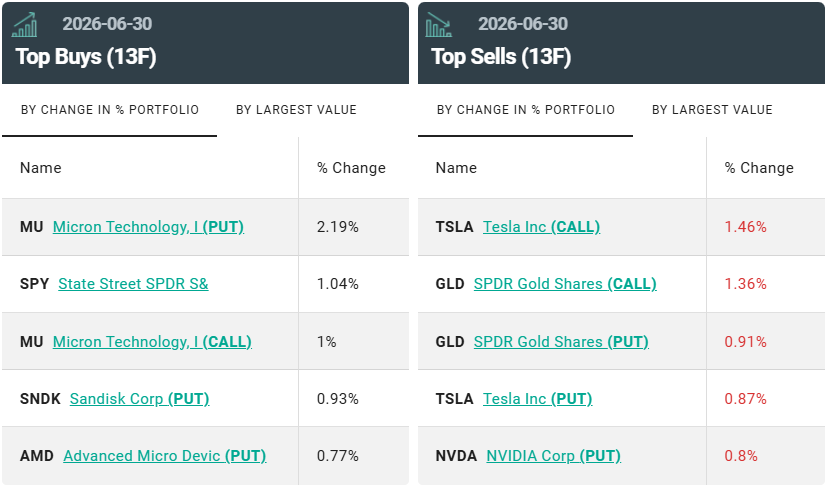
Judging from changes in position ratios, the top five buying targets are: Micron Technology put options, SPDR S&P 500 ETF, Micron Technology bullish options, SanDisk put options (SNDK.US, PUT), and AMD put options.
The top five selling targets were Tesla call options (TSLA.US, CALL), SPDR gold ETF call options (GLD.US, CALL), SPDR gold ETF put options (GLD.US, PUT), Tesla put options (TSLA.US, PUT), and Nvidia put options (NVDA.US, PUT).
Incident review
Leopold Ashenbrenner, who was once dubbed the “AI stock god” by the market, founded this hedge fund called “SA” in September 2024, based on the deep insight of the AI industry accumulated by the OpenAI core research team. The fund's core strategy is to bet heavily on the AI infrastructure circuit, while adding leverage of up to 4 times to amplify profits, and also hedging operations with shorting traditional software stocks. By betting on AI-related stocks with high leverage, SA generated impressive returns in just a few months. The fund disclosed in a letter to investors in early July this year that the combined return for the first half of 2026 was as high as 439%. According to another report, the fund's management scale climbed to 45 billion US dollars in early July.
However, in July, the AI sector of the US stock market, which continues to interpret the market, ushered in a sharp reversal. The AI hardware and memory chip sectors collectively made a deep correction, and highly concentrated fund positions were hit hard. According to the data, Micron Technology, the heavy stock of SA, fell by a cumulative total of 28.69% in July, and SanDisk's decline reached 46.57%. In contrast to this, software short positions used by funds to hedge risks have bucked the trend and directly caused losses in both directions. High leverage further amplified account retracement, and fund margin safety pads were broken down. SA received additional security deposit notices one after another, and was eventually forced to package and sell the vast majority of its open market holdings to Ken Griffin's castle at a discount to resolve the crisis and prevent disorderly sell-offs from impacting the market.
Driven by a sharp decline in the net value of the SA fund it invests in, Jane Street Capital recorded a huge loss of about 15 billion US dollars in July. This is the first time since 2016 that this Wall Street institution, known for its strict risk control and quantitative transactions, experienced negative transaction revenue, causing huge shock in the global trading community.
According to the internal memorandum of understanding from Jianjie Capital, due to the sharp decline in the net value of the SA Fund, almost all of the company's income from this investment during the year was reduced to zero. In addition to this, long positions in Asian non-AI stocks laid out by Jianjie Capital also experienced significant losses. High-yield trading positions in the early market market were collectively retracted after a rapid change in style, and multiple losses were compounded, eventually leading to huge monthly losses of 15 billion US dollars. According to reports, this loss will be included in Jianjie's financial results for the third quarter. Jane Street has closed most of its risk exposure in specific areas where it lost money in July and reduced other strategic risk commitments.
However, giants like Castle Investment, which had already passed a large number of Put/Call options at the end of the second quarter, successfully completed a “double harvest” of this part of high-quality computing power assets through takeover and low absorption during the July blood wash.
This 13F report for the second quarter just fixed the “quiet storm” on the eve of Wall Street's biggest holocaust in recent years.