
Expectations of the Fed's interest rate hike have cooled down. The US dollar fell three times in a row to hit a new low since May, and the emerging market currency index soared to a record high
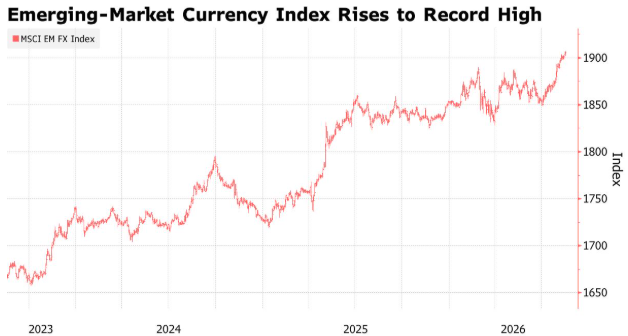
The Zhitong Finance App learned that as a series of weak US economic data completely destroyed market expectations for the Federal Reserve's interest rate hike in September, global capital is being repriced at the fastest speed in recent months. On August 17, the Bloomberg Dollar Spot Index fell for the third consecutive trading day, hitting its lowest level since May 15. At the same time, the MSCI Emerging Markets Currency Index rose 0.2% intraday to a record high; the Emerging Markets Equity Index climbed 0.6% at the same time, and risk appetite picked up markedly.
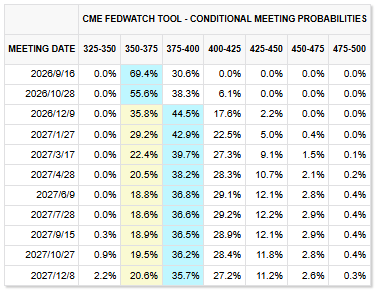
Data “three consecutive hits”: the probability that the Fed will raise interest rates in September plummeted from 75% to 30%
It is no accident that the dollar continues to weaken. In just two weeks, three sets of key economic data have successively broken the market's confidence that the Federal Reserve will continue to raise interest rates.
First blow: Unexpected contraction of non-farm payrolls in July. According to data released on August 7, the US non-farm payrolls decreased by 23,000 in July, while the market expected an increase of 80,000. The May and June data were drastically revised down, totaling 103,000. The US labor market is showing clear signs of cooling.
Second hit: CPI and PPI cool down at the same time. The July CPI and PPI data both showed fatigue. Inflation data is back on a downward trajectory, further weakening the urgency for the Federal Reserve to raise interest rates.
Third blow: retail sales “explode” to end nine consecutive increases. US retail sales announced on August 14 fell 0.6% month-on-month in July, far below the 0.1% increase expected by the market, ending nine months of continuous growth. The retail sales control group, which is directly related to GDP accounting, also recorded a 0.4% month-on-month decline. Consumer confidence also worsened due to rising cost of living.
The effect of the superposition of the three sets of data was immediate. According to the CME FedWatch tool, the market's implied probability of the Fed's interest rate hike in September has plummeted to 30% from about 75% in late July. The US swap market has now only fully absorbed expectations of a 25 basis point rate hike in January next year, in stark contrast to the scenario where the market expected to raise interest rates before the end of the year a week ago. The remaining rate hikes expected by the market throughout the tightening cycle have narrowed to around 36 basis points.
The US dollar “stalls” and the “carnival” of emerging markets
A direct consequence of the weakening dollar is a full-scale explosion of emerging market assets. Wee Khoon Chong, senior Asia Pacific market strategist at Bank of New York Mellon said, “Emerging market currencies are supported today, mainly driven by the weakening dollar and the continued recovery in risk appetite in the stock market. We are seeing a strong resurgence of foreign capital inflows into emerging markets, particularly the Asian market. ”
Arbitrage trading is recovering. As the path of the Federal Reserve's interest rate hike leveled off, the relatively high interest rate advantage of emerging markets was once again highlighted, attracting global capital chasing returns.
The geo-risk premium has declined. Galvin Chia, an emerging Asian strategist at Société Générale, pointed out that the strengthening of Asian currencies is the result of multiple factors resonating: “Asian currencies seem to have benefited from weak US data last week and the weakening trend of the US dollar at the beginning of this week. The lack of new geopolitical news over the weekend and the price of Brent crude oil below $90 may also support the market. ”
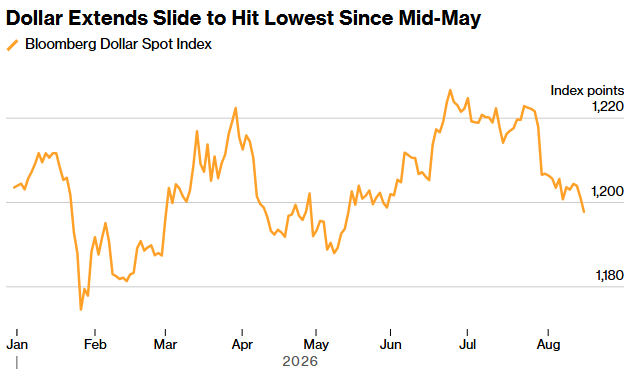
The US dollar index DXY has fallen to around 99.50 and has been hovering at a new low for nearly two months. EUR/USD used the momentum to break through the 1.1577 key resistance level and stand at the 100-day EMA. The yen recovered to around 159 against the US dollar. From a quantitative perspective, the correlation coefficient between Citigroup's US Economic Accident Index and the US dollar index reached 0.85 in the past 20 days, and changes in economic data exceeding expectations have become the core variables affecting the trend of the US dollar.
The signals in the options market are more clear. For the first time since late February, one-month options turned into bets on the depreciation of the US dollar, and longer-term contracts are still beneficial to the US dollar.
This week's key variable: Can the FOMC minutes “save the hawks”?
Whether the dollar's decline can continue, this week's two major events will provide key guidance.
Wednesday (August 20): FOMC July Meeting Minutes. At the Federal Reserve meeting on July 29, interest rates remained unchanged in the 3.5%-3.75% range for the fifth time in a row, but there were three negative votes — Dallas Federal Reserve Chairman Logan, Cleveland Federal Reserve Chairman Hamak, and Minneapolis Federal Reserve Chairman Kashkari all advocated raising interest rates.
Chris Turner, head of global marketing at ING, said, “If there are statements in the minutes that suggest that the decision to keep interest rates unchanged may be closer than most people expect, then we think it will be difficult for the market to completely return to a hawkish mentality.”
As Chong of Bank of New York Mellon said, foreign capital is “rebounding strongly” into emerging markets. Meanwhile, Société Générale's Chia warned that the end of the summer off-season market combined with a vacuum of geopolitical news may have amplified current fluctuations.
The minutes of this week's FOMC meeting will be a key litmus test for the continuation of this trend. If the minutes reveal the “reaction function” of the Federal Reserve under Walsh, it may change the market's judgment on the probability of interest rate hikes.
Friday: PMI data. If the US PMI shows that its growth advantage expands, it may provide some support for the US dollar. Elias Haddad, head of global market strategy at Brown Brothers Harriman, pointed out that if strong US economic data can reinforce America's growth advantage, it may boost the dollar.
The emerging market currency index reached a record high, the dollar fell to a three-month low, and foreign capital poured back into the Asian market — behind these changes, there appears to be a loosening of market confidence in the “American exceptionalism.”