
Looking at the practice of Pinduoduo (PDD.US) empowering the countryside from the perspective of garlic leaving the village, “free delivery into the village” stirs up economic activity
In the history of Chinese villages for thousands of years, agricultural products from the field to the table have never been as convenient as they are today. In the past, farmers grew good things and either waited for vendors to come to the door or sold them at the bazaar. In any form, they often had to endure price pressure from layers of middlemen... A good harvest did not necessarily increase their income. This is a difficult situation that has continued for thousands of years. And Pinduoduo (PDD.US) is changing all of this by piloting “free delivery to the village”. When express delivery cars carry packages into the village every day and take agricultural products out of the village on the way back, the countryside has become an essential part of commercial flow.
In Qi County, Henan, the famous “hometown of garlic in China” in the country, Zhang Zhenfeng, a 70-year-old garlic farmer, has changed the way he sells garlic this year. He no longer needs to take garlic to the county market to be pressured, and he no longer passively waits for hawkers in the village to come to his door. Zhang Jinjian, a post-90s e-commerce seller in the same village, took the initiative to buy it and sold 5,600 yuan more per mu than the market price. Behind this deal is a systematic restructuring of rural logistics efficiency. At the end of 2025, Pinduoduo piloted a “free delivery to the village” service in Qi County to bring express delivery and carry garlic. The industry problem of “express delivery into the village and empty car return” was solved, and the logistics cost of agricultural products leaving the village dropped dramatically. When the route of express delivery cars and the way out for agricultural products are combined into one, the underlying logic of rural commerce is being rewritten.
How did Pinduoduo make it possible to “go in both directions” of entering and leaving the village?
Zhang Jinjian's relationship with e-commerce began in 2017. At the time, he opened his first store in Pinduoduo. At first, there were only a few orders or a dozen orders a day, but then slowly rose to 1,200 orders. The turning point happened at a platform event. Due to the good quality of garlic, the store poured in 20,000 orders overnight. “I had no experience at all at the time.” Zhang Jinjian recalled that the packing cartons prepared at the time were not enough. He contacted the manufacturer overnight to transfer the shipment, and temporarily called dozens of people in the village to help. It took three days to complete the 20,000 orders.
Those three days made him realize that when the order quantity was up, delivery efficiency and contract execution time must keep up simultaneously. His solution was to prepare his own trucks, organize workers to load packed garlic every day, and then arrange for drivers to drive them to express delivery outlets in the county. For short-distance transportation of ten kilometers, the monthly labor and fuel costs exceed 3,000 yuan, or nearly 40,000 yuan a year. He tried to negotiate with several express delivery companies to pick up the package, but none of them relented — entering the village meant that the trip was empty, and the cost could not be covered. At the time, shipping from county outlets all over the country was about 7 yuan for a single ticket of 5 kg of garlic. If you pay for the extra cost of going to the village to pick up the package, it's not as cost-effective as sending it yourself after the discount.
The turning point came at the end of 2025. Pinduoduo is piloting a “free delivery to the village” service in Qi County. Every day, express delivery cars carry packages entering the village to the countryside, and pick up the packages to be sent by the villagers on the way back. Zhang Jinjian hit it off with the salesman entering the village: collecting garlic, sorting, packing, and putting up sheets during the day. After unloading the packages purchased online by the villagers in the afternoon, the courier truck sent to the village went directly to the warehouse to load and take away the packages that needed to be sent out that day. The problem of no load on the return trip has been solved. Garlic no longer needs to be repeatedly loaded and unloaded, and the anxiety of time stuck in time has dissipated.
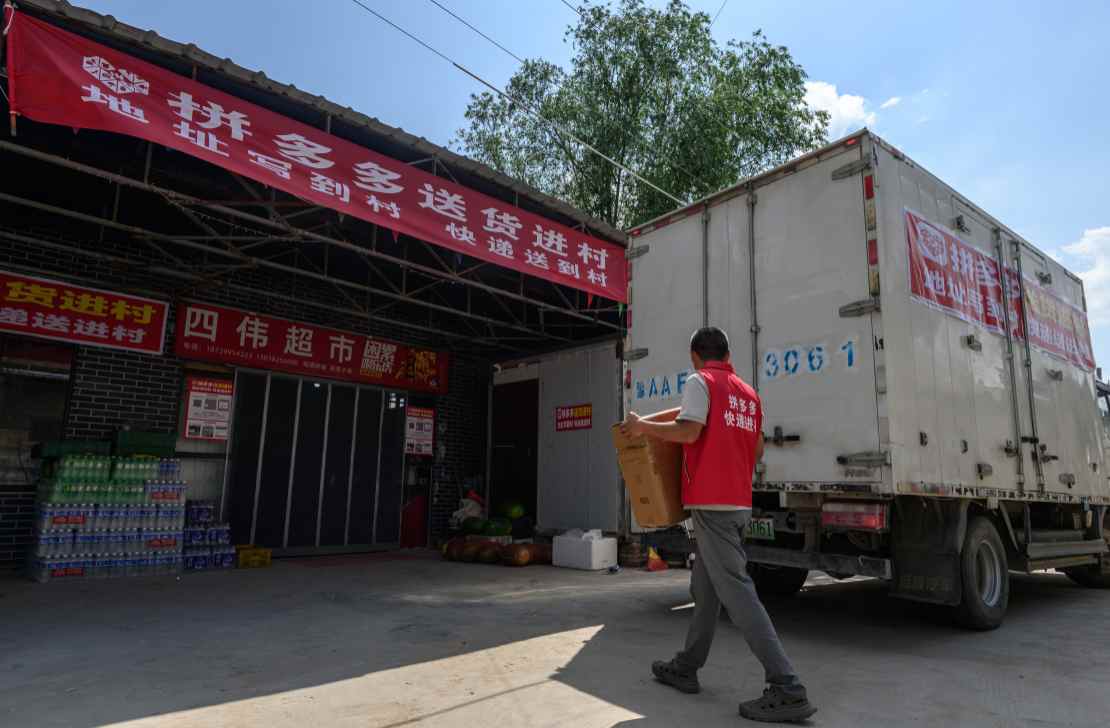
Duan Yuanhang, the person in charge of the “free delivery to the village” transit warehouse in Qi County, felt this deeply: “In the past, orders in the village were scattered, road conditions were complicated, and the cost of single delivery was high, and express delivery companies generally lacked the momentum to sink. Now that Pinduoduo has borne the second-tier transfer fee, everyone's enthusiasm is clearly different.”
Zhang Jinjian calculated an account: in the past, garlic was delivered to the county branch for more than 3,000 yuan a month, and then shipped nationwide from the branch. The shipping cost for a five-kg single ticket was 7 yuan; now the same weight is sent directly from the village entrance to the whole country, and the shipping fee has been reduced to about 3 yuan. “Logistics costs have been reduced, and profit margins have increased quite a bit.” For him, this change is a jump in efficiency from “delivering by yourself” to “getting on the bus at the entrance of the village”; for the entire garlic industry in Qi County, it is a supply chain reshaping from “difficult for agricultural products to enter the city” to “get on the bus as soon as you leave the village.”
Once logistics are in place, the “living water” of the economy is here
The changes in Zhang Jinjian's business quickly spread to everyone in the village.
In the past, farmers grew garlic and were most worried about sales. This year, Zhang Jinjian collected a large amount of garlic from the village at a price slightly higher than the market purchase price. Garlic farmers like Zhang Zhenfeng were able to sell 5,600 yuan more per mu. In Zhang Jinjian's warehouse, quite a few villagers who supply him also come here to help with packing. They are paid on a piece-by-piece basis. They can earn 130 yuan a day and earn about 4,000 yuan a month. His online store also invited five or six anchors, each rotating for two or three hours, with a fixed salary of 3,600 yuan to 4,000 yuan. As couriers drive past country roads day by day, garlic fields and garlic farmers appear on the live broadcast. The entire chain from growing garlic, harvesting garlic, packaging to delivery can be completed in the village, which also means that profits stay in the village.
Duan Yuanhang provided another set of data: Currently, the Qixian transit warehouse processes 10,000 to 12,000 inbound express deliveries and about 2,000 outbound express deliveries every day. Of these, agricultural products account for 1,800 inbound express deliveries, the vast majority of which are local garlic. The digital gap between entry and exit shows that rural areas still have huge room for “upward circulation” — and the process of filling this gap itself is creating growth.
In Caotun, Qi County, you used to have to go to a town five kilometers away to pick up an express delivery. It was ten kilometers round trip by electric bike, about an hour at a time. Once the village site is built, villagers will be able to pick up express delivery at the entrance of the village. Xu Lingling's supermarket has been in operation for 16 years. At the end of last year, it became a “free delivery to the village” village-level site. “Now, 100 to 200 packages are stored every day, and people who pick up couriers easily buy bottles of water and cigarettes. The supermarket traffic is clearly increasing.”
But the beginning of this logistics transformation didn't go well. Duan Yuanhang recalled that when they first entered the village, the villagers were very alert, and quite a few people held mobile phones to make videos. “Later, we unified work clothes, promotional posters, and vehicle signs, and stepped up publicity efforts so that villagers could actually see the convenience. Little by little, my concerns were allayed.” Nowadays, more and more young people are trying to open stores on Pinduoduo to sell good garlic from their hometown all over the country. “I couldn't do anything I wanted to do before; I just got stuck in the delivery hurdle.” Zhang Jinjian said, “Without stable logistics channels and suitable express delivery prices, small sellers simply can't do it.”
When express delivery cars are no longer empty, the countryside is no longer just the end point of consumption, but the starting point of the supply chain. When small entrepreneurs like Zhang Jinjian stopped worrying about logistics costs, when garlic farmers like Zhang Zhenfeng stopped worrying about sales, and when village-level sites like Xu Lingling relied on express delivery to revive the supermarket business — a sustainable rural commercial capillary network is being formed. It proved one thing: where logistics are accessible, economic vitality will naturally find a way to grow. Zhitong Finance believes that what Pinduoduo used infrastructure investment in exchange is a leap from “passive waiting” to “active connection” in rural areas, and an unprecedented reversal of the position of Chinese villages.