
6J Futures: Japanese Yen Tests the 160 Intervention Line Again
Between Intervention Fatigue and a Widening Rate Gap
Sentiment toward the Japanese yen remains fragile and highly reactive to intervention headlines rather than settling into a clean trend. USDJPY traded around 159.3 to 159.4 on August 14, and the yen was on pace to lose close to 1% for the week as speculators resumed selling in the absence of any follow up intervention from Tokyo. That weakness follows a sharp reversal from late July, when Japan's Ministry of Finance and the Bank of Japan conducted what Bloomberg estimated at roughly $53 billion, or ¥8.45 trillion, in yen buying on July 30, reportedly the largest single day intervention on record. Unusually, the operation appeared to draw direct support from the US Treasury under Secretary Scott Bessent, a detail that added weight to the move but has not stopped the yen from drifting back toward its prior lows. On August 13, Bloomberg reported that Prime Minister Sanae Takaichi's government is now supportive of a near term Bank of Japan rate hike, with policymakers likely to act in either September or October. The core tension has not changed. The Fed funds rate sits at 3.50% to 3.75% under new Chair Kevin Warsh, while the BOJ policy rate remains at only 0.75%, leaving a gap wide enough to keep funding the yen carry trade. Adding to the pressure, the ongoing Iran war has kept energy import costs elevated for resource poor Japan, complicating both inflation and growth forecasts and giving the BOJ another reason for caution even as political pressure to hike builds.
What the Market Has Done
- The market has generally been downtrending. From March to May, the market was in a sideways range between 0.00645 (Daily level 2) and 0.00625 (Daily level 3, the 160 USDJPY historical intervention level).
- As the market grinded down towards the 0.00625 area at the start of June, there was some responsive buying which caused a small bounce and suggested that traders were front running an expected BOJ intervention.
- This did not happen at the time, and longs were forced to liquidate as prices grinded below this level down to the 0.00613 area (Daily level 4, the USDJPY 163 to 165 area).
- Intervention happened on July 30, which caused prices to spike back up above 0.00625 (the 160 USDJPY level) and rotate back up to the 0.00645 area (Daily level 2).
- Most recently, sellers have responded from the 0.00645 area (155 USDJPY level), and prices are once more approaching that 0.00625 area.
- It is worth observing that the two confirmed Bank of Japan interventions this year both landed at month end, with the first on April 30 (extending through the Golden Week holiday into early May) and the second on July 30. Both episodes also followed a Federal Reserve decision and arrived just ahead of a scheduled BOJ policy meeting, a pattern worth watching for any future defense of the 0.00625 level.
What to Expect in the Coming Weeks
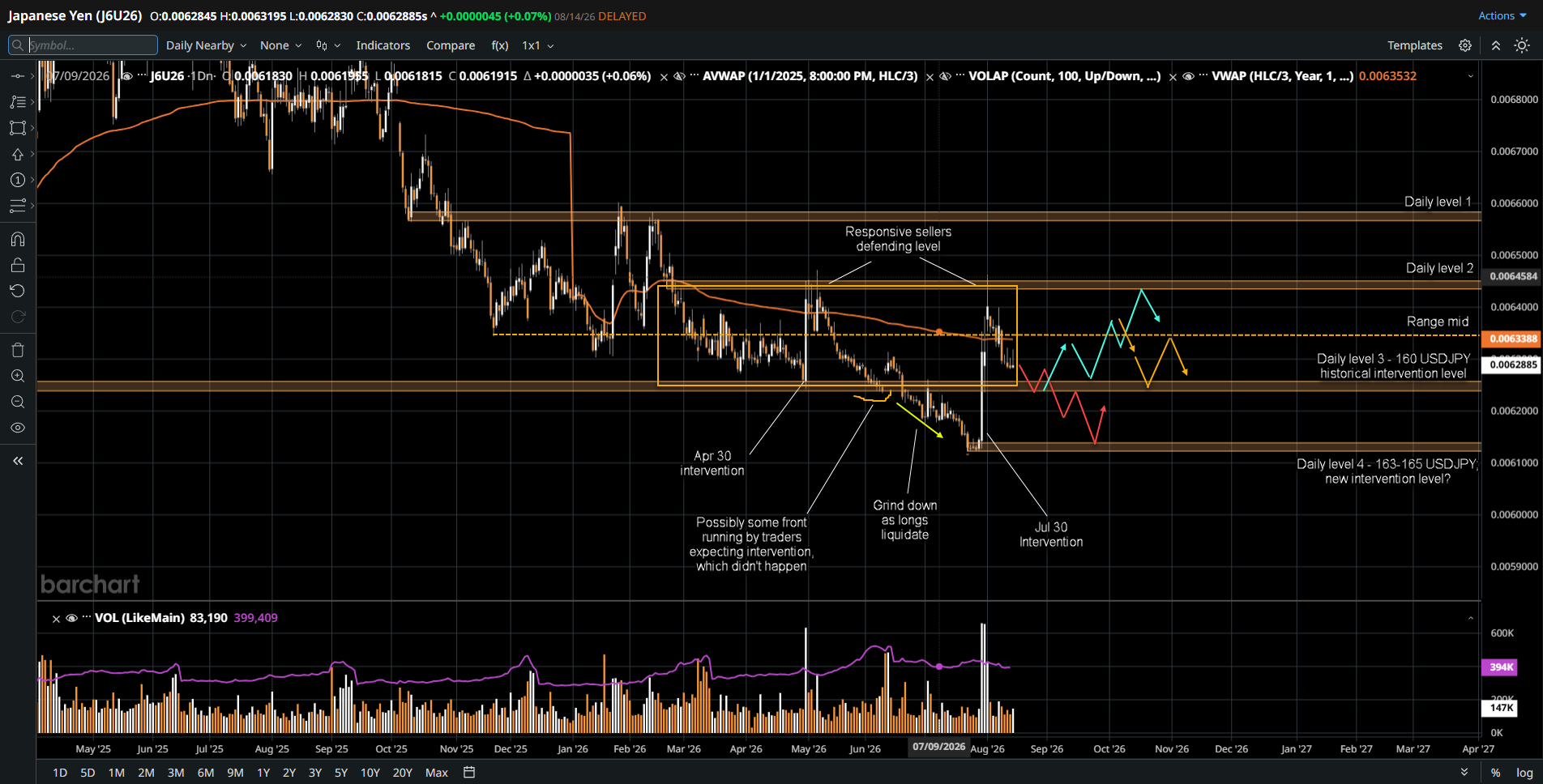
The key level to watch remains 0.00625 (Daily level 3).
Bullish Scenario
- If buyers are able to defend decisively at the 0.00625 level, expect a move back up to 0.00645 (Daily level 2).
- A possible trigger would be a surprise Bank of Japan rate hike announcement or a fresh round of confirmed intervention before the pair closes below 0.00625.
- A possible trigger would be a weaker than expected US inflation or payrolls print that pulls Fed rate expectations lower and narrows the yield gap.
Bearish Scenario
- If buyers are not able to hold bids at 0.00625, expect a move back down to the new intervention level at the 0.00613 area (Daily level 4).
- A possible trigger would be the Bank of Japan holding rates again at its next meeting while signaling no urgency to act despite Takaichi's government pushing for a hike. Another possible trigger would be further escalation in the Iran war that lifts oil prices and reinforces the safe haven bid for the US dollar over the yen.
Neutral Scenario
- If buyers are able to defend 0.00625 but face selling resistance at the 0.00634 area (Range mid), expect a two way auction between these two levels as the market balances out.
- A possible condition supportive of this, would be a data dependent Federal Reserve and Bank of Japan both holding steady through September, leaving the carry trade intact but capped by intervention risk near 160.
Conclusion
Technically, 0.00625 (the 160 USDJPY level) remains a critical marker on the 6J chart, since it was the trigger for the first Bank of Japan intervention of the year back in April. The second and largest intervention on July 30 actually came from lower down, near the 0.00613 area (roughly 163 to 165 on USDJPY), after price had already broken below 0.00625 and longs were forced to liquidate. Price then rotated back up to 0.00645 following that intervention, and it is now moving back down toward 0.00625, testing the same ceiling that has twice capped rallies since April. A confirmed break and hold below 0.00625 would open the door back toward the 0.00613 area, while a defended bounce keeps the broader March through August range intact. Fundamentally, two central banks are pulling in different directions. The Federal Reserve holds rates near 3.50% to 3.75% under Chair Kevin Warsh, while the Bank of Japan's 0.75% policy rate leaves a wide cushion for carry trade flows, even as Takaichi's government pushes for a hike as soon as September or October and rising bond yields, fiscal deficits, and Iran war driven energy costs add further complexity. With the yen once again approaching the zone that has already triggered two Bank of Japan interventions this year, first near 160 and then near 163, the coming weeks could prove decisive for where 6J futures head into the autumn. Where do you see the yen heading from here, and will 0.00625 hold this time?
We are a professional-grade futures brokerage engineered by traders to provide the high-performance architecture and futures trading platform required for serious market participation. We serve as a professional technical partner for traders who prioritize data integrity and objective analysis. Take the next step in your professional evolution and Open an Account today.
Disclaimer:
This article is provided for informational and educational purposes only and does not constitute financial, investment, or trading advice. The analysis presented reflects the author’s market observations and opinions at the time of writing and is not a recommendation to buy or sell any futures contract, security, or financial instrument. Futures trading involves significant risk and is not suitable for all market participants. Losses may exceed initial margin deposits, and market conditions can change rapidly.
Any scenarios, levels, or market expectations discussed are hypothetical in nature and are intended solely to illustrate potential market behavior. They do not represent actual trading results and should not be interpreted as guarantees of future performance. Past performance, market behavior, or historical price action are not indicative of future outcomes.
Readers are solely responsible for their own trading decisions and risk management. Always conduct independent research, consider your financial situation and risk tolerance, and consult with a qualified financial professional, if necessary, before engaging in futures or derivatives trading.