
Max Stock (TASE:MAXO) After Strong Results And Dividend Still Looks Pricey
Max Stock (TASE:MAXO) has drawn fresh attention after reporting second quarter and half year 2026 results, alongside a new cash dividend declaration that together give investors more detail on its current financial position.
See our latest analysis for Max Stock.
The latest earnings and dividend news comes after a mixed few months for Max Stock, with the share price at ₪34.03 and a 30 day share price return that is down 7.22%. Even so, momentum over a longer horizon remains strong, with a year to date share price return of 32.93% and a five year total shareholder return of 267.61%. This suggests recent results and the new cash dividend are being viewed positively in the broader story.
If this kind of long term compounding interests you, it can be useful to see which other companies have built strong owner led cultures and track records through our 106 top founder-led companies
Bulls see Max Stock’s recent earnings and dividend as support for a higher valuation, while bears point to the pullback after a strong multi year run. Do the current numbers still justify paying a higher price for this stock?
Price to Earnings of 31.7x: Is it justified?
On the current numbers, Max Stock trades on a P/E of 31.7x, which puts a clear premium on its recent earnings performance compared to peers.
The P/E ratio compares the share price to earnings per share and is a common way to see how much investors are willing to pay for each unit of profit. For a retailer like Max Stock, it often reflects how confident the market is that current profit levels can be sustained or improved.
Recent data shows earnings growth of 35.9% over the past year and an average of 17.7% per year over five years, with net profit margins at 9.8% compared to 8% last year. That growth profile, along with an outstanding 57.3% return on equity and what is described as high quality earnings, helps explain why the market is prepared to apply a higher P/E than many peers.
Even so, Max Stock is described as expensive relative to both the Asian Multiline Retail industry average P/E of 20.7x and a peer average of 21.3x. That gap suggests investors are already pricing in stronger profitability and returns than the broader industry. Anyone assessing the stock will want to decide whether that higher multiple is supported by their own expectations for future earnings.
See what the numbers say about this price — find out in our valuation breakdown.
Result: Price-to-Earnings of 31.7x (OVERVALUED)
However, Max Stock still faces risks from any slowdown in Israeli consumer spending, as well as pressure on margins in a highly price sensitive discount retail segment.
Find out about the key risks to this Max Stock narrative.
Another view on Max Stock’s valuation
While the 31.7x P/E suggests Max Stock is richly priced compared to peers, the SWS DCF model points in the same direction. At a share price of ₪34.03 and an estimated future cash flow value of ₪25.20, the stock appears overvalued on a cash flow basis as well. Which signal should carry more weight for you?
Look into how the SWS DCF model arrives at its fair value.
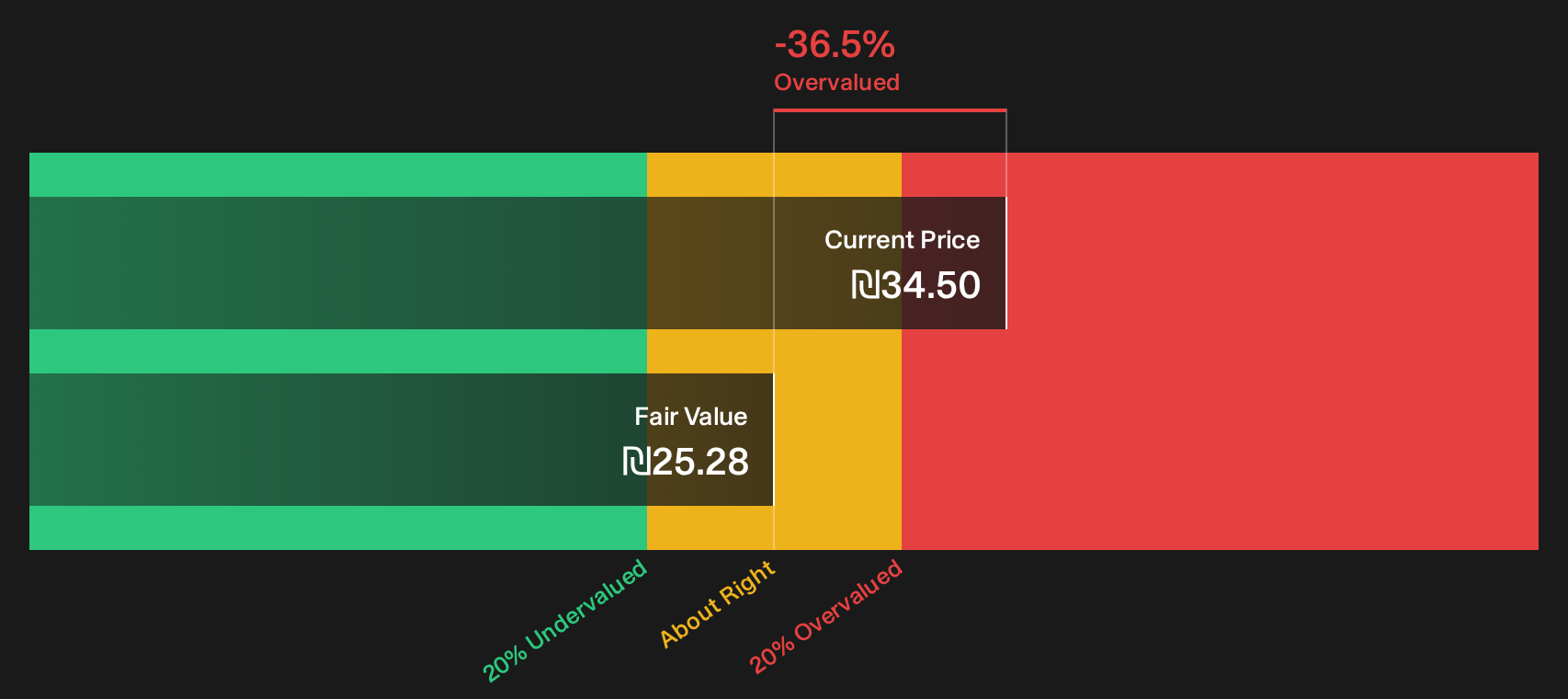
Simply Wall St performs a discounted cash flow (DCF) on every stock in the world every day (check out Max Stock for example). We show the entire calculation in full. You can track the result in your watchlist or portfolio and be alerted when this changes, or use our stock screener to discover 253 high quality undervalued stocks. If you save a screener we even alert you when new companies match - so you never miss a potential opportunity.
Next Steps
With Max Stock attracting both optimism and caution in equal measure, it makes sense to look at the full picture yourself and decide quickly. To see how the positives stack up against the concerns, review the balance of 1 key reward and 1 important warning sign
Looking for more investment ideas beyond Max Stock?
If you are serious about building a stronger portfolio, do not stop with Max Stock. Use targeted screeners to quickly uncover other opportunities that match your approach.
- Target potential bargains that combine quality and attractive pricing by running the 253 high quality undervalued stocks tailored to investors who care about fundamentals.
- Prioritise resilience and capital preservation by focusing on companies in the 297 resilient stocks with low risk scores that score well on financial strength and risk measures.
- Hunt for overlooked opportunities with solid foundations by checking the screener containing 609 high quality undiscovered gems before the crowd catches on.
This article by Simply Wall St is general in nature. We provide commentary based on historical data and analyst forecasts only using an unbiased methodology and our articles are not intended to be financial advice. It does not constitute a recommendation to buy or sell any stock, and does not take account of your objectives, or your financial situation. We aim to bring you long-term focused analysis driven by fundamental data. Note that our analysis may not factor in the latest price-sensitive company announcements or qualitative material. Simply Wall St has no position in any stocks mentioned.
Have feedback on this article? Concerned about the content? Get in touch with us directly. Alternatively, email editorial-team@simplywallst.com