
The “Double Throat Crisis” Has Caused a Super Bull Market in Refining Stocks! Cracking price differences have reached historical extremes, and US refiners are enjoying the global shortage of refined oil products
The Zhitong Finance App learned that as the new round of the geopolitical situation in the Middle East seems to be getting out of control — particularly as both the US and Iran emphasize that their camps control the Strait of Hormuz, global refining stocks are experiencing an unprecedented surge in the market, but historical experience shows that it may soon come to an end.
This round of geopolitical conflict has pushed the core of the global energy shortage from the “Middle East crude oil supply itself” to “usable refining capacity and refined oil products” on a large scale, bringing cracking price differences and refinery companies' profits to extreme levels in history. However, this excess profit driven by war premiums has a strong return to average. Once the situation eases, refining stocks may experience a double retreat in valuation and profit faster than crude oil. The EIA (US Energy Administration) defines Crack Spread (Crack Spread) itself as the difference between the wholesale price of refined oil products and the cost of crude oil, so it is closer to the marginal profitability of refineries than absolute oil prices.
“Double throat crisis” reduces the supply of refined oil products on a large scale
As of August 17, the geopolitical situation between the US and Iran has not substantially cooled down; on the contrary, it has formed a “Hormuz+Mander Strait” dual shipping bottleneck. Negotiations between the US and Iran are still at an impasse, and the Strait of Hormuz almost came to a standstill after a new tanker attack: Kpler statistics show that only 5 commodity ships passed through on August 15, and even none on the 16th, compared to 31 ships the previous weekend, and the daily traffic volume before the war exceeded 130 ships; the strait undertook about one-fifth of the world's oil and LNG transportation before the war. Furthermore, both the US and Iran are currently strongly emphasizing that their own camps can control the Strait of Hormuz, and have engaged in fierce verbal confrontations and geographical games with each other, and on Monday local time, Trump said he refused to extend the 60-day cease-fire agreement between the US and Iran.
Meanwhile, Yemen's Houthis imposed a naval blockade on Saudi Arabia. Shipping in the Mander Strait declined markedly, and the latest data did not even record the passage of Saudi crude oil; previously, Saudi Arabia had already diverted large quantities of crude oil northward from Yanbu to the Mediterranean Sea via the Suez Canal and SUMED pipelines, and some tankers shut down the AIS to carry out “dark voyages.” This latest geopolitical situation also means that the Red Sea alternative route originally used to bypass Hormuz is also under threat, and the global oil transportation system is in fact suffering from risk premiums at two key entry points at the same time.
This year was a historic year for oil refiners. The three major oil refining giants headquartered in the US — Marathon Petroleum (Marathon Petroleum), Valero Energy (Valero Energy), and HF Sinclair have all surged by more than 80% in 2026. Compared with the S&P 500 index, it only rose 11% during the same period; at the same time, the cracking spread benchmark index, WTI 3-2-1 Crack Spread (Crack Spread), is close to $59 per barrel, nearly tripling from January's price level. That is, in less than 1 year, the record has nearly tripled.
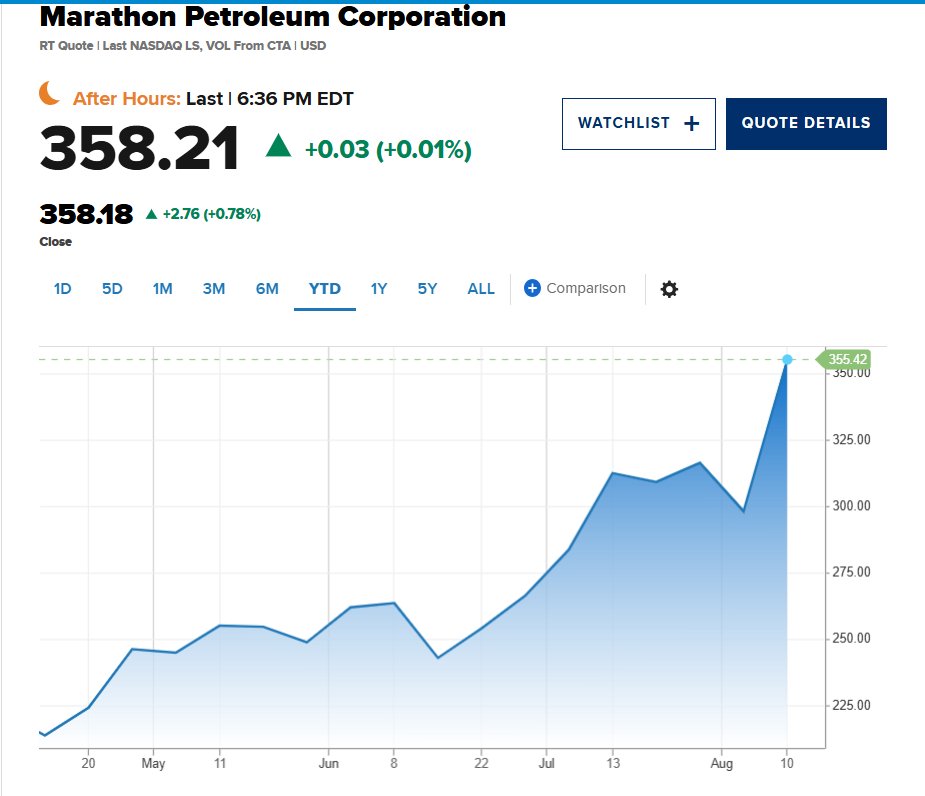
In particular, the stock prices of the two largest refiners, Marathon Petroleum and Valero Energy, have nearly doubled since this year. Phillips 66 (PSX.US), one of the US oil and gas giants, has risen sharply by 66% — and about one-third of this increase occurred in just one month. For comparison, between 2010 and 2021, the average level of the same cracking spread was only about $19.
How rare is this round of a super-bull market in refining stocks in history?
According to data provided by Carter Worth, a senior analyst at WorthCharting, the S&P 500 oil and gas refining and marketing sub-industry index, composed of Marathon Petroleum, Valero Energy, and Phillips 66, has surged 104% at the index level since this year. By the close of last Friday, the index was 41% above Worth's most popular technical indicator — the 150-day moving average. This has only happened 5 times in the index's history. However, in all of the previous 5 cases, the return for the next 6 months was negative, and the average return was -10.1%.
If investors still can't help but want to keep up now, they need to be aware that the core factor driving current refining profit margins is geopolitics, and the geopolitical risk premium can be reversed. The reason for the sharp rise in cracking spreads stemmed from the hostile conflict in the Strait of Hormuz, compounded by a long and ongoing geopolitical war between Russia and Ukraine. Although the Strait of Hormuz has recently received more attention, Russia itself is also an important global producer of refined oil products. Under normal circumstances, production may reach about 5.5 million barrels per day, but according to some estimates, this production has now declined by 25% to 30%.
If the Gulf region actually reaches and maintains a cease-fire agreement, cracking spreads will fall rapidly, and refining stocks will fall accordingly. At the time of writing, of the 3:2:1 cracking spread on the New York Mercantile Exchange (Nymex), the September contract was about $69.92, compared to less than $20 at the beginning of January; the August 2027 contract was $44.38, which is more than 35% lower than that. From February 2016 to February 2026 — that is, before the attack against Iran — the average level of this cracking spread was approximately $21.68.
Cyclical industries — or industries characterized by a return to the mean — tend to look “cheapest” at the top of the cycle because record profits lower price-earnings ratios. If this is not the case, then the market is actually valuing it according to the assumption that “abnormally high profit margins will last forever,” but in fact, this profit margin will not be maintained forever. Because of this, the rolling price-earnings ratio of large US refiners, such as Phillips 66 and Marathon Petroleum, has fluctuated greatly between mid-single digits and 35-40 times over the past decade — with the exception of the most special COVID-19 pandemic period.
There is often a saying in the market: “The best antidote for a high price is the high price itself.” However, this mechanism usually takes a long time to work. Demand disruptions do exist, but changes in consumer behavior take time; and on the supply side, production cannot return to normal overnight. If there continues to be a shortage of supply in the refined oil market, then the mid-cycle cracking price spread may indeed be structurally reset to a higher level, which means that currently these valuation multiples may not necessarily be at the peak of the cycle for as long as it seems on the surface; moreover, if the situation in Hormuz remains tense until the end of the year, then the so-called “excessive expansion of the market” may also extend even more excessively.
Refining is indeed a very good business, but if some investors are lucky enough this year to fully participate in this round of the market, it is likely that the time has come to a profit settlement; and for those who are bolder and want to bet on a return to the average before the end of the year, they may even consider setting up bearish positions — preferably through options, of course — betting on any easing of the situation will promote the normalization of cracking spreads.
Senior analyst Carter Worth uses Marathon Petroleum (Marathon Petroleum) as a reference operator—but frankly speaking, this investment logic is basically the same for all large refiners, so if you own other large refining stocks, a similar trading structure can also be applied.
Trade Breakdown (Trade Breakdown): Buy a put option (PUT) with an execution price of $330 and due on December 18, 2026, and pay $21.90; sell a put option (PUT) with an execution price of $280 which expires on December 18, 2026, with revenue of $7.15; Maximum loss: $1,475; Maximum profit: $3,525; Difficulty of operation: Intermediate.
This “Trade Breakdown” constructs a bearish bearish spread (Bear Put Spread) for Marathon Petroleum (MPC): buy a Put with an execution price of $330 due on December 18, 2026, and sell a Put with the same maturity date and execution price of $280 to reduce shorting costs; the net expenditure is 21.90−7.15 = 14.75 US dollars/share, corresponding to 100 shares for each option, so the maximum loss is $1,475, and After deducting the net cost of $14.75 for the difference between the two execution prices of $50, the maximum benefit was $3,525, and the break-even point at maturity was approximately $315.25. In other words, this is a bearish trade where both risk and return are capped: analysts seem to be betting that Marathon Petroleum (MPC) stock price will fall before the end of the year due to falling cracking spreads and the geographical risk premium subsides. If it falls to $280 or less at maturity, the maximum benefit can be obtained; if it is still $330 or more at maturity, the entire net premium of $1,475 will be lost.
The rise in crude oil is only an indication; the real profit is hidden in the “refining bottleneck” — cracking price spreads have reached historical extremes
The reason why refining stocks have become one of the purest winners in this round of conflict, is not the “rise in oil prices,” but “the price of refined oil has risen far faster than the cost of raw materials in refineries,” thus causing the cracking price gap to explode.
Middle Eastern refineries were affected by the war and disruptions in crude oil delivery, and Russian refining volume fell to a low level of nearly 20 years due to the Ukrainian attack, and exports of refined oil products from China and other important Asian demand countries also began to weaken; in July, global diesel exports fell by about 1.3 million b/d over the same period last year. At the same time, the price of Brent crude oil has fallen from a high of about $126 per barrel during the war to around $90.87 on August 17, but the supply of diesel, gasoline, and aviation fuel is still extremely tight — so refining is facing a very typical “fall in input cost (input cost reduction) +high product price (price of refined oil) = sharp increase in refining margin (that is, refining profit margin soars), and the theoretical gross profit that large refiners can earn for each barrel of crude oil processed.
US refineries are particularly dominant because they have a relatively stable supply of North American crude oil, sophisticated refining facilities, and global export capacity for refined oil products. They can transform US crude oil into the world's scarce diesel, gasoline, and aviation coal, and then directly turn product shortages caused by geopolitics into cash flow.
This “refining bottleneck alpha” has actually hit the profit sheets and stock prices of these North American refining giants: Marathon Petroleum (Marathon Petroleum), Phillips 66, and Valero Energy reached a combined profit of about US$12.6 billion in the second quarter and returned US$6.3 billion to shareholders; as of mid-August, the stock prices of the three companies rose by about 110%, 75%, and 98% respectively during the year, and the US diesel cracking price difference reached a record 93.84 US dollars/barrel.
What is really scarce in war is not necessarily underground crude oil; it may be “effective refining capacity to turn crude oil into consumable fuel.” But this is also the biggest risk for refining stocks — once the US-Iran cease-fire, the Houthis blockade is lifted, and Russian refineries gradually resume, the shortage of refined oil products will be repaired faster than the impact on crude oil supply, and Crack Spread will return to average; therefore, refining stocks are currently both one of the biggest geopolitical profit winners, and probably one of the most sensitive profit winners under any credible cease-fire news.