
Geely Auto (00175): Mid-term price and volume profit improved simultaneously, and “one Geely” drives high-quality growth
There is an easy way to determine whether a car company is high enough, and that is “Shifu Zhi Jincao.”
Specifically, at a stage where the industry has entered stock competition and is being disrupted by multiple adverse factors, it is still able to achieve resilient growth by comprehensively promoting globalization, high-end and intelligence, making it a high-quality car company. This is confirmed by the 2026 interim results and sales data disclosed by Geely Auto (00175). 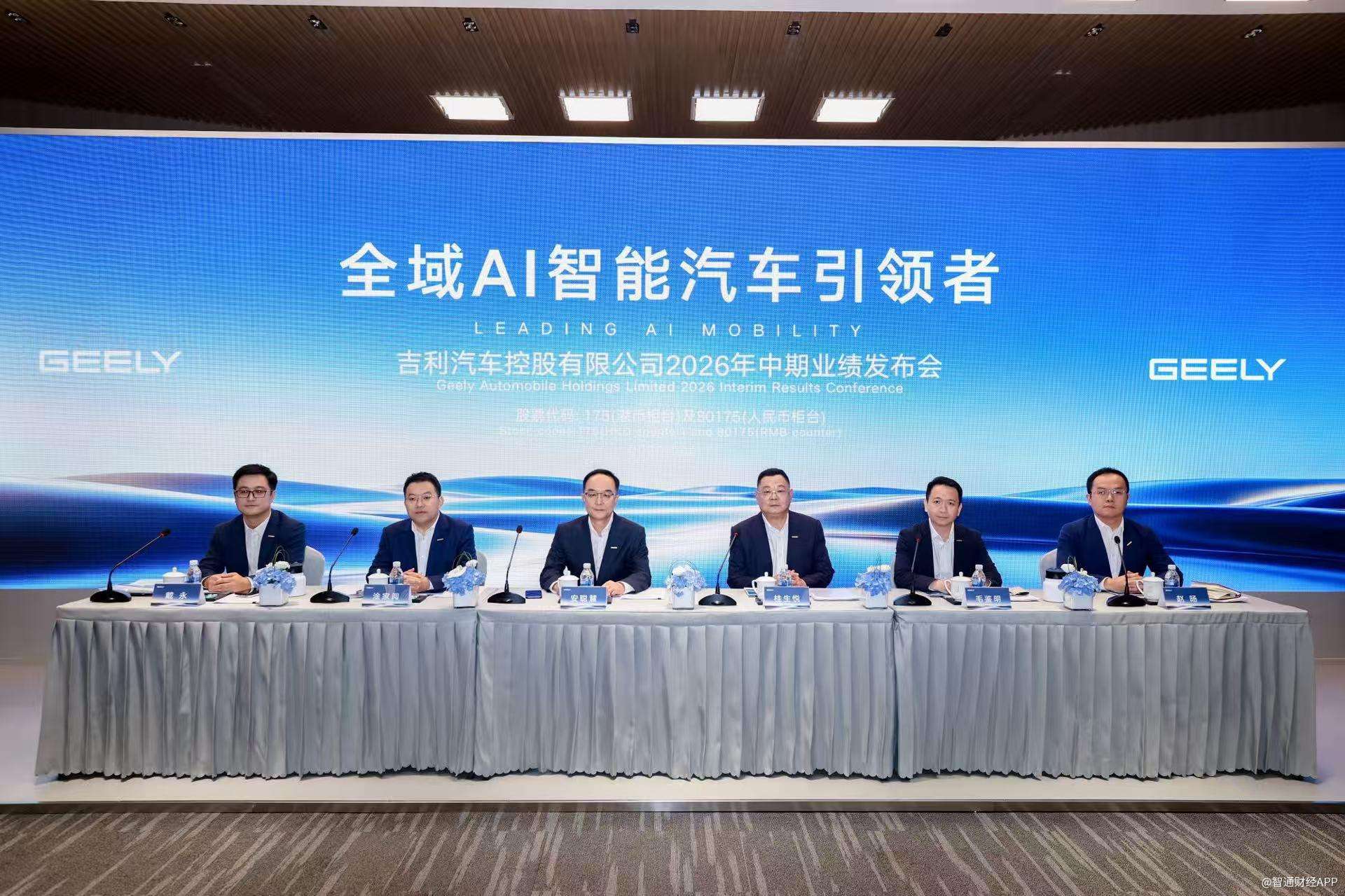
Top domestic sales in half a year, with volume, price, and profit rising
According to data from the China Automobile Association, the domestic wholesale volume of passenger cars (including exports) in the first half of 2026 was 12.72 million units, down 6% year on year, putting pressure on the overall demand of the industry. Faced with external environmental pressure, Geely achieved total sales volume of 1,423 million vehicles in the first half of the year, an increase of 1% over the previous year. According to data from the Passenger Federation, the company was the domestic sales leader for passenger cars in the first half of the year, and was also the only car company with domestic sales exceeding one million vehicles during the period. It is worth noting that Geely Automobile also increased sales by 1%, leveraging a 15% year-on-year increase in revenue to 173.6 billion yuan (RMB, same below), achieving positive revenue growth for the sixth year in a row.
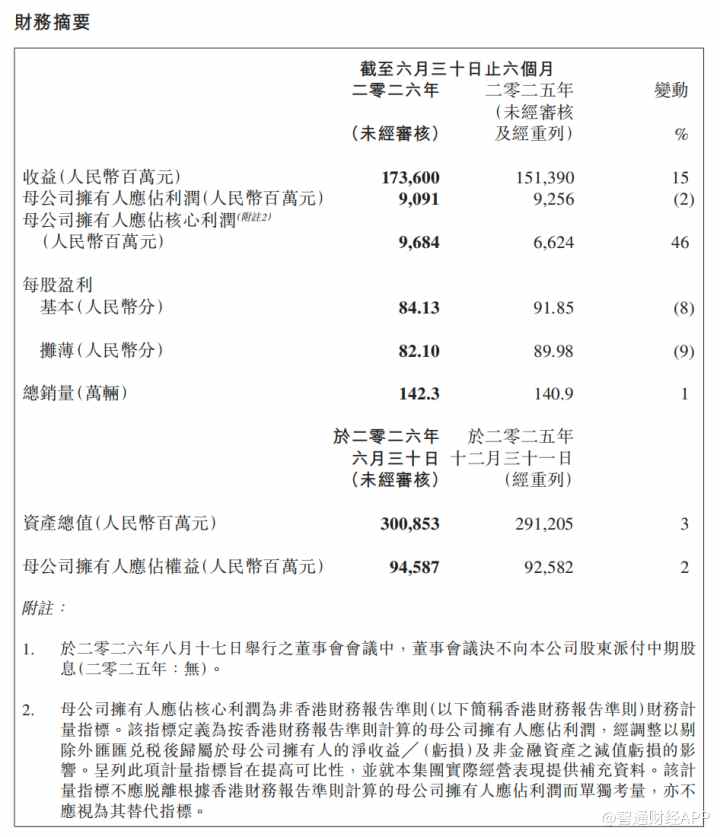
On the profit side, excluding the effects of exchange gains and losses and depreciation of non-financial assets, the core net profit to mother reached 9.684 billion yuan, a sharp increase of 46% over the previous year. On the other hand, looking at the 7 leading automakers that recently disclosed their semi-annual performance forecasts, 2 had almost cut their profits, and 5 lost money.
A set of contrasting data reflects changes in Geely's growth model. In an environment where the industry has generally fallen into a “price-for-volume” environment, Geely has embarked on a development path of “volume, price and profit rising sharply.” In the first half of the year, the company's overall gross sales margin increased to 17.9%, and the average bicycle sales revenue rose to 112,000 yuan.
On the cost side, management expenses increased slightly by 1% year on year to 2.93 billion yuan, but the management fee ratio decreased by 0.2 percentage points year on year, reflecting the effectiveness of business integration under the “One Geely” strategy to continuously improve resource utilization efficiency. At the same time, overseas channels expanded on a large scale, and sales expenses increased by only 0.1 percentage points year-on-year, reflecting the economies of scale brought about by brand integration and channel reuse.
Increased operating efficiency increased bicycle profitability. In the first half of the year, the company's core bicycle net profit increased 45% year on year to 6,806 yuan, driving net cash flow from operating activities during the period to 19.9 billion yuan, an increase of 32% over the previous year; capital reserves reached 69.6 billion yuan at the end of the period.
Geely Auto actively gives back to shareholders based on good business quality. In the first half of the year, the company implemented a total of HK$1,885 billion in repurchases and implemented a dividend of HK$0.5 per share on July 30, an increase of 51.5% over the previous year. The total dividend payout reached HK$5.39 billion, and the core profit dividend ratio exceeded 30% for five consecutive years.
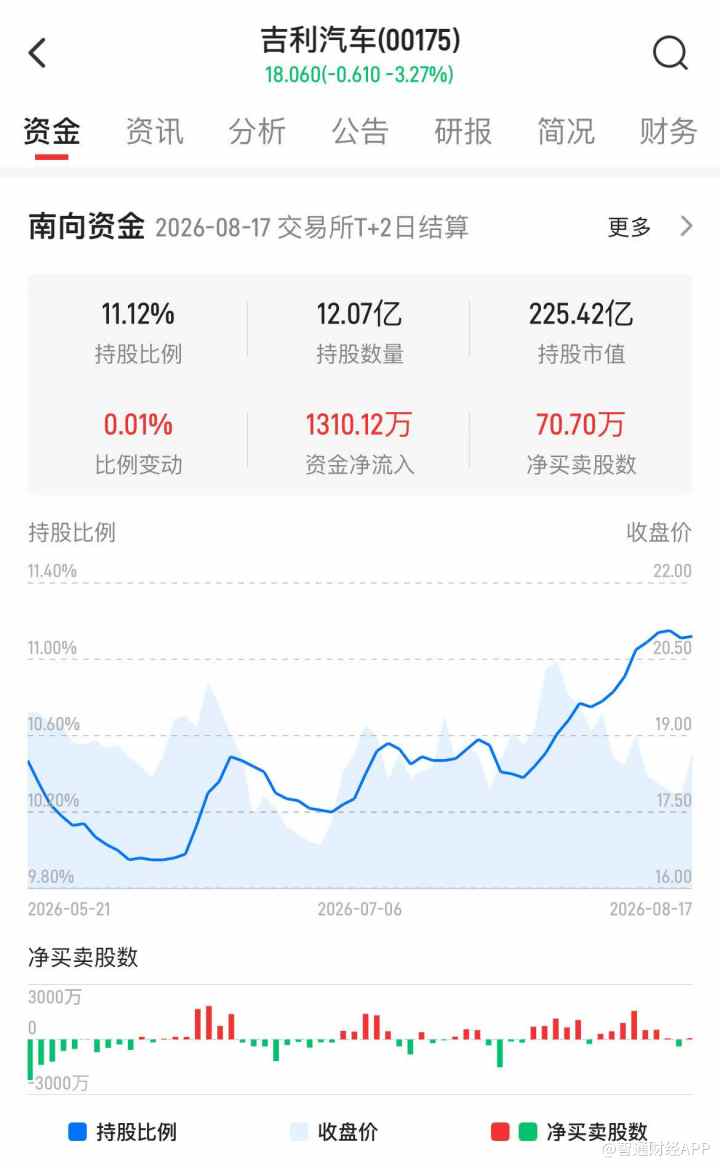
In the secondary market, investors continue to cast a “vote of confidence” in Geely. Since the beginning of 2026, 46 institutions have increased their holdings or opened positions in the first half of the year. According to data from the Zhitong Finance App, as of August 14, Southbound Capital held 1.27 billion shares of Geely Automobile, with a shareholding ratio of 11.12%. Recently, many domestic and foreign investment banks have given positive ratings. Among them, CICC maintained Geely's “outperforming the industry” rating and a target price of HK$30, corresponding to 12.6 times/10.1 times 2026/2027 P/E, with 60.7% upside.
The “One Geely” system improves efficiency, and the four major brands work together to consolidate the basic market
The positive feedback from the capital market is essentially a pricing on the company's ability to integrate strategies and growth prospects. Relying on the deep integration of the “One Geely” system, the four major brands achieved misaligned collaboration: the four major brands, Krypton, Linker, Galaxy, and China Star, respectively anchor different price bands and target customer groups, achieve differentiated competition at the front desk, and share R&D, procurement, and supply chain resources in the back office to effectively avoid problems such as repeated investment and internal consumption that tend to occur during the new energy transformation phase.
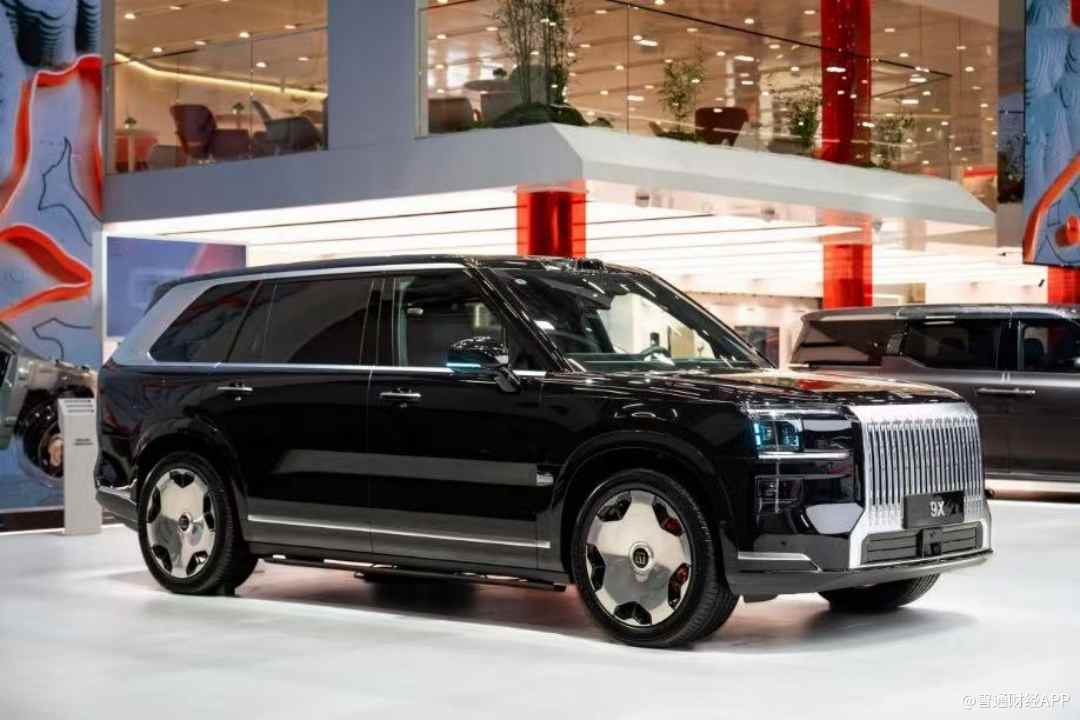
The Zhitong Finance App noticed that Krypton has grown into Geely Auto's profit pillar. In the first half of the year, 178,400 vehicles were sold, accounting for only 12.5% of total sales, but contributed 31.7% of revenue. The average customer unit price of the brand was about 350,000 yuan. The Extreme Krypton 9X continues to lead the domestic large SUV segment of more than 500,000 yuan. In the second half of the year, the Extreme Krypton brand will launch the Extreme Krypton 9X, and form four ultra-luxury dual flagships with 009 Guanghui. The Extreme Krypton 9X will enter overseas markets one after another, kicking off Geely's high-end expansion into the sea. According to an analysis by the Northeast Securities Research Report, with the completion of privatization and integration into the main body of the listed company, R&D and supply chain synergy effects are gradually being implemented; relying on the high-end product matrix composed of 9X and 8X, it is expected that Kyokrypton will gradually unleash profit potential.
Lynk & Co breaks out of homogenization and focuses on the “trend, sport, personality” label. In the first half of the year, 144,000 vehicles were sold, and the Linker 07GT was used as the fulcrum of change to develop high-end market segments; overseas partners with Volvo carried out operational cooperation in Europe to reduce the cost of trial and error when going overseas through mature channels.
Geely Galaxy is the basic market for mainstream new energy, with sales of close to 520,000 units in the first half of the year. Instead of simply following the domestic low price route, represented by Star Wish, the domestic version consolidated the scale and obtained higher gross profit from the overseas version, forming a “domestic chassis building and overseas profit raising” model. In the second half of the year, two new high-margin models, the TT and the Battleship 700, were launched, superimposing iterations on existing models to continuously optimize the profit structure.
The fuel business remains an important ballast stone for the company's cash flow. Geely China Star sold over 580,000 units in the first half of the year, winning the Chinese brand fuel passenger car sales championship for the 10th year in a row. Facing the continued contraction of the domestic fuel vehicle market, the company promoted the i‑HEV smart engine hybrid transformation. Currently, it has launched major models such as Xingrui, Xingyue L, and Emgrand, and aims to sprint to sell 30,000 iHEV models per month by the end of the year. It is worth noting that the hybrid product is scheduled to go overseas in 2027; from a global perspective, fuel and hybrid models still occupy 60% of the market, and Geely's overseas technology system is expected to open up new growth space.
Go overseas in a symbiotic way with the industry to create a new growth curve
Overseas markets have become a strong growth engine for Geely today. Overseas exports in the first half of 2026 were 474,200 vehicles, a sharp increase of 158% over the previous year. The export scale for half a year has already exceeded the full year of 2025; exports in a single month in June and July continued to exceed 100,000 units, and the overseas sales ranking rose to third place among domestic car companies. Based on growth performance that exceeded expectations, Geely raised its annual overseas sales target from 640,000 units to 920,000 units, and sprinted to 1 million units.
Geely Automobile CEO Gan Jiayue said at the mid-term results conference that in the first half of the year, the company's exports showed three characteristics: mainstream car companies had the highest export growth rate, new energy export growth rate first, and high-end Chinese brands had the highest export growth rate; the company has set long-term goals, and two-thirds of future sales will come from overseas markets.
It is worth noting that compared to the asset-heavy factory construction and overseas routes commonly used by its peers, Geely has explored a “industrial symbiosis” overseas model: developing joint ventures with local giants such as Ford, Renault, Proton, and Volvo to share each other's existing production capacity, supply chain, and channel resources. The advantages of this model are outstanding: it can not only quickly complete overseas market sales, but also hedge against business risks caused by geographical conflicts and changes in overseas policies, and achieve more stable and sustainable overseas expansion in an anti-globalization environment.
Ford's Spanish factory cooperation reached in July of this year is a typical example of this model. Geely Automobile invested 221 million euros to acquire 34% of Ford's Valencia plant in Spain, and the two sides formed a joint venture to carry out contract production of the vehicle. Citigroup Research estimates that the investment cost of this joint venture to obtain production capacity is only 10% to 20% of the construction of a new overseas greenfield plant; at the same time, it can directly reuse the mature local supply chain to help hedge against potential import tariffs on EU electric vehicles. The deal is expected to land in the fourth quarter, which will become an important milestone in Geely's localization in Europe.
Up to now, Geely has put into operation 12 overseas manufacturing plants, with a total overseas production capacity of more than 650,000 vehicles, and is expected to exceed 840,000 units by the end of the year; sales channels cover 114 core markets, and overseas offline outlets surpass 2,000; Swedish and German R&D teams have completed integration to reduce the time lag between global model launches and promote the transition from “products going overseas” to systematized overseas.
High growth in R&D investment to create a global leader in AI smart cars
The capital market's valuation logic for automakers is undergoing profound changes: simple sales volume is no longer the core of pricing; self-developed technical reserves and full-link intelligent capabilities are gradually becoming the key to bridging the valuation gap. Geely is positioned as a “global AI smart car leader”. The company's technological attributes are not limited to vehicle cockpit intelligence, but rather infiltrates AI into the entire design, R&D, manufacturing, and after-sales business chain.
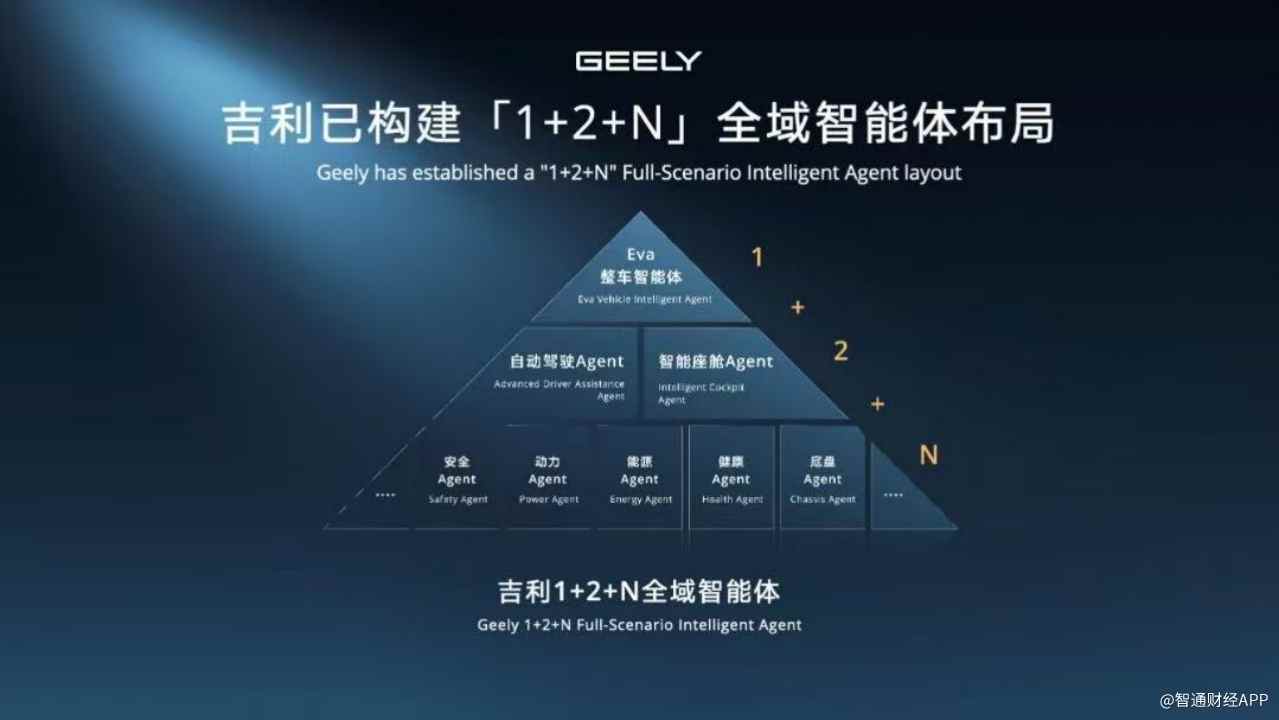
In the first half of 2026, Geely Automobile invested about 9.2 billion yuan in R&D expenses, an increase of 25.5% over the previous year. Through a high level of R&D investment, the company has built a “1+2+N” global intelligent technology framework: with the WAM world behavior model as the core, the Super Eva Smart Device and the Qianli Grand G-ASD intelligent driving system are the two pillars, extending multi-dimensional AI capabilities in safety, chassis, and energy. It lays out chips, large models, intelligent robots, and low-orbit satellites to create a foundation for integrated technology in heaven and earth. It is one of the few domestic automakers that have achieved multi-stage full-stack self-development.
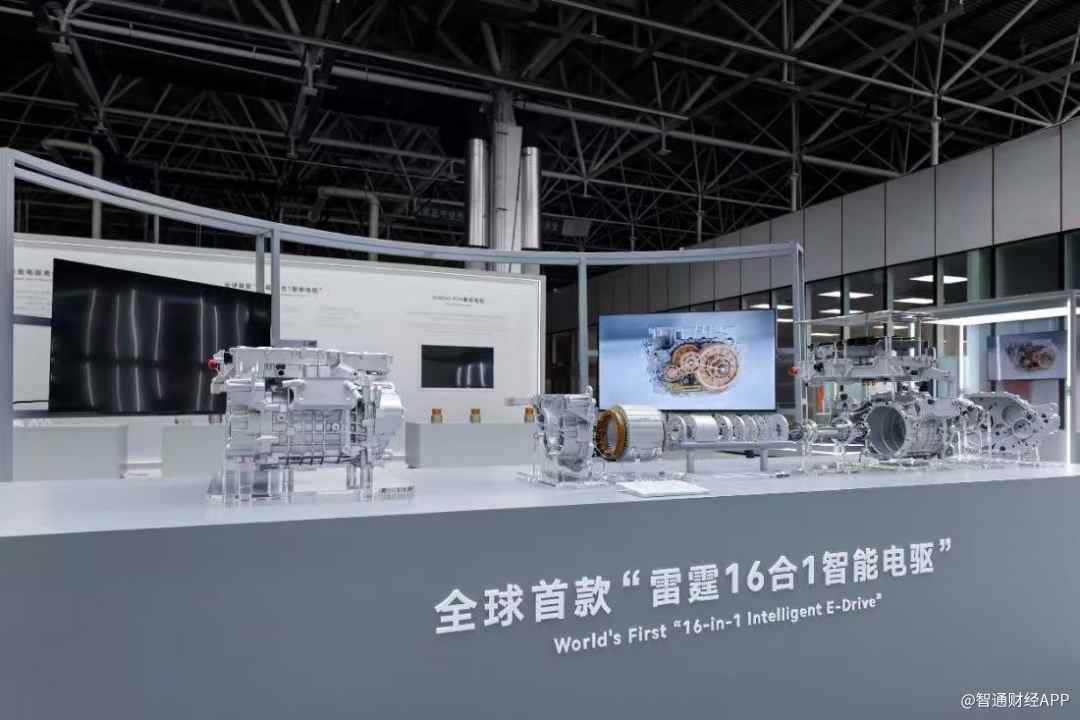
The three-electric system has completed vertical integration. Relying on technology players such as Haosi Power, Jiyao Tong, and Stardrive Technology, Geely opens a complete link from underlying materials to system integration. Self-developed technologies such as i-HEV Smart Hybrid, Thor AI Electric Hybrid 2.0, Aegis BRICS batteries, and Thunder 16-in-1 smart electric drives have been mass-produced on a large scale. In the second half of the year, an iterative version of the WAM World Behavior Model will be released, an AI off-road architecture and all-terrain AI digital chassis will be launched; the “2030 Laboratory” will be set up to target cutting-edge directions such as power semiconductors, physical intelligence, and big models to reserve disruptive technologies for the future.
From an investor's perspective, when enterprise growth no longer depends on internal price, but rather comes from product technology iteration, brand improvement, and global system output, the valuation framework should break out of the PE constraints of traditional manufacturing enterprises. Currently, Geely's valuation is at a historically low level. As high-end models continue to be released and overseas production capacity is gradually released, operating leverage and valuation restoration are expected to resonate.
Conclusions
As can be seen from this mid-term report card, Geely Automobile chose to follow a meaningful and sustainable high-quality development path. Relying on internal system integration, technological iteration, high-end breakthroughs, and a global layout, Geely handed over a special questionnaire: rejecting internal price reports and relying on system capabilities to achieve value growth. In the deep adjustment cycle of the industry, the company took into account scale and operating efficiency, and became a typical example of domestic car companies moving from scale expansion to value growth. Looking ahead, as the efficiency dividends, technical dividends, and brand dividends of the “One Geely” strategy continue to be released, Geely is expected to participate in the global automobile industry competition with a more steady attitude, providing a practical reference for the improvement of Chinese automobile brands.