
San Francisco Federal Reserve economists estimate a medium-term neutral interest rate of 1.5%, which suggests that the Fed's policy is “loose”
The Zhitong Finance App learned that a recent study by San Francisco Federal Reserve economist Vasco Curdia estimates that the medium term neutral interest rate for the US economy is about 1.5%, but there is great uncertainty about this estimate. This estimate suggests that the Federal Reserve's current policy interest rate may be relaxed.
The indicator aims to measure the natural interest rate in the medium term and is an important benchmark for evaluating whether monetary policy is tight or loose. The San Francisco Federal Reserve defines natural interest rates as the actual short-term interest rate when the economy is running at a potential growth rate.
What does a 1.5% neutral interest rate mean?
Curdia's study uses a medium dimensional measurement method aimed at smoothing out the sharp fluctuations and statistical noise common in short-term estimates. The 1.5% estimate obtained by this method is significantly higher than the level implied by some early models.
Assuming a potential inflation rate of at least 2.5%, an actual neutral interest rate of 1.5% corresponds to a nominal neutral policy interest rate of about 4%. In other words, when the Federal Reserve's policy interest rate falls below 4%, monetary policy is still theoretically relaxed; conversely, if it is above 4%, it begins to suppress the economy.
Currently, the Federal Reserve's policy interest rate remains in the 3.5% to 3.75% range. In other words, currently the Federal Reserve is not only not “putting on the brakes,” but is still “stepping on the gas.”
This conclusion is clearly at odds with the current judgment of most Federal Reserve officials that monetary policy is in a restricted range, or at most close to neutral.
Dramatic changes in natural interest rate estimates
Curdia's study also showed that estimates of natural interest rates have changed significantly over time. The figure below shows that from the late 1980s to the 1990s, natural interest rate estimates were at a high level; before and after the 2008 global financial crisis, natural interest rate estimates slipped into a negative range and gradually rebounded in recent years.
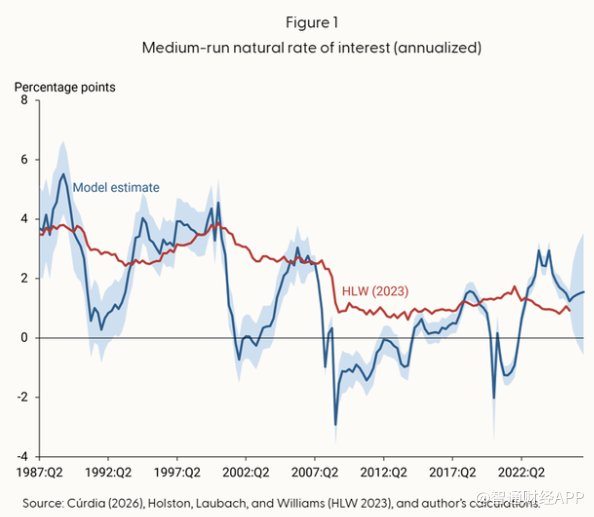
In particular, it should be pointed out that neutral interest rates are not directly observable economic variables, but are based on theoretical values estimated by specific economic models. Differences in model settings, data selection, parameter assumptions, etc. may cause significant deviations in results.
Kurdia also admits that the 1.5% estimate is still highly uncertain.
The market still expects the Fed to stay on hold in September
Current market pricing shows that the probability that the Federal Reserve will keep interest rates unchanged in September is about 69%; by the time of the December meeting, investors only expect another rate hike during the year. The US CPI, PPI, and employment data simultaneously sent a signal of cooling, causing the market to re-evaluate the need for the Federal Reserve to continue to tighten its policy.
Goldman Sachs believes that before the September interest rate meeting, there will not be enough members of the Federal Open Market Committee to shift to hawkish positions, which is not enough to trigger interest rate hikes. Unless there is an unexpected sharp change in the upcoming August economic data, the Federal Reserve will keep interest rates unchanged.
Notably, the US bond market is currently experiencing severe turmoil. The yield on 30-year US bonds once soared to 5.3%, the highest level since 2007, reflecting the market's deep concerns about long-term inflation, fiscal deficits, and the Federal Reserve's policy path. This phenomenon indicates that the US debt pricing logic is undergoing a profound revaluation, and the Federal Reserve is facing an unprecedented policy dilemma.