
Defense technology integrator Lyntris (LYNX.US) raised 297.5 million US dollars in a discounted IPO, and the “listing boom” of defense stocks faced a rational return to valuation
The Zhitong Finance App learned that in the context of geopolitical conflicts continuing to drive up defense spending, another defense technology company has entered the US stock market. On August 18, Lyntris Inc. (LYNX.US), a defense technology company controlled by private equity firm Trive Capital, announced the completion of an initial public offering to issue 17 million shares at a price of 17.50 US dollars each, raising a total of about 297.5 million US dollars. However, not only was this pricing lower than the previous issuance range of 19 to 22 US dollars, but the issuance scale was also drastically reduced from the initial 24 million shares. Based on the tradable shares listed in the document, the company's market value is approximately US$1.89 billion. Lyntris shares will officially begin trading on the New York Stock Exchange on August 19.
Interpretation of IPO data: “valuation correction” from 52.8 billion to 29.8 billion
Lyntris's IPO process experienced a significant contraction in just a few weeks. According to the company's prospectus submitted to the US Securities and Exchange Commission (SEC) on August 10, Lyntris and its shareholders initially planned to issue 24 million shares, with a pricing range of 19 to 22 US dollars per share, with a target fundraising of up to 528 million US dollars, with a corresponding valuation of about 2.53 billion US dollars.
However, the final pricing result was a double contraction:
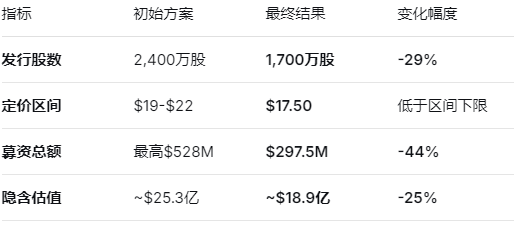
The final price corresponds to a market value of approximately $1.89 billion. Notably, the company actually sold about 5.7 million shares in this IPO, which is higher than the 4.9 million shares initially proposed, while current shareholders reduced the scale of its sale by more than 7.8 million shares. This structural adjustment shows that in order to complete the listing in a weak market environment, the company chose to let old shareholders transfer more shares to the new share capital in order to reduce the initial selling pressure on the secondary market.
Company Portrait: “Defense Technology Integration Platform” created by Trive Capital
Lyntris is not a startup from scratch, but rather a product of private equity capital operations. In May of this year, Dallas-based private equity firm Trive Capital merged its two portfolio companies — Accelint and Vitesse Systems — to form Lyntris.
Both Accelint and Vitesse previously focused on solving different aspects of the battlefield's “connectivity problem,” and after merging, they formed a complete technology chain covering sensor hardware, mission software, and AI capabilities. Since 2018, the merged entity has expanded in size through 12 acquisitions.
Vitesse Systems focuses on sensor hardware, provides multi-band RF technology, satellite payloads, and radar systems, and has provided over 80 L-band antenna arrays for the Space Development Authority's Tranche 1 and Tranche 2 transmission layers. Accelint focuses on command and control, autonomy, and mission systems enabled by artificial intelligence. Lyntris CEO Brian Morrison described this integration as “connecting sensing companies with AI-enabled command and control companies to create value for customers and combatants across the entire chain of perception, understanding, and action.”
Lyntris is headquartered in Falls Church (Falls Church), Virginia. Its main products are battlefield sensors and ancillary software to serve the US Department of Defense and its allies. As of December 31, 2025, the company has participated in more than 200 active defense projects, and no single project accounts for more than 7% of the company's revenue. As of June 30, 2026, the company's backlog of orders had doubled from a year earlier to US$923.9 million.
Lyntris first secretly submitted a listing application on June 9, 2026, and officially submitted the S-1 document publicly on July 23. The company was formed by Trive Capital in 2018 through a series of mergers and acquisitions, and has expanded in scale through the integration of Accelint and Vitesse and 12 acquisitions since 2018.
Financial Insights: The “Profit Pain” Behind High Revenue Growth
Lyntris's financial data shows typical defense technology company characteristics — revenue is growing rapidly, but not yet profitable. In the six months ending June 30, 2026:
Revenue: US$241 million, up about 34.6% year on year (US$179.1 million in the same period last year);
Net loss: US$13 million, up from US$9.7 million in the same period last year;
Adjusted EBITDA: Approximately $37.8 million.
For the past 12 months ending June 30, 2026, the company had revenue of approximately US$450.8 million and a net loss of approximately US$11.8 million. The company plans to use the proceeds from the IPO to repay approximately $60 million in outstanding debts, etc.
Matt Kennedy, senior strategist at Renaissance Capital, stated, “(Defense) companies need to prove that they can achieve sustainable growth and are driven by mission-critical products. Investors will significantly discount revenue from one-time projects.”
The “wave of listing” in the defense sector and the return of rational valuations
Lyntris is one of the latest wave of defense companies to enter the open market since spring 2026. Since April, many defense and space companies such as AEVEX, Arxis, HawkEye 360, Applied Aerospace & Defense, and Doncasters have completed listing in New York. The war in the Middle East continues to drive investor interest in the defense sector.
However, Lyntris's IPO pricing results revealed the subtle changes behind this “wave of listings.” After months of strong performance in the defense sector, investors are showing greater valuation sensitivity. Lyntris has shrunk from an initial valuation target of $2.53 billion to $1.89 billion, a decrease of 25%, indicating that the market is putting more stringent demands on defense technology companies' profit paths.
The summer IPO window is generally characterized by low volatility and strong market conditions, but Lyntris's discounted offering shows that even the popular label “defense” cannot completely exempt the market from scrutinizing the rationality of valuations. IPO Scoop quoted a veteran IPO person as saying, “It should work.” ——This is probably the most appropriate picture of the current IPO market: it is no longer a “snap buy” market, but a rational return to “reasonable pricing to close”.
Lyntris completed the IPO by falling below the promotion range and drastically reducing the distribution scale. It is not only a closing footnote to the 2026 summer IPO window, but also a microcosm of the defense technology sector moving from “subject hype” to “profit verification.” Amid ongoing geopolitical conflicts and the long-term trend of expanding defense spending, defense technology companies are still going public — but investors are becoming more picky.
Trive Capital's defense technology integration platform, built through the merger of Accelint and Vitesse through 12 acquisitions, now needs to prove to the open market that the $9239 million backlog of orders and more than 200 defense projects can be transformed into sustainable profit growth in the near future. The answers will begin to be revealed in the first quarterly earnings report.