
Bank of America survey: 47% of fund managers bet that European stocks will outperform US stocks and optimism that US stocks will return to pre-war highs in Iran
The Zhitong Finance App learned that as the European economic outlook shows greater resilience and the US stock market faces uncertainty amid the artificial intelligence (AI) spending frenzy, more and more investors are shifting their eyes from US stocks to European stocks.
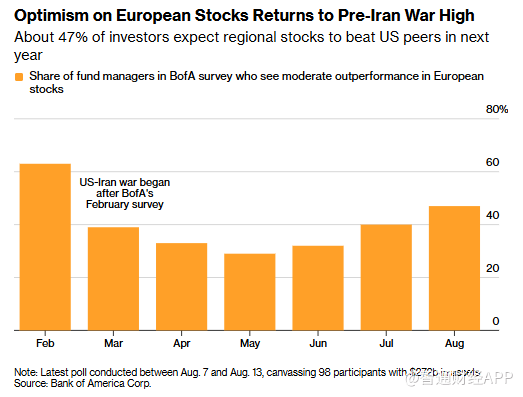
According to the Bank of America's latest survey, about 47% of fund managers expect European stock returns to slightly outperform US stocks in the next year. This ratio is the highest level since the outbreak of the Iran war in February 2026.
European stock market optimism returns to pre-war highs
European recession concerns subside, profits become the driving force for the stock market
The basis for optimism is solid: around 97% of participants surveyed said they did not expect Europe to fall into recession, the highest percentage since 2007. Meanwhile, more than three-quarters of respondents believe that the further rise in the stock market in the future will be mainly driven by rising profit expectations.
Bank of America strategist Andreas Bruckner said, “We are re-examining the topic of focusing on Europe at the beginning of the year. This theme was grossly interrupted by the outbreak of the Iran War.”
After handing over the strongest quarterly earnings in nearly four years, the European stock market has repeatedly reached new highs this month. According to LSEG I/B/E/S data, the second-quarter earnings of the Stoxx 600 Index constituents are expected to increase 22.4% year over year, the strongest growth rate since the third quarter of 2022. According to the data, the profit of the MSCI Europe Index increased by 14%, and the performance of more than half of the constituent stocks exceeded expectations. Both indicators were the highest levels since the beginning of 2023.
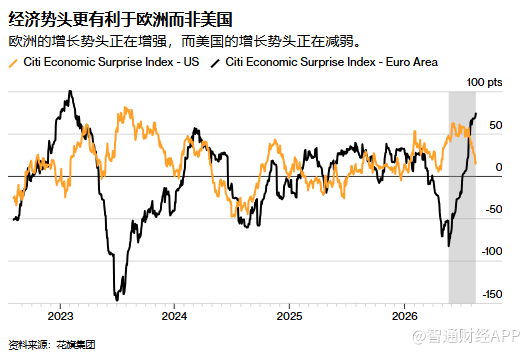
According to a Citigroup index, there is also a stark contrast between the economic growth momentum of Europe and the US: European economic data exceeded expectations by the highest level since February 2023, while recent US retail sales and employment data frequently stalled.
The valuation logic of not only relying on “cheap” to win over Europe is being restructured
Although this round of rise has raised European stock market valuations, in the opinion of some investors, this increase in valuation is reasonable, and even more attractive than “buying simply because it is cheap.” Currently, the forward price-earnings ratio of the European Stoxx 600 index is about 15 times, and the discount margin compared to the S&P 500 index has narrowed to the smallest since February 2022.
Justin Onuekwusi, chief investment officer at St. James Wealth Management, said: “Compared to the US, Europe's valuation discounts are still quite attractive. But the market seems to be shifting from focusing solely on valuation to more on profit and revenue, which is a positive sign.” He currently oversubscribes to European stocks and has a negative view of US stocks.
Soaring bond yields test confidence but historical experience supports
Despite this, recent spikes in bond yields are testing market optimism. French long-term borrowing costs hit their highest since 2008 this week, and German long-term treasury yields also rebounded to 2011 levels. Behind this are concerns about inflation caused by the continued rise in oil prices and the uncertain prospects for a lasting cease-fire between the US and Iran.
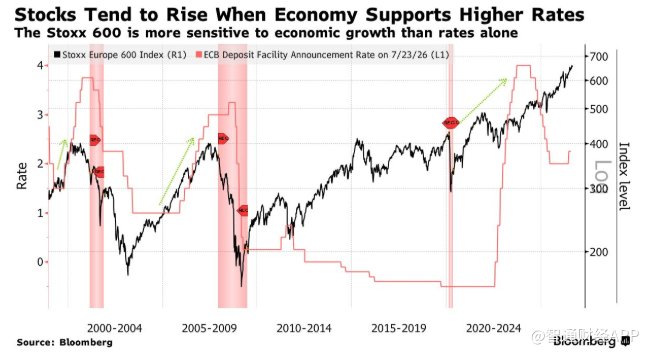
The Stoxx 600 index has not continued its gains since August. After outperforming the S&P 500 for two consecutive months, it has lagged behind the latter's 2.7% increase so far this month. According to the Bank of America survey, more than half of participants expect the ECB to raise interest rates within the next year. However, this may not necessarily trigger a sell-off in the stock market — history shows that as long as economic growth supports interest rate hikes, the stock market can continue to rise.
The Stoxx 600 Index is more sensitive to economic growth due to changes in the ratio
The burning of money by AI has made Wall Street uneasy and has instead become an “invisible dividend” for Europe
Large US tech companies' large-scale capital expenditure in the AI field has triggered market tension, which in turn has brought a comparative advantage to the European stock market. Unlike the US benchmark index, which is highly focused on large AI spenders, Europe's benchmark stock index focuses more on industries that support the development of artificial intelligence, such as infrastructure and green energy, and targets that can benefit from the promotion of AI applications.
Alpesh Patel, managing partner at RootBridge Capital, said, “The less trendy cyclical sectors are interesting — they don't involve AI, but they are profitable, and resilient — this is the best way for you to spread the risk of AI related profits.”
Madison Faller, a global investment strategist at J.P. Morgan Chase Private Bank, believes that after this year's sharp rise, stock selection strategies have become the key. She is optimistic about the European financial and industrial sectors, which will benefit from a more favorable economic environment. Faller also favors companies that have physical assets that are difficult to replace and are less susceptible to AI disruption.
European positions are still below the historical average, and US stocks are already at a high level of congestion
Position data shows that investors still have room to buy more European stocks. According to the Bank of America survey, net 6% of fund managers are overallocated Eurozone stocks, and this ratio is still slightly below the long-term average. On the other hand, the allocation ratio for US stocks has reached its highest level since December 2024, which is about 1.5 standard deviations above average.
Simply put, when the market began to feel “tired” of the AI narrative of the US stock market and turned to a more cost-effective and profitable direction, the European stock market was re-entering the eyes of global investors with solid profit recovery, resilient economic fundamentals, and relatively low positions. Europe is not an “outsider” to the AI wave; it is extracting its own growth dividends from it in a different way than Silicon Valley.