
Amid the global bond market storm, “high market economics” has become the latest weak point: Japan's response is limited
The Zhitong Finance App learned that Japan has fewer and fewer means to cope with the sharp decline in the bond market. This sharp decline may cause debt financing costs to exceed the expectations of the Japanese government, and Prime Minister Takaichi Sanae's ambitious spending plans are constrained by uncontrollable factors. Analysts say the tools currently available to stabilize the market — sporadic cuts in bond issuance or emergency central bank purchases — are only temporary remedies for the bond market, which is being squeezed by stubborn inflation and increasingly loose fiscal policies.
Mari Iwashita, executive interest rate strategist at Nomura Securities, said, “Japan has never experienced such stubborn price pressure since the last oil crisis. The challenge of anchoring the inflation rate at the Bank of Japan's target level of 2% is becoming greater.”
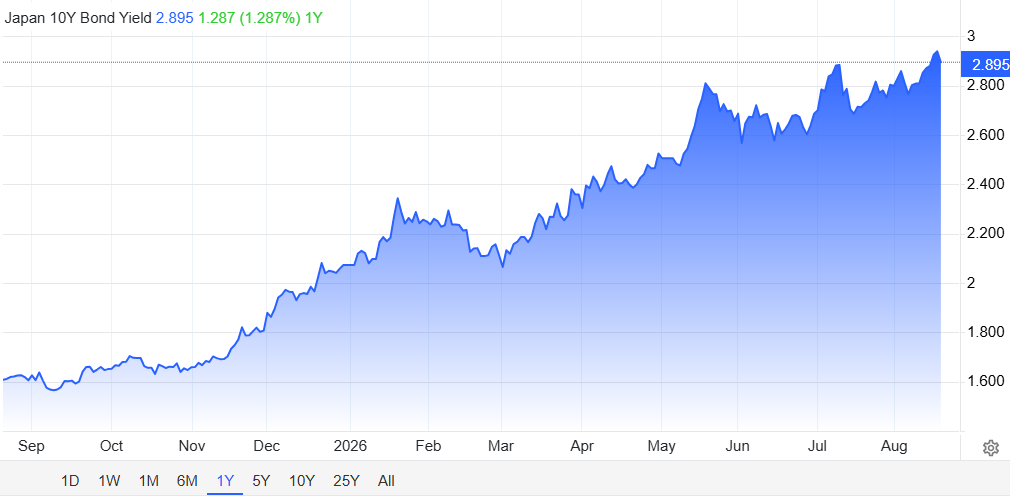
The epicenter of the global bond sell-off is in Japan, and the yield on the benchmark Japanese 10-year treasury bond is about to surpass 3%, the first time since the mid-1990s. Investors are increasingly worried about Japan's huge debt and the risk of inflation caused by the Middle East war. On Tuesday, Japan's 10-year treasury yield fell to around 2.89% on Wednesday after hitting a 30-year high of 2.945%.
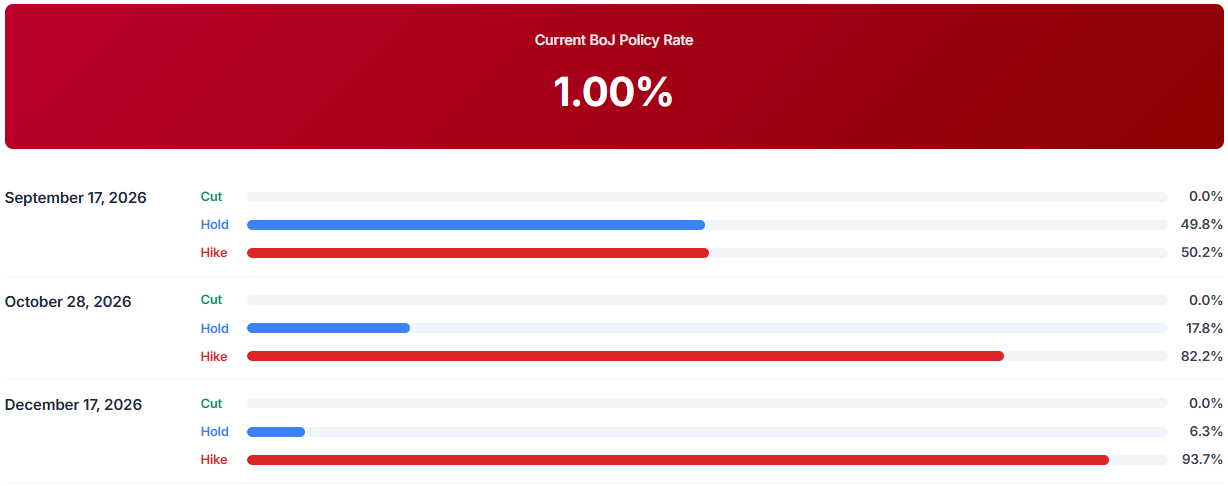
Although government subsidies keep the core inflation rate below the 2% target, the Bank of Japan warned that there is a risk that inflation will be overadjusted, which may require early interest rate hikes. Expectations that interest rates will be adjusted sooner and earlier have reduced concerns that the Bank of Japan is lagging behind in dealing with inflation. However, analysts said that this has also triggered a repricing in the bond market. Investors now believe that interest rates are likely to reach 2%, far higher than the peak of close to 1.5% previously anticipated.
A severe test
The sharp rise in yield is becoming a severe test of Takaichi Sanae's economic strategy. She believes that the reason for the increase in spending is that economic growth will exceed long-term borrowing costs, thus enabling Japan to maintain its huge debt burden without jeopardizing financial stability.
If the yield on 10-year Japanese treasury bonds exceeds 3%, and the inflation rate is 2%, the actual growth rate can only hover around 1% at most, then this assumption will be questioned. In an estimate released in July, the Japanese government predicted a real GDP growth rate of 0.9% for the current fiscal year ending March 2027 and 1.1% for the next fiscal year.
Higher yields will also threaten the affordability of Takaichi Sanae's key economic growth plans. Meanwhile, conservatives within the ruling party are urging her to cut spending.
If interest rates continue to rise above 3% (the level the government assumes in its budget), debt financing costs will soar to more than the 31 trillion yen ($1950 billion) currently reserved, while weakening Takaichi Sanae's iconic move to inject investment into growing industries.
According to the sector's benchmark estimates, assuming that Japan's 10-year treasury yield climbs to 3.6% in fiscal year 2029, debt repayment costs for that year will rise to 41 trillion yen.
To make matters worse, the government has ruled out capping spending requests in strategic growth areas from next year's budget, a move that could force the government to issue more debt on top of the revenue lost as a result of plans to cut food taxes.
The key to the Japanese government's response
As the bond market continues to be volatile, the market is increasingly concerned about whether policymakers have credible options to curb the sell-off. Analysts said the Ministry of Finance may temporarily cut bond issuance or listen to concerns about oversupply of bonds at a regular meeting with investors next month.
Ataru Okumura, chief interest rate strategist at SMBC Nikko Securities, said, “Adjusting the bond issuance schedule to make it irregular will help curb the rise in yield.” Furthermore, any indication that the department may consider cutting the issuance of 10-year bonds is also worth paying attention to.
Another option is for the Bank of Japan to increase its efforts to purchase bonds for emergency market operations. Even while gradually reducing the scale of purchases, the Bank of Japan has maintained this tool to deal with the sharp and disorderly rise in yield that threatens financial stability.
A source familiar with the Bank of Japan's ideas said that although the Bank of Japan will not completely rule out the possibility of intervention, given that the recent rise in yield is driven by fundamental factors, the central bank may not think it is necessary to intervene now.
Many analysts believe that unless the government reconsiders its reliance on subsidies and tax cuts to ease the cost of living pressure, yields will continue to face upward pressure, and this expansionary approach will only stimulate demand and inflation.
Naomi Muguruma, chief bond strategist at Mitsubishi UFJ Morgan Stanley Securities, said, “If the government increases fiscal spending and increases price pressure brought about by the Middle East War, the Bank of Japan will not be able to stabilize inflation expectations. Inflation is now a major risk for anyone trading Japanese treasury bonds. The core of the problem is that the market has doubts about the government's determination to curb inflation.”