
Performance growth exceeds expectations! “The first major medical model stock” iFLYTEK Healthcare (02506) increased 49.4% in the first half of the year's revenue by 446 million yuan, focusing on the three major businesses to open up 10 billion ARR growth space
The Zhitong Finance App learned that 2026 is the beginning of the “15th Five-Year Plan”, and the medical artificial intelligence industry is entering a critical window period to switch from pilot verification to large-scale promotion. The policy of strengthening primary care continues to be deepened, the construction of a “national network” of medical insurance video clouds has been accelerated, domestic computing power has been upgraded to a national strategy, the commercial application of large-scale models in medical scenarios has entered the deep-water zone, and industry policy dividends continue to be released.
On August 18, iFLYTEK Healthcare (02506) handed over a mid-term questionnaire on “High Scale Growth, Optimization of Quality and Efficiency, and Reinforcement of Barriers”. During the reporting period, the company achieved revenue of 446 million yuan, a year-on-year increase of 49.4%, significantly exceeding industry expectations; gross profit of 236 million yuan, an increase of 53.5% over the previous year; and a comprehensive gross profit margin of 52.9%. According to the data disclosed by the results conference, the company's sales repayment in the first half of the year was 348 million yuan, an increase of 49% over the previous year, and repayment and revenue achieved simultaneous growth; net loss to mother narrowed by 20%, and business quality continued to improve.
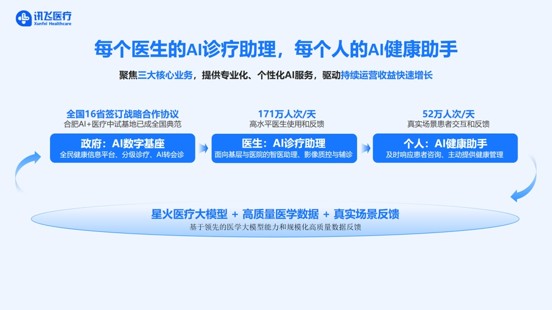
The three major businesses work together: stable basic market, leading growth engine, and improved profit quality
Focusing on the mission of “building an AI diagnosis and treatment assistant for every doctor, an AI health assistant for everyone”, the company focuses on the three major business segments of AI diagnosis and treatment assistants, AI health assistants, and AI digital foundation. The resources are skewed towards ARR's recurring revenue business, and the business model is transformed from one-time project delivery to platform operation. The three major businesses form a collaborative pattern of “stable basic market, leading growth pole, and profit optimization”.
AI diagnosis and treatment assistants continued to strengthen as a basic market, achieving revenue of 202 million yuan in the first half of the year, an increase of 47.5% over the previous year, and a gross profit margin of 56.1%. In July 2026, the Department of Primary Health of the National Health and Health Commission held a conference in Hefei to promote digital intelligence to empower primary health care work. The live display focused on iFLYX Healthcare's intelligent medical assistants, the Anhui Video Cloud Platform, and the Anhui Provincial Consultation and Referral Service Platform. The results of regional construction were recognized at the national level, and clear instructions were given to accelerate nationwide promotion. This national-level live meeting set the tone and provided policy certainty for the large-scale implementation of the medical AI industry. The National Health Commission's “Implementation Opinions on Promoting and Standardizing the Development of “Artificial Intelligence+ Healthcare” applications clearly states that intelligent auxiliary applications for primary diagnosis and treatment will basically achieve full coverage by 2030, and that deployment will be accelerated in many places after the Hefei site conference. This goal is expected to be completed as early as 2028.
Currently, intelligent medical assistants have covered 828 districts and counties in 31 provinces and over 77,000 primary medical institutions, accounting for more than 80% of the primary districts, counties, and cities that have deployed AI auxiliary diagnosis, and have an absolute control advantage; they have provided more than 1.2 billion AI auxiliary diagnosis recommendations, assisted in generating 490 million standardized electronic medical records, identified 130 million unreasonable prescriptions, and corrected 2.07 million cases of valuable diagnosis. The company took the lead in constructing the only national pilot base for primary care AI in the country, opening up a complete link of technical verification, scenario polishing, and nationwide replication. On the side of grade hospitals, the new generation of diagnosis and treatment assistants have served more than 700 grade hospitals, breaking through the bottlenecks of far-field multi-speaker voice recognition and automatic medical record generation technology to reach the practical threshold. The medical record generation adoption rate is 91%. It has now entered the batch expansion stage, and is exploring a recurring revenue model that is billed based on the amount of medical records adopted.
AI health assistants became the core engine driving growth, achieving revenue of 182 million yuan in the first half of the year, a year-on-year increase of 74.9%, ranking first among the three major businesses. Among them, the video cloud business revenue increased by more than 200% year-on-year, with more than 1980 video cloud platform networking organizations in Anhui Province, more than 160 million cases of precipitated image data, a 90% drop in physical film usage, and an annual provincial health insurance cost of about 2 billion yuan; the Guangxi project achieved full coverage of level-II hospitals within 90 days; and in July 2026, the company won a new bid for a 5-year video cloud service project in Ningxia. Relying on the existing imaging cloud base, the company further laid out a pan-imaging cloud, expanding its business boundaries from traditional radiology imaging to full medical techniques such as testing, pathology, ECG, and ultrasound. Recently, the National Health Insurance Administration has successively issued guidelines for setting up price projects for laboratory and pathological medical services, implementing “shortfall revenue reduction” for medical institutions that fail to upload data according to regulations, using a price mechanism to force data standardization to go to the cloud, opening up new charging space for the company's “imaging+test+pathology” integrated platform, and strengthening the pan-imaging cloud business growth logic. In addition, AI post-diagnosis patient management has been normalized in leading hospitals such as Qilu Hospital of Shandong University and the First Affiliated Hospital of the Chinese University of Science and Technology. The number of fully serviced patients continues to rise, the conversion rate of paying users remains high, the operating business continues to expand, and ARR growth momentum is sufficient.
The revenue of AI Digital Foundation in the first half of the year was 62 million yuan, up 7.9% year on year, and gross margin increased sharply by 22.7 percentage points year on year. As resources are skewed towards recurring revenue business, the profit structure of the business continues to be optimized. AI city digital bases have been implemented in Shanghai, Shenzhen, Hefei, etc. Among them, Shanghai's Jing'an “AI-Driven Residents' Health Portraits” was selected in the 79th WHO Assembly's “Digital Intelligence Empowers Primary Care Services — Chinese Practice”; AI disease control digital bases have been implemented in the four provinces of Shaanxi, Liaoning, Fujian, and Anhui; AI regional collaborative digital bases are deeply involved in the construction of close county medical communities and grassroots infrastructure projects.
Continued strengthening of the technical base: the Harness architecture drives the data flywheel effect
The company's self-developed Harness dual-model technology architecture is based on clinical application pain points, drug supervision compliance requirements, and medical institution business logic, and is a deterministic engineering control base outside the model. The architecture does not require model weight changes, and relies on rigid constraints, standardized packaging, and full-link business orchestration to transform fragmented medical industry experience into industrial medical AI productivity that can be replicated in batches, delivered stably, and controlled in compliance.
On top of the engineering architecture, the core capabilities of Spark Healthcare's big model continue to break through. In June, the company released the Spark Medical Big Model V3.5, which is based on national production computing power training, which significantly surpassed mainstream models at home and abroad in key tasks such as medical questioning, diagnosis and recommendation, document generation, and multi-modal interaction. The average effect of the six core competencies increased to 92.4%. It created an original “evidence alignment - reflection and verification - expert strengthening” framework, and the medical illusion rate was reduced from 3% to 1.9%. It reached the top with a score of 98.9 in the MedBench smart device evaluation of the Shanghai Artificial Intelligence Laboratory; in the IDC “China Medical Big Model Technology Evaluation 2026” comprehensive ranking, the Spark Medical Big Model ranked first in the industry, and ranked first in 12 segmented capability evaluations, including assisted diagnosis, medical record generation, and health consulting.
More long-term value is the gradual formation of the data flywheel effect. Relying on 1.71 million AI-assisted feedback from doctors and 520,000 patient-side service feedback per day, real scene data continues to feed back model iterations, forming a positive cycle of “technology-scenario-data-technology”. In the medical AI circuit, building a data barrier is far more difficult than the model itself. The first-mover advantage will continue to accumulate over time, creating a competitive barrier that is difficult to catch up quickly.
The commercialization dividends of the big model continue to be realized, and the transformation of ARR operations is accelerated
The scaling up of the business and the strengthening of the technical base will jointly push the company to a key point in upgrading the business model. From a traditional “one-time construction, one-time payment” project system for medical informatization to a “pay-per-use, per-service cycle” operation system, the transformation of ARR operations has accelerated.
Currently, ARR growth is mainly driven by two major operating engines: the video cloud business, which relies on the “One Country Network” policy and billing mechanism for medical insurance, the number of people charging for digital imaging services is rapidly growing, and further expanding into pan-imaging cloud fields such as testing and pathology; the second is post-diagnosis patient management, which has formed a clear patient payment logic for key specialty diseases. The number of hospitals operating and the number of patients served is rapidly expanding, and the single-hospital model has been verified.
However, the prerequisite for large-scale implementation is adhering to the bottom line of the medical industry. Healthcare is a field with a high technical threshold and extremely low fault tolerance rate. Reducing illusions and ensuring clinical safety is the entry threshold for medical AI. iFLYTEK adheres to a long-term principle. Using medical AI that has passed the National Medical Practitioner Qualification Examination as the foundation of competency, it continues to refine models, accumulate medical expertise, and establish a reliable safety mechanism between the generative characteristics of AI and the deterministic requirements of medical treatment. This is a fundamental guarantee that commercialization can be stable and far-reaching.
As the first major medical model in China, iFLYTEC's ARR transformation not only optimizes a company's revenue structure, but also provides an observable and targetable commercialization sample for the entire medical AI industry. Facing the future, as the “Healthy China” strategy and the “15th Five-Year Plan” advance further, the market space for medical AI will be further opened up. iFLYTEK will continue to deepen its technical base, expand application scenarios, optimize revenue structures, move steadily towards the goal of becoming a global medical model leader, and play a more solid role in the intelligent upgrading of China's healthcare system.