
Rogers Communications (TSX:RCI.B) Stock Could Be 16% Undervalued On Wildfire Satellite Rollout
Rogers Communications stock has delivered a 6.2% return over the past year, yet the current checks still point to a company that looks cheap relative to its intrinsic value estimate and earnings multiples. With recent headlines around satellite connectivity in British Columbia and media partnerships, investors are considering whether the current share price of $49.90 already reflects these developments.
- Over the last 12 months, Rogers Communications shares are up 6.2%, which is a modest gain for investors assessing whether there is still meaningful upside from here.
- New connectivity and media initiatives, including satellite to mobile services and content deals, may support long term cash flows, while ongoing competitive and execution risks can affect how much of that value ultimately reaches shareholders.
- The broader checks lean cheap, with Rogers Communications screening as undervalued in 5 of 6 valuation checks on the current framework.
The stock's next move may depend on whether investors conclude that the current price still sits below a reasonable intrinsic value for Rogers Communications.
Does Rogers Communications Look Undervalued on Dividends?
The Dividend Discount Model values Rogers Communications by projecting its future dividend stream and discounting those payments back to today. The model uses the current dividend of CA$2 per share, an estimated return on equity of 13.53%, and a payout ratio of about 48.65%, which together imply that just under half of earnings are paid out while the rest are retained to support future growth.
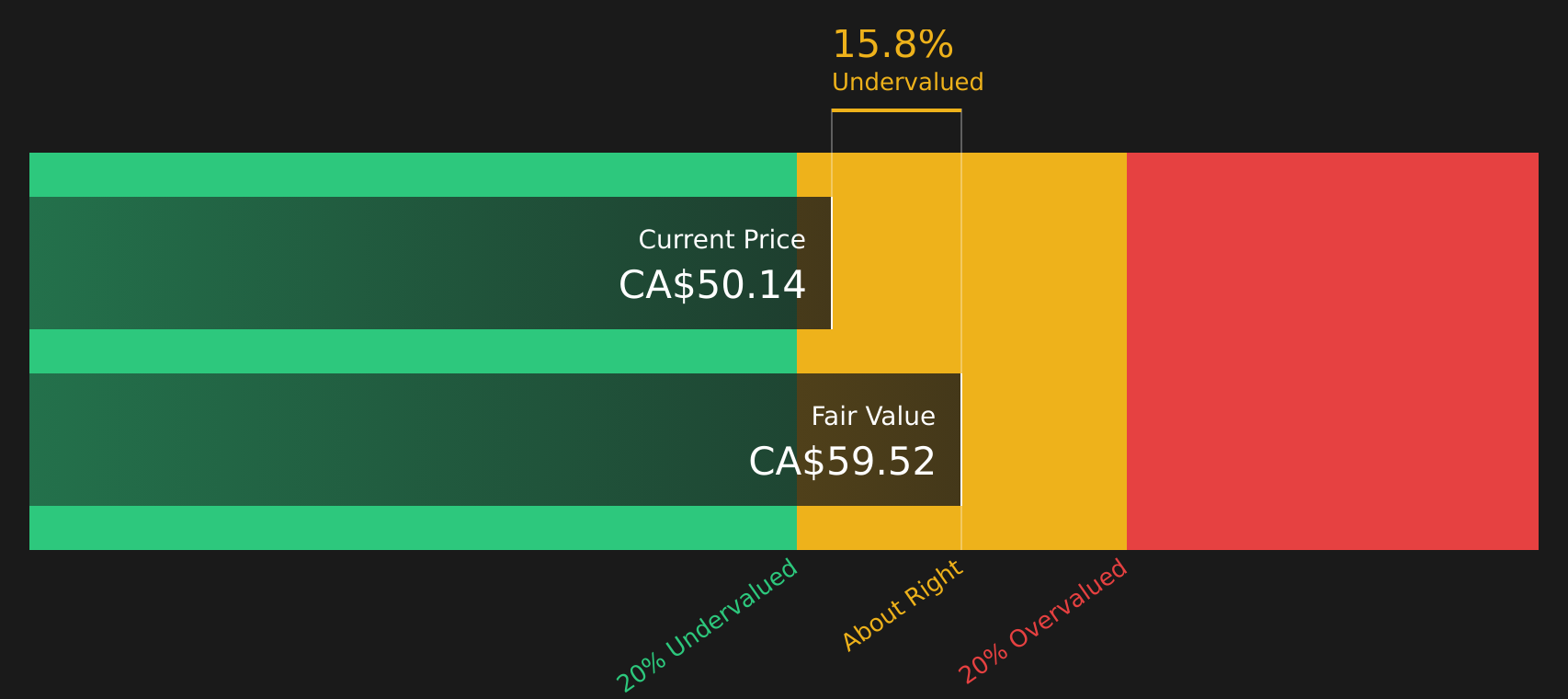
To keep things conservative, dividend growth in the model is capped at 3.08%, even though the broader earnings growth estimate used internally is higher. On that basis, the DDM points to an estimated intrinsic value of about CA$59.52 per share compared with the current price of CA$49.90. This indicates the stock screens as undervalued by roughly 16.2%. Because the new Prime Video NHL deal and MLSE stake increase are very visible media moves, the fact that the price still sits below the model’s value suggests investors may not be fully crediting the long term dividend stream yet.
On this Dividend Discount Model view, Rogers Communications stock currently looks undervalued relative to its projected dividend capacity.
Our Dividend Discount Model (DDM) analysis suggests Rogers Communications is undervalued by 16.2%. Track this in your watchlist or portfolio, or discover 11 more high quality undervalued stocks.
Is Rogers Communications Still Cheap on Earnings?
P/E is often the cleanest starting point for Rogers Communications because earnings remain a core focus for many shareholders watching both its telecom and media businesses.
Rogers Communications currently trades on a P/E of about 4.4x, which is well below the Wireless Telecom industry average of roughly 15.2x and also below the broader peer group average of about 12.3x. On Simply Wall St’s fair multiple framework, which adjusts for the company’s size, margins and risk profile, a P/E of around 7.1x is more in line with what the model suggests for Rogers Communications.
That fair ratio indicates that the stock trades at a sizeable discount to what its earnings profile might usually command, even after factoring in the extra moving parts from media deals and satellite connectivity initiatives.
On this P/E view, Rogers Communications stock appears undervalued compared with both its industry and what its own earnings characteristics would typically justify.

See what the numbers say about this price — find out in our valuation breakdown.
The Rogers Communications Narrative: What Would Justify Today's Price?
Simply Wall St Narratives pick up where this valuation puzzle for Rogers Communications leaves off by spelling out which paths for revenue growth, margins and earnings would need to play out for the stock to be worth materially more or less than today’s price. Each narrative ties its number to a clear view of how Rogers Communications' future growth, profitability and risks might evolve, which you can revisit as new information emerges on the Community page.
The Rogers Communications community is divided between a cash flow focused sports and infrastructure bull story and a more cautious view that emphasizes regulation, debt and cord cutting risk.
Bull case: 17% undervalued
"The near-term integration and longer-term monetization of sports/media assets, notably MLSE, remains a significant hidden value driver..."
Read the full Bull Case to see why Rogers Communications could be undervalued
Bear case: 9% overvalued
"Elevated post-acquisition debt leverage from the Shaw and MLSE transactions, combined with significant ongoing capital intensity for network upgrades and expansion, will constrain free cash flow..."
Read the full Bear Case to see why Rogers Communications could be overvalued
Do you think there's more to the story for Rogers Communications? Head over to our Community to see what others are saying!
The Bottom Line
For Rogers Communications, both the Dividend Discount Model (DDM) intrinsic value estimate and the earnings multiple view point in the same direction. The stock screens as undervalued on its projected dividend stream and on its P/E relative to peers. That gap reflects a market that is still cautious about balance sheet pressure, capital needs and execution on media and satellite initiatives. The central question from here is whether Rogers Communications can translate these investments into durable cash flows without eroding financial flexibility. This will determine whether the current discount is attractive or instead indicates that risks remain underappreciated.
This article by Simply Wall St is general in nature. We provide commentary based on historical data and analyst forecasts only using an unbiased methodology and our articles are not intended to be financial advice. It does not constitute a recommendation to buy or sell any stock, and does not take account of your objectives, or your financial situation. We aim to bring you long-term focused analysis driven by fundamental data. Note that our analysis may not factor in the latest price-sensitive company announcements or qualitative material. Simply Wall St has no position in any stocks mentioned.
Have feedback on this article? Concerned about the content? Get in touch with us directly. Alternatively, email editorial-team@simplywallst.com