
A 40-year low yen boosted export boom: Japan's July exports far exceeded expectations, and demand for AI chips weathered the haze of the Middle East conflict
The Zhitong Finance App notes that Japan's export growth accelerated to the fastest growth rate since 2022, driven by strong demand for Japanese chips and cars and the fall of the yen to a 40-year low.
According to data released by Japan's Ministry of Finance on Thursday, exports rose 23.2% year on year in July, further accelerating from the 19.3% increase in June. This result was higher than the median 20.1% increase expected by economists, and also recorded the fastest growth rate since October 2022.
Imports increased by 27.8%, faster than the 25.4% increase last month, and higher than the 25.1% expected by economists. On an unadjusted basis, the trade deficit widened from 409.9 billion yen after correction in June to 634.5 billion yen, marking the third consecutive month of deficit.
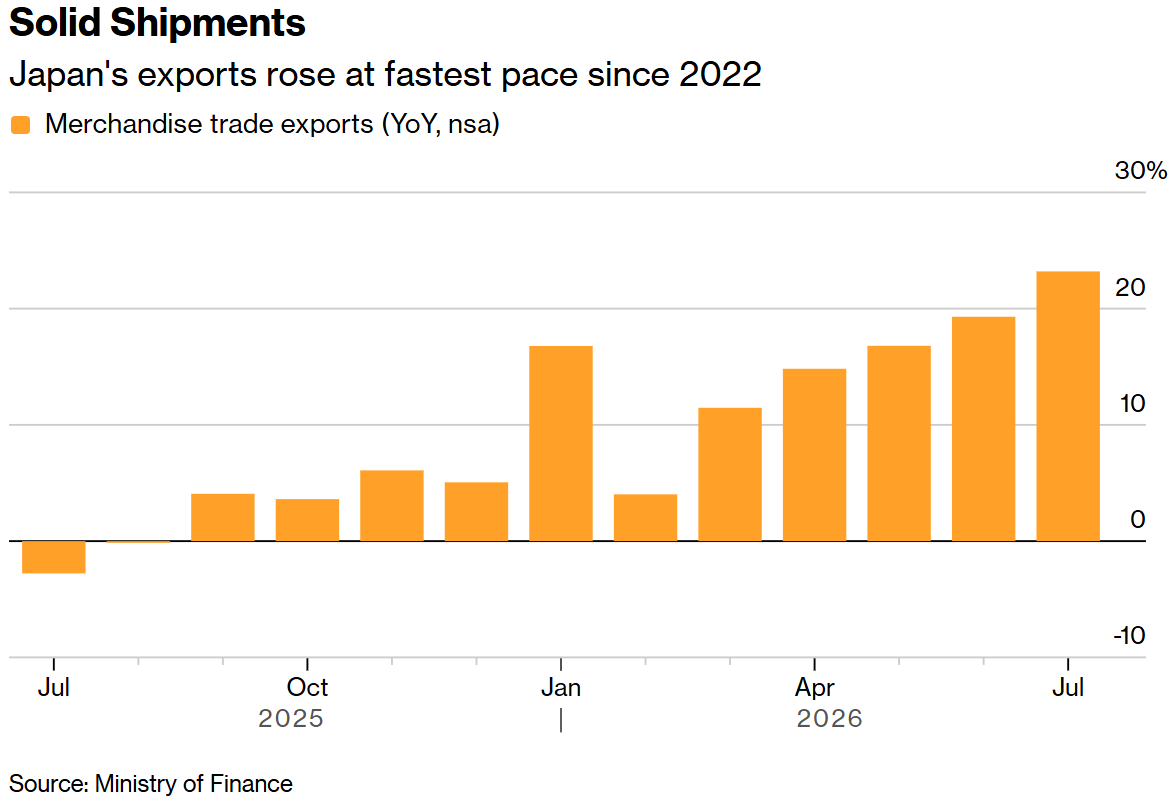
Japan's export growth rate hit the fastest since 2022
The data shows that up to now, the Japanese manufacturing industry has largely successfully coped with the impact of the Middle East conflict. This data is an encouraging sign for the Japanese economy as economic growth fell short of expectations in the three months up to June due to weak domestic demand.
Yuki Ito, an economist at Nomura Securities, said, “Exports of semiconductor manufacturing equipment and semiconductor components are increasing due to the recent AI boom,” he mentioned that exports of chemical products have also risen, adding: “I'm guessing part of the reason is that restrictions on the supply of naphtha have been eased to a certain extent, leading to a rebound in exports that had been declining until now.”
The weak yen boosted shipments and became one of the factors supporting the development of companies by increasing the competitiveness of Japanese products in overseas markets. The currency hit its lowest level against the US dollar in 40 years in July. According to the Ministry of Finance, the average exchange rate of the yen against the US dollar was 161.83, a year-on-year depreciation of 11.2%.
Strong global demand for artificial intelligence chips is one of the core drivers of this growth. Exports of electronic components, including semiconductors, increased by about 49%. Other areas of growth include passenger car exports, which increased by 21%.
In terms of export destinations, shipments to the US increased by 22%, while shipments to China and Europe increased by 25.8% and 19.1%, respectively.
Meanwhile, after the Strait of Hormuz was actually closed due to the war in Iran, the conflict continued to change Japan's energy procurement model.
The trade report shows that total oil imports rose sharply by nearly 88%, and imports increased by 5.5%. Looking at the share of imports, the share of imports from the US rose from 7% in February to 36% of the total volume, while the share from the Middle East fell to 59%.
The 60-day negotiation window set under the US-Iran Memorandum of Understanding expired on Monday, but no permanent peace agreement was reached, and uncertainty surrounding the conflict remains. The interim agreement aimed to resolve disputes over the Strait of Hormuz, Iran's nuclear program, and economic sanctions, but failed to produce a lasting solution.
Economist Yuki Ito said, “Judging from shipping data, it appears that Japan continues to make progress in seeking alternative supplies from the US.”