
Big reversal! Political stability and fiscal improvements have become the trump cards for attracting gold, and investors “abandon the law”
The Zhitong Finance App learned that as the market prepares for next year's Italian and French elections, more and more bond investors are betting that compared to France, Italy's political turmoil will be calmer. Asset management companies Barings and Carmignac Gestion have been increasing Italian bonds over the past few months, joining the ranks of other investors already optimistic about Italian bonds, including MFS International. These inflows of capital are driving Italian bond yields below the level of French bonds for the same period — French bonds, which were traditionally viewed as safer, are now beginning to be demanded by investors for a higher risk premium.
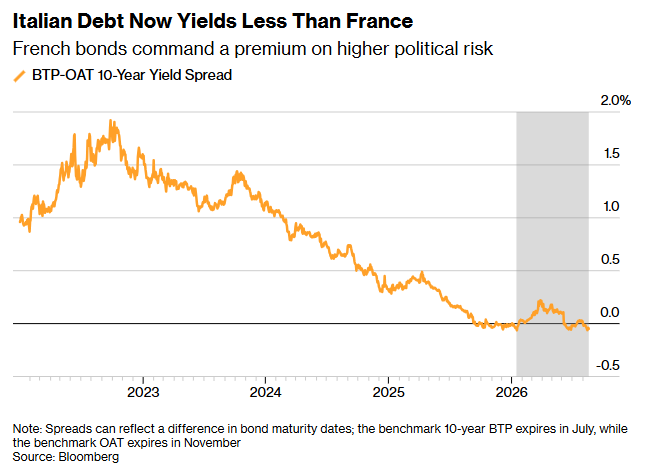
French bonds are being charged a premium due to higher political risk
Many investors are now shying away from French bonds because France will begin budget negotiations next month, which is likely to become a political flashpoint and set the tone for next spring's presidential election. At the same time, investors believe that Italy's past days of financial loss of control and political turmoil are a thing of the past.
Italian Prime Minister Georgia Meloni is seeking to win a second term as prime minister. Barings investment manager Brian Mangwiro, who has been buying Italian bonds for up to 10 years, said: “This is probably one of the longest tenured and most stable governments we've seen in Italy for a long time. We still think the risk of major political upheaval in Italy is quite low, which is part of the reason Italy is one of our biggest oversized positions.”
This sentiment marks a sharp shift in the bond market's perception of Italy compared to 2022. When Meloni first came to power, Italian bonds were sold off. The yield on Italian bonds is now lower than that of French bonds, which also reflects the structural transformation of the European bond market. This is a major reversal since the Eurozone debt crisis.
In recent months, global bonds have generally been hit by fears that oil prices will drive inflation, and Eurozone bonds are no exception. But Italian bonds are becoming an unexpected haven for the region. This reflects market optimism about Meroni's commitment to control Italy's fiscal deficit — in contrast, given the growing popularity of populist politician Marina Le Pen, it may be difficult for the current French government to achieve similar goals.
Allegedly, Meloni is considering holding the next general election early, which may be several months ahead of the deadline set by law at the end of 2027. However, holding early elections did not seem to stop investors from continuing to buy Italian bonds.
Marie-Anne Allier, fixed income manager at Carmignac Gestion, said: “Italy appears to be a country that can at least provide political stability, and at least its debt as a share of GDP will drop.” “Compared to the rest of Europe — with the exception of Spain, and especially compared to France and Germany — these are two big advantages.” According to reports, Marie-Anne Allier began buying Italian bonds at the beginning of this year, while shorting French bonds.
Natixis SA interest rate trader Youness Boukakiou said that the positive momentum of Italian bonds has been increasing over the past few months. He pointed out that buying Italian bonds with a term of 3 to 10 years has become one of the most popular deals this summer. Meanwhile, he added that many investors in the market have been avoiding French bonds.
Youness Boukakiou said, “If you want to buy some assets that provide yield in the European government bond sector, now you have two options: France or Italy. And judging from the current situation, Italy's prospects are better.”
Furthermore, according to Larissa de Barros Fritz, senior interest rate strategist at ABN Amro Bank, another favorable factor for Italy is that only 9% of its sovereign bonds are held by investors outside the Eurozone, far lower than France's 26%. Regional investors are more likely to withstand the risk of events and hold bonds until maturity. Meanwhile, 14% of Italy's national debt is held by Italian households, compared to zero in France. Larissa de Barros Fritz said this fact “has a supporting effect in these times.”
MFS International's Annalisa Piazza still maintains an oversized position on Italian bonds. If political posturing causes Italian bonds to be sold off, and she believes there is no reasonable basis for this sell-off, she will consider increasing her position further. She said that if the market fluctuates greatly and “the market falls into panic as a result, I will buy it.”