
China Chamber of Commerce for Import and Export of Mechanical and Electrical Products: China's total exports of ships and offshore equipment amounted to US$32.71 billion in the first half of the year, up 23.1% year-on-year
The Zhitong Finance App learned that the China Chamber of Commerce for Import and Export of Mechanical and Electrical Products released a report on the foreign trade situation of shipbuilding and offshore engineering for the first half of 2026. In the first half of 2026, China's export trade of ships and marine products continued its upward trend. Shipbuilding and offshore equipment exports totaled US$32.71 billion, an increase of 23.1% over the previous year. The top 5 export ship types are oil tankers, bulk carriers, container ships, liquefied gas and other cargo and passenger and cargo vessels, with export values of 7.7 billion US dollars, 7.05 billion US dollars, 4.8 billion US dollars, 4.33 billion US dollars and 3.15 billion US dollars respectively. The total export value of these ship types accounts for 82.7% of China's total exports of marine products.
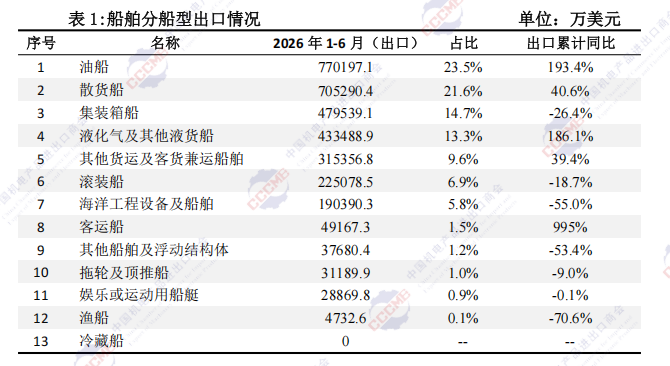
(1) Fulfilment of high-price orders for liquid carriers combined with accelerated delivery was the primary driving force for export growth in the first half of the year. In the first half of the year, China's oil tanker and liquefied gas tanker exports surged 193% and 186%, respectively. Total exports were about 12 billion US dollars, contributing an incremental amount of nearly 7.9 billion US dollars with an export share of about 37%, and became the absolute main driving force for exports of marine marine products. Among them, 169 oil tankers were exported, up 78% year on year, and the average unit price increased by 65%; 70 liquefied gas carriers were exported, up 71% year on year, and the average unit price increased by 67.5%. The characteristic of “sharp rise in volume and price” is characteristic. This explosive growth is mainly due to the fact that high-priced orders for VLCCs, large LNG, and dual-fuel product tankers locked in 2023-2024 have entered a centralized delivery period, as well as improvements in shipcompanies' construction efficiency. In the first half of the year, leading shipping companies such as Jiangnan Shipbuilding, Hudong China, Hengli Heavy Industries, Beihai Shipbuilding, and Guangzhou Shipbuilding International all delivered high-value liquid cargo ships several months ahead of schedule.
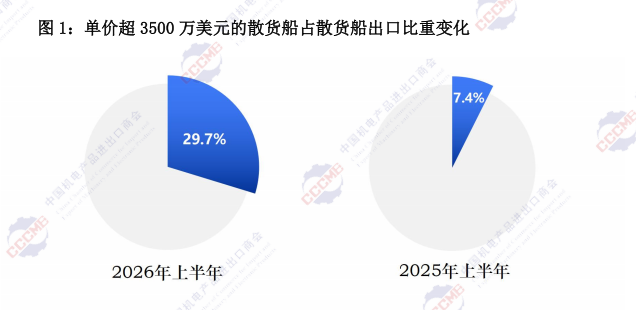
(2) The “steady increase in volume and price” of bulk carrier exports was an important support for export growth in the first half of the year. In the first half of the year, China's bulk carrier exports were 7.05 billion US dollars, an increase of 40.6% over the previous year; of these, 249 bulk carriers of 150,000 DWT and below were exported, with an export value of about US$6.3 billion, an increase of 43.3% over the same period last year. The number was almost the same as the same period last year, but the average unit price surged 42.7% year on year. Nine bulk carriers of 150,000 to 300,000 DWT were exported. The number was the same as last year. The export value was 650 million US dollars, and the unit price increased slightly by 4.2%. One bulk carrier of 300,000 tons or more was exported, worth about US$110 million. The rapid growth in bulk carrier exports also benefited from the intensive fulfillment of high-priced orders around 2024. In addition, the share of high value-added ships in the export structure of small and medium-sized bulk carriers increased significantly. In the first half of the year, exports of the main types, the Panamax (Panamax, 60,000 to 80,000 DWT) and Ultramax (Ultramax, 6.1-64,500 dwt), jumped from 10 ships in the same period in 2025 to 67 ships, which strongly boosted the average export price of bulk carriers.

(3) Container ship deliveries continued to decline, and export value retreated to third place. In the first half of the year, China's container ship export value was 4.795 billion US dollars, down 26.4% from the previous year, and retreated to third place in the export ship type ranking; in terms of quantity, 60 container ships were delivered in the first half of the year, a decrease of 33.3% over the previous year. According to data from the Shanghai International Shipping Research Center, 98 new container ships were delivered worldwide in the first half of the year, totaling 707,000 TEU, a sharp drop of 39.1% over the previous year [1]. Currently, the global pace of new container ship deliveries continues to decline from the peak in 2024. It is expected that China's annual container ship exports will decline further compared to 2025.
(4) Exports of marine engineering equipment and ships have declined to a high level and are under pressure in stages. From 2024 to 2025, China's exports of offshore equipment and ships grew rapidly for two consecutive years, and reached a historical peak of 13.551 billion US dollars in 2025, with a year-on-year increase of 119 percent in the first half of 2025. On the basis of last year's high base, exports of offshore equipment and ships in the first half of 2026 were 1.9 billion US dollars, a year-on-year decrease of 55%. In addition to high base factors, due to geopolitical factors in the first half of the year, the investment and implementation cycle for overseas oil and gas companies lengthened, and the progress and delivery pace of some projects were also clearly affected. However, at present, there are plenty of orders for offshore equipment in China. It is expected that some projects will gradually be released and delivered in the second half of the year, but after comprehensive consideration, the export value is likely to continue to decline throughout the year.
(5) Ro-Ro ship delivery peaks have declined, and new demand has spawned new orders. Ro-Ro exports in the first half of 2026 amounted to US$2.25 billion, a year-on-year decrease of 18.7%. Since 2021, China's automobile exports have been growing rapidly year after year, which has strongly promoted the formation of a global wave of Ro-Ro orders from 2021 to 2024. This batch of orders has been concentrated into the delivery period, driving the explosive growth of Ro-Ro ship exports for two consecutive years — the export value reached US$5.83 billion in 2025, an increase of about 7 times over 2023. Based on the pace of hand-held order delivery, the export scale of Ro-Ro ships in 2026 is likely to be lower than the delivery peak in 2025. According to customs data compilation, in the first half of 2026, China's automobile exports reached 5,030,400 units, an increase of 54.5% over the previous year. Demand for roRo shipping increased accordingly [2], once again driving up new global Ro-Ro orders.
Shipbuilding and offshore export trade in other major countries
(1) Korea. In the first half of 2026, South Korea's exports of ships and offshore equipment amounted to US$15.61 billion, an increase of 20.2% over the previous year. Among them, liquid cargo ships exported US$10.47 billion, up 102.6% year on year, accounting for 67.1%, and are the most important ship type exported by South Korea. Cargo ship exports, mainly container ships, amounted to US$4.14 billion, a year-on-year decrease of 40.7%, accounting for 26.5%. Floating or submersible production platforms exported US$750 million, accounting for 4.8%.
(ii) Japan. In the first half of 2026, Japan exported 6.03 billion US dollars of ships and offshore equipment, an increase of 6.6% over the previous year. Among them, cargo ships, mainly bulk carriers, exported 4.23 billion US dollars, a year-on-year decrease of 5.9%, accounting for 70.1%. Liquid cargo ship exports reached US$1.59 billion, a year-on-year increase of 59.3%, accounting for 26.4%.
(3) Italy and Germany. In the first half of 2026, Italy exported US$4.79 billion of ships, a year-on-year decrease of 22.3%. Among them, ocean cruisers and cruise ships (large cruise ships) exported US$2.5 billion, a year-on-year decrease of 15.7%, accounting for 52.3%, mainly to the United States and Switzerland; exports of recreational or sports speedboats amounted to US$2.19 billion, a year-on-year decrease of 17.3%, accounting for 45.7%. From January to May 2026, Germany exported US$3.49 billion of ships, an increase of 120.4% over the previous year. Among them, exports of recreational or sports speedboats amounted to US$3.02 billion, a year-on-year surge of nearly 13 times, accounting for 86.3%; exports of passenger or cargo ships such as cruise ships, cruise ships, cargo ships and other passenger or cargo ships amounted to US$230 million, accounting for 6.7%.
(4) India and Turkey. In the first half of 2026, India exported US$3.54 billion of ships, an increase of 89.3% over the previous year. Among them, liquid cargo ship exports were US$1.63 billion, up 197% year on year, accounting for 46.1%; dredger exports were US$570 million, up 115% year on year, accounting for 16%; other ships (including lifeboats, but excluding rowboats) exported 560 million US dollars, up 23.2% year on year, accounting for 15.7%. In the first half of 2026, Turkey exported US$2.03 billion of ships, an increase of 69.4% over the previous year. The main export ship types include passenger or cargo ships such as cruise ships, cruise ships, cargo ships, etc.; ships and floating structures; recreational or sports speedboats, etc.
The global shipping trade boom continues, and China's dominant position continues to be consolidated
According to Clarkson research statistics, in the first half of 2026, global orders for new ships totaled 1,481, with a total order amount of 132.6 billion US dollars, which is close to the highest level in history for half a year. In this wave of orders, China overwhelmingly led the three major indicators, further consolidating its dominant position in the industry.
(1) China's new orders account for more than 80% of the world's total, and the double increase in quantity and quality has reached a record high. In the first half of the year, China received 121.06 million DWT of new shipbuilding orders [3], an increase of 173.1% over the previous year, accounting for 82.3% of the world's total volume, surpassing the historical peak of orders for the whole year, with export vessels accounting for 93.4%. The three major ship types, bulk carriers, container ships, and tankers, all account for more than 80% of the international market share of new orders [4]. At the same time as the total volume has jumped, the quality of new orders has also improved markedly: the scale and share of orders for high-value-added LNG carriers have both risen, and international competitiveness continues to strengthen, accelerating the global LNG carrier market pattern dominated by Korean shipyards for a long time; new green ship orders account for more than 68% of the international market share, continuing to lead the global green shipbuilding circuit.
(2) Handy orders are full, and trade revenue visibility is high in the next 3-4 years. By the end of June, China's shipbuilding handheld orders were 363.25 million dwt, an increase of 54.9% over the previous year, accounting for 71.2% of the world's total, of which export ships accounted for 92.1%. Currently, domestic shipping companies generally cover production capacity for the next 3-4 years with strong performance certainty. As high-value-added ships such as LNG carriers, oversized container ships, and green dual-fuel carriers enter the centralized delivery period, the average export price of single ships may continue to rise, and trade revenue and scale will expand simultaneously.
(3) Shipbuilding completion volume is growing rapidly, and delivery capacity continues to strengthen. In the first half of the year, China completed 36.5 million DWT of shipbuilding, an increase of 51.2% over the previous year, accounting for 62.2% of the world's total, of which export ships accounted for 94%. In the context of high-base hand-held orders, the rapid increase in shipbuilding completion volume is a direct reflection of the continuous improvement in production capacity and construction efficiency of Chinese shipyards. It strongly supports the stable and efficient delivery of orders, proves the comprehensive competitiveness of China's shipbuilding, and is of positive significance in enhancing the trust of international shipowners and expanding the share of global orders for new ships.
Industrial and trade policy orientations of other major shipbuilding countries
(1) Korea has anchored core technological advantages and systematically built a global industrial network. The Korean government continues to increase support for core technology research and development, smart shipyard construction, and industrial talent training, and clearly focuses on developing 7 types of future core ship technologies, including LNG carriers, ammonia carriers, hydrogen carriers, and liquefied carbon dioxide carriers. In order to ensure energy security and industrial chain autonomy, it is planned to invest 300 billion won to cultivate domestic offshore wind power projects; implementing the “Guolun Nationally Made in China” policy will promote the localized supply of core capacity such as basic resources and energy. In terms of a global layout, we will continue to strengthen technology exports to Southeast Asian countries such as Vietnam, the Philippines, Indonesia, and India and Saudi Arabia; rely on Korea-US shipbuilding cooperation centers to be deeply embedded in the US military and commercial shipbuilding supply chain; at the same time, actively lay out new strategic pivots such as Morocco, cover the European, African, and US markets, and participate in business patterns such as international ship construction, maintenance, and fleet support.
(2) Japan is promoting the revival of local production capacity and clarifying the core goal of “Japanese ships made in Japan”. Japan's shipbuilding production capacity has continued to decline in recent years, from 16 million gross tons in 2019 to 9 million gross tons in 2024 [5], and local supply capacity can no longer cover the needs of domestic shipowners. In order to reverse this trend, the Japanese government, on the one hand, plans to double production capacity to 18 million gross tons by 2035 through joint public-private investment of 1 trillion yen; on the other hand, it incorporates “Japanese ships made in Japan” into the “Japan Growth Strategy” in an effort to revive the local shipbuilding industry on the premise of ensuring the safety and autonomy of the maritime transport chain. However, in recent years, the Japanese shipbuilding industry has mainly used conventional ship types such as bulk carriers. The construction of high-end LNG carriers, which are the core of energy transportation, has been interrupted, or may need to restart high-end local manufacturing capacity by introducing key external technology.
(3) Europe consolidates its leading global position in key technologies and strengthens industrial resilience through internal collaboration. The EU sees the global leadership of high-end ship types such as cruise ships as the key to driving complex manufacturing capabilities in other shipbuilding fields. The “EU Maritime Industry Strategy” proposes to establish the “EU Industrial Maritime Value Chain Alliance” to strengthen Europe's industrial autonomy and technological leadership in the field of maritime manufacturing and emerging technologies; support the digitalization, cleaning and circular transformation of European shipyards through the “Future Shipyard” R&D and innovation plan; and coordinate multi-year public orders in the EU/European Economic Area to consolidate industrial resilience with stable demand expectations. In terms of trade strategy, on the one hand, a monitoring mechanism will be established, and industry-specific trade measures will be adopted when necessary; on the other hand, export credit financing instruments at the EU level will be established to support shipbuilders, equipment manufacturers and service providers to carry out business in third country markets.
(4) The United States is actively restoring production capacity through capital traction and “Friend Bank” cooperation. The US government issued the “Maritime Action Plan”, which clearly states the four pillars of strengthening shipbuilding capacity, labor training reform, protecting the maritime industry foundation, and building national security, economic security, and industrial resilience. Among them, production capacity reconstruction is at the core. On the capital side, while focusing on optimizing and expanding relevant stock capital policies, infrastructure investment funds [6] and “maritime safety trust funds” [7] for shipyards were added to restore “blood transfusions” for production capacity. On the path to implementation, the United States proposed a “bridge strategy” using the mature shipbuilding capabilities of South Korea and other allies as transitional support, using “multi-ship procurement” contracts to allow the first batch of ships to be built by allied shipyards, and at the same time required direct investment and technical cooperation with US shipyards to finally achieve local construction.
Situation assessment and related suggestions
Overall, the shipping industry is currently in a super boom cycle. China's shipping companies will be full of orders for the next 3-4 years, and the certainty of performance growth is extremely high. However, the higher the number of orders and tight production capacity, the more they need to be wary of the intertwined accumulation of risks. All shipping companies should focus on building the following lines of defense:
The first is to strictly control delivery performance risks. The current high volume of on-hand orders places higher demands on production resilience. Facing the current situation of tight construction schedules and intensive delivery nodes, we need to be wary of quality fluctuations caused by factors such as extreme climate disturbances and high-intensity work by skilled workers. It is recommended, on the one hand, optimizing production rhythm management and improving emergency response mechanisms for extreme weather; on the other hand, strengthening the quality control system throughout the process, resolutely putting an end to ignoring process standards due to rush construction periods, and adhering to the bottom line of “secure delivery and delivery of ships”.
The second is to prevent exchange rate and cost risks. The ship construction cycle is long and capital intensity is high, which is significantly affected by fluctuations in foreign exchange rates and commodity prices. In response to the characteristics of long-term and price locked orders, it is recommended that shipping companies establish a normalized monitoring mechanism, rely on professional institutions, comprehensively use tools such as forward foreign exchange settlement, option combinations, and futures hedging to customize safe-haven plans, resolutely put an end to speculative transactions, and strictly abide by the bottom line of “risk aversion without speculation”.
The third is to mitigate production and compliance risks. In response to the current situation where production capacity is operating at a high level and the rules game is intensifying, the focus should be on preventing hidden safety hazards in high-risk operations and compliance risks such as international sanctions and carbon tariffs. On the one hand, improve the responsibility system for production safety, improve the full-process control of high-risk operations and the normalized investigation mechanism for hidden hazards; on the other hand, establish a dynamic compliance system to adapt to international maritime and regional supervision requirements and maintain the double bottom line of safety and compliance.